

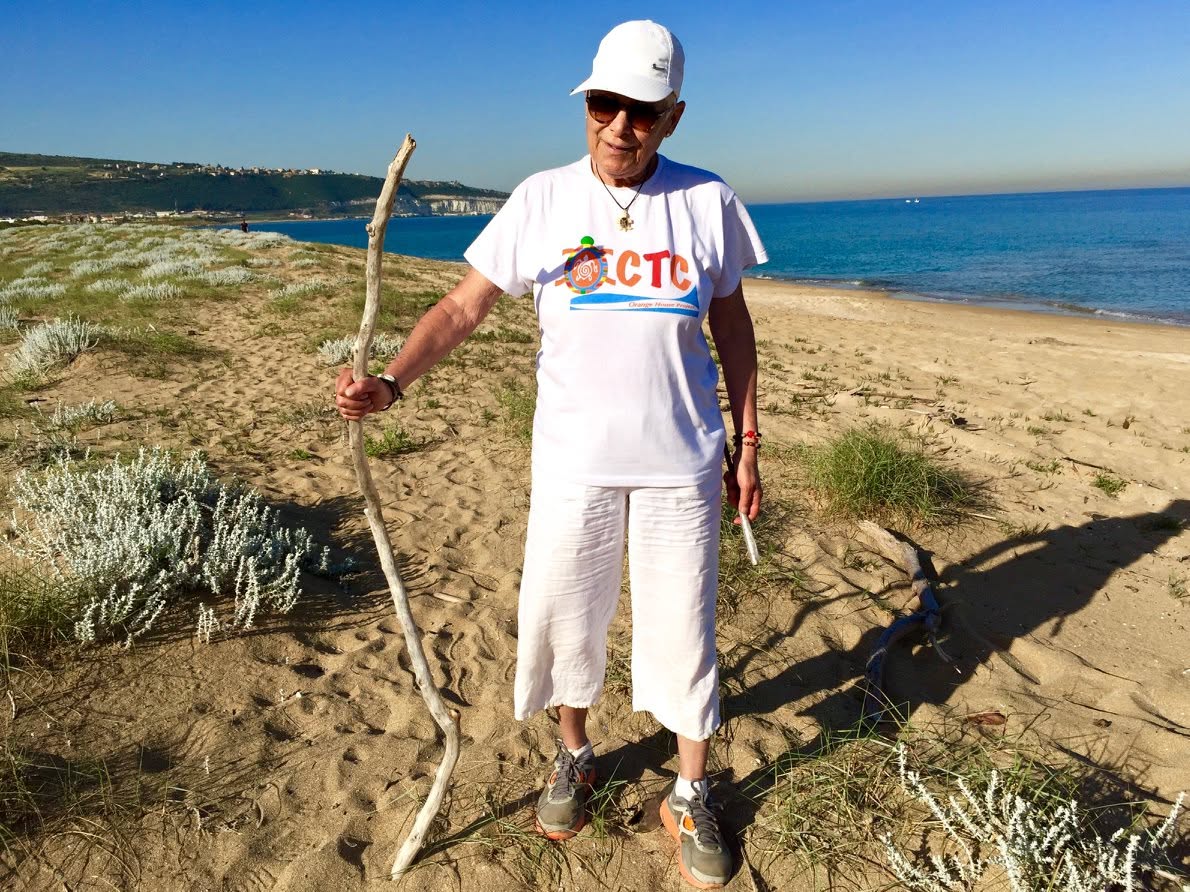
Mona Khalil, a marine turtle protection figure in South Lebanon, died as a result of her injuries following an Israeli strike against her house in Mansouri, near Tyre. His death mourned a country already damaged by the bombings and deprived the Lebanese coast of a rare voice, committed for more than twenty years to the preservation of a unique laying site.
The death of Mona Khalil, announced after several days of hospitalization, adds a familiar and respected name to the long list of civilians carried away by the war in southern Lebanon. A figure in the protection of sea turtles on Mansuri beach in the Tyre District, she had been seriously injured in an Israeli strike against her house, known as Orange House. Her assistant was also injured. He was taken to Jabal Amel Hospital, where he first survived the attack. She died as a result of her injuries, according to available local information.
His disappearance is far beyond the circle of environmental activists. In Mansouri, Mona Khalil was not only an owner attached to a beach. Since the early 2000s, it had become the guardian of a rare coastline, one of the last sea turtle laying areas in Lebanon. It had spent more than 20 years protecting nests, outbreaks, dunes and a fragile relationship between inhabitants, sea and biodiversity. In a country often absorbed by political, financial and military crises, his fight reminded us that another emergency also existed: saving what remains of life.
An injury caused by a strike in Mansouri
Mona Khalil was seriously injured in early June when an Israeli strike hit her house in Mansuri, south of Tyre. The home, now known as Orange House, has been used for years as a base for an environmental and ecotourism project dedicated to the protection of marine turtles. Post-attack information indicated that she had been transported to Jabal Amel Hospital. Her assistant, an Ethiopian national according to local media, was also injured.
The circumstances of the attack aroused great emotion because Mona Khalil was a civilian identified for her environmental work. His house was not known as a military facility. She was associated with a beach, volunteers, turtles, children watching outbreaks, and researchers following her project. The attack occurred in an area under heavy military pressure since the conflict in southern Lebanon extended. Mansouri is located in a strategic coastal area close to areas affected by strikes and population displacement.
In the following hours, calls for blood donation had been circulating. Mona Khalil’s state of health was first described as serious and then stabilized by some local relays. His death recalls the fragility of these first announcements in a war where serious injuries remain exposed to complications, difficult evacuations and an already tried and tested hospital system. He also recalls that each strike leaves behind it a long temporality: that of care, families waiting, injuries that worsen and deaths that occur after the initial shock.
The Orange House, a refuge that has become a symbol
The Orange House was not a simple colourful building on the coast of Mansouri. It was a place of memory, welcome and protection. Mona Khalil had built a project around a clear idea: to preserve a beach where turtles and green turtles lay. The site was known to nature lovers, Lebanese ecologists, many foreign visitors and those following the few sustainable environmental initiatives in the South.
The history of this project dates back to the late 1990s. After many years outside Lebanon, Mona Khalil had returned to Mansuri, on family land. A night encounter with a turtle who came to lay on the sand changed the course of her life. She then realized that this beach was not just a childhood landscape. It was a fragile habitat, almost miraculously preserved by years of difficult access and proximity to the former occupied area.
Together with her entourage and volunteers, she began to monitor nests, protect eggs, support outbreaks, and raise visitor awareness. It has fought against plastic pollution, light nuisances, destructive fishing practices, coastal construction and administrative indifference. The work was discreet, daily, repetitive. It was necessary to walk at night on the sand, spot traces, sometimes move endangered nests, prevent dogs or the curious from destroying them, explain again and again why a beach is not only a space to exploit.
A life dedicated to marine turtles
Mona Khalil had made the sea turtle a Lebanese symbol. In his fight, the animal was not an exotic image. It was an ancient presence on the south coast, a witness to the Mediterranean and Lebanon’s ability to protect what is not immediately reported. That pedagogy was important. Many Lebanese have discovered, through it, that their country still has important nesting sites for endangered species.
Its action was based on a simple conviction that nature protection cannot be separated from local communities. It was not just a ban. She explained. She was hosting. She invited visitors to observe without disturbing. She was turning a beach into an open class. Children and adults could understand that the survival of a nest sometimes depends on an extinguished light, a picked plastic or a respected distance.
This work also made Mona Khalil a sometimes contested personality. Defending a beach against real estate interests, local habits or negligence is never neutral in Lebanon. She has often had to resist pressure. But his perseverance eventually imposed Mansouri as a known place of marine conservation. In a country where natural reserves lack resources, it has embodied another form of authority: that of consistency.
A civil death in a war that overflows
Mona Khalil’s death is part of a broader context of war in southern Lebanon. Israeli bombings hit villages, neighbourhoods, roads, relief workers, infrastructure and agricultural areas. The human balance sheets increase over the days. Hundreds of thousands of people have been displaced. Houses were destroyed in entire localities. Hospitals and rescue teams work under constant pressure.
In this landscape, Mona Khalil represents a category of victims often less visible: civilians whose lives were dedicated to something other than war. She didn’t command a unit. She didn’t hold a front. She was protecting a beach. She was watching on nests. His death recalls that the bombings not only destroy buildings and human lives. They also destroy commitments, projects, accumulated knowledge and places where a society had managed to build something other than survival.
So South Lebanon is not just losing one activist. He’s losing an environmental memory. He lost a voice that linked the sea to the inhabitants, the coast to education, turtles in the future. In a country where ecology is often pushed to the background by political or security urgency, this loss is heavy. It shows that the war also reaches the few areas where Lebanon was trying to repair its relationship to nature.
Mansouri, a beach caught between war and protection
Mansouri isn’t a trivial place. Located in the south of Tyre, the town belongs to this coast where fishing, agriculture, Palestinian memory, Shiite villages, presence of the Finul and history of Israeli occupation cross. The beach that Mona Khalil defended had survived several threats. It had resisted waste, construction, tourist pressures, war episodes and public negligence. It had become a fragile island in a country where the coast was often delivered to concrete.
The strike that injured Mona Khalil hit a place already loaded with this story. The Orange House was both a house, a project, a refuge and a symbol. She told about a woman’s return to the South, after years of life elsewhere. She also recounted a way of living Lebanon out of slogans: by collecting waste, protecting eggs, welcoming visitors, talking to children, refusing to make the beach a vague land or a luxury yard.
Mona Khalil’s death occurred while the sea turtles’ laying season remained a sensitive period. In spring and summer, females return to the beaches. Nests must be identified, monitored, protected. War complicates everything. Travel limits the presence of volunteers. Strikes make certain areas dangerous. Lights, debris, rubble and bomb-related pollution threaten sites. The disappearance of the one who embodied this watch makes the task even more difficult.
A tribute to quiet courage
To pay tribute to Mona Khalil is not only to greet an environmental activist. It is to recognize a form of courage often ignored. The courage to remain attached to a place. The courage to defend a beach when many saw it as an available space. The courage to talk about turtles in a country that sometimes seemed to have no room for softness. The courage to believe that local action can count.
His life said something about Lebanon that the war does not sum up. A Lebanon of open houses, still wild beaches, initiatives held at arm’s length, women who build institutions without waiting, volunteers who arrive at dawn to check a nest. Lebanon often exists far from the spotlight. Yet it is essential. It gives the country a depth other than that of fronts, crises and speeches.
Mona Khalil had made turtle protection an accessible cause. She wasn’t just talking to experts. She spoke to those who passed by, to those who did not know, to those who could learn. It showed that an egg in the sand can take collective responsibility. She pointed out that protecting a threatened animal also means protecting a part of oneself, part of the country, part of the Mediterranean.
A disappearance that questions the protection of civilians
The death of Mona Khalil also raises a more serious question: what remains of the protection of civilians when houses, roads and places identified by their civil service are struck? Israel claims to be targeting Hezbollah and its infrastructure. Lebanon replied that strikes killed civilians, destroyed homes and affected places with no visible military link. The case of Mona Khalil is part of this tension. It will be difficult for relatives and environmentalists not to see it as an example of a war that goes beyond its stated objectives.
Journalistic prudence requires a distinction between established facts and accusations. What is reported is that an Israeli strike hit her house in Mansuri, that she was seriously injured, that she was hospitalized and that she died as a result of her injuries. What comes under Lebanese interpretation is the reading of this death as an additional proof of the civilian cost of the Israeli offensive. This reading is now widely shared in environmental, humanitarian and local settings.
For Lebanon, this disappearance should also open a debate on the protection of natural heritage in wartime. Beaches, reserves, wetlands, forests and spawning sites are not details. They’re part of the territory. Destroying them or making them inaccessible amounts to a lasting impoverishment of the country. In the case of Mansouri, loss is primarily human. But it is also environmental and cultural.
What Mona Khalil leaves behind her
Mona Khalil leaves behind a beach, a project, a method and a generation of people aware of the protection of marine turtles. It also leaves a simple but powerful idea: a place can be saved by the stubborn presence of a few people. Without large budgets, no political apparatus, no effective ministry, she had succeeded in making Mansouri a reference. It is this success that the war comes to strike.
His legacy will now depend on those who will continue this work. Volunteers, associations, residents and local authorities will have to protect the beach despite the war and the absence of the beach’s face. Nests will still have to be monitored. The waste will still have to be collected. Children will still have to learn that turtles return only where at night, sand and silence allow them to live.
Mona Khalil had chosen to make South Lebanon a place of care, not just a place of resistance or pain. She had chosen to defend the most vulnerable, those who do not speak and whose survival depends on others. His death, after a strike against his house in Mansouri, leaves a concrete question to the Lebanese: who will watch over this beach, its nests and this fragile part of the country that the war still threatens to erase?






