

Lebanese Government adopts new security measures in Beirut
The Lebanese government announced on Thursday new measures to strengthen security in the capital, against the background of military escalation and growing regional tensions.
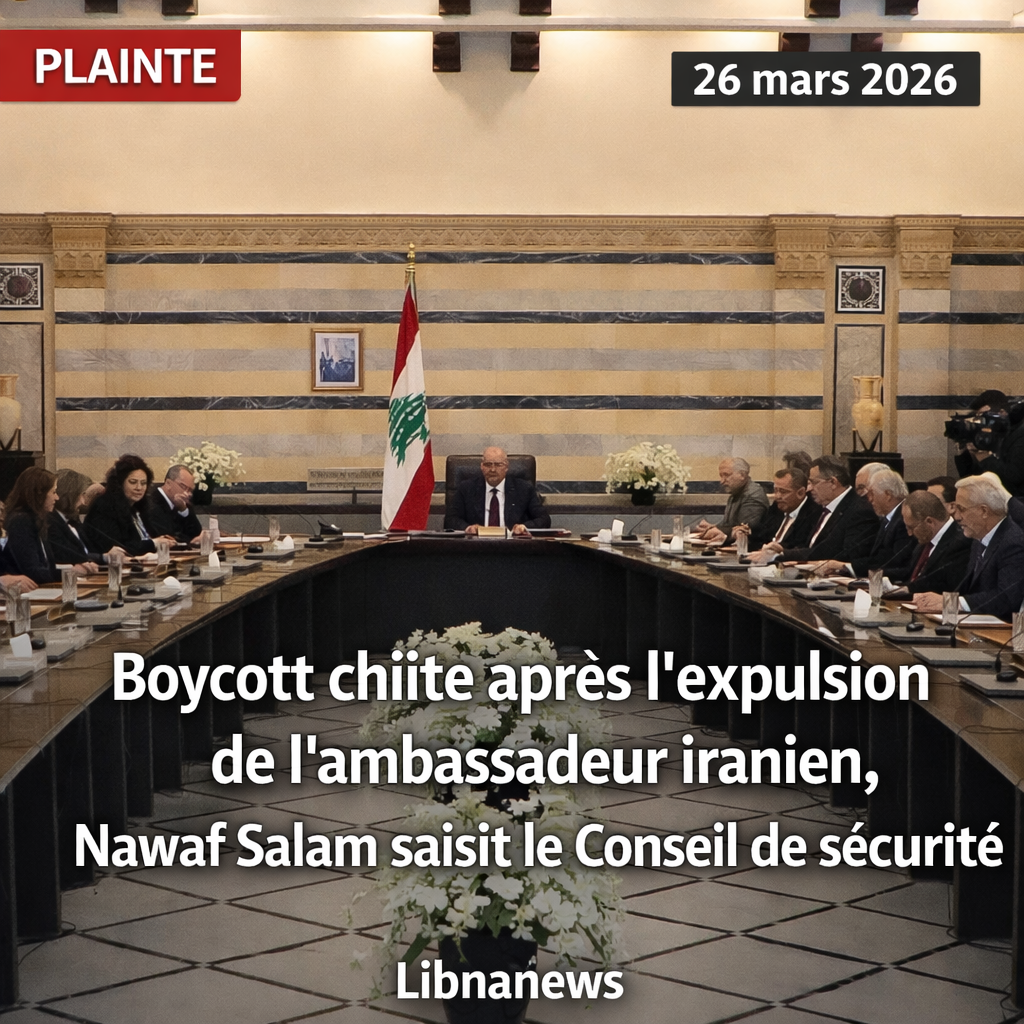
Chaired by Nawaf Salam at the Grand Sérail, the session was officially devoted to internally displaced persons, the consequences of Israeli bombings and their military, humanitarian, social, financial and economic effects. But the political context dominated the meeting. The absence of the Shiite tandem confirmed that the Iranian ambassador’s case has ceased to be a mere diplomatic dispute to become an open crisis within the executive itself.
At the end of the meeting, the Minister of Information, Paul Morcos, reported that the executive had decided to visibly strengthen the security arrangements in Beirut. According to him, this decision will lead to an intensification of army and security patrols in the city, with the aim of reassuring the population, while the war continues to weigh on the country.
Beirut denounces Israeli project south of Litani
At the heart of the meeting, Nawaf Salam reacted strongly to repeated statements by Israeli officials on a possible occupation of the area south of Litani. According to the Head of Government, threats to a « security zone » or « buffer zone » constitute an extremely serious development for Lebanese sovereignty.
The Prime Minister accused Israel of blowing up most of the bridges on the Litani River in order to cut this area off from the rest of Lebanese territory. He also denounced a process of massive displacement of the inhabitants of the towns and villages south of the river, as well as a daily progression of the Israeli army, accompanied by the destruction of houses and sometimes complete levelling of neighbourhoods or localities.
For Nawaf Salam, these actions raise fears of a willingness to prevent the rapid return of civilians to their homes. The Head of Government stated that these practices violate international law, international humanitarian law and the UN Charter.
Lebanese complaint to the Security Council
Faced with this situation, the Prime Minister asked the Foreign Minister to immediately file a complaint with the UN Security Council. He also announced his intention to contact the Secretary-General of the United Nations directly at the end of the meeting, in order to formally refer the matter to international forums.
This initiative marks a new Lebanese attempt to internationalize the denunciation of the Israeli offensive in the south of the country, at a time when Beirut is seeking recognition of the danger posed by any sustainable installation of a buffer zone or a security band in its territory.
Kuwait at the centre of the Government’s concerns
The ministerial meeting was also marked by the Prime Minister’s reaction to the announcement in Kuwait of the dismantling of a new terrorist cell. Nawaf Salam expressed regret that, among those accused in this case, there were two individuals presented by the Kuwaiti authorities as linked to Hezbollah.
He stressed that any attack on the security of Kuwait also affects Lebanon, emphasizing the historic strength of relations between the two countries. He recalled that the overwhelming majority of the Lebanese community in Kuwait respects the laws in force and actively contributes to the economic life of the country.
The Head of Government stated that he had contacted his Kuwaiti counterpart to express Beirut’s firm condemnation of these acts, as well as Lebanon’s total solidarity with the emirat.
The Shiite boycott gives another scope to the meeting
But the main political novelty of the day is the boycott of Hezbollah and Amal ministers. Their absence was directly related to Beirut’s decision this week to declare the Iranian ambassador persona non grata and to ask him to leave the country by 29 March. Both sides denounced this measure, finding it hostile to Iran and contrary to the interests of Lebanon.
This boycott gives institutional scope to the crisis. It reflects the depth of disagreement between, on the one hand, an executive who seeks to assert the prerogatives of the State in diplomatic matters and, on the other hand, a Shiite tandem who sees this decision as a political attack against Tehran and, in a hollow, against its own place in Lebanese balance.
Nawaf Salam warns about the refocusing of Iranian strikes towards the Gulf
Another highlight of his speech was the denunciation of the displacement of the centre of gravity of the Iranian strikes. Nawaf Salam claimed that the Iranian bombings were now directed more at the Gulf countries than at Israeli territory.
He argued that since the beginning of the war, 83 per cent of Iranian attacks, whether missiles or drones, had affected mainly the Gulf countries, but also Jordan, Turkey and Azerbaijan, compared with only 17 per cent directed towards Israel. According to him, among the targets affected were vital facilities and civilian sites, which constituted a particularly dangerous escalation.
The Prime Minister acknowledged that the Gulf States had been able to effectively defend their territory, but felt that Lebanon could not remain silent when friendly Arab countries were targeted daily. He announced that he would continue his contacts with several Arab leaders to reaffirm Beirut’s solidarity.
Displaced persons as victims of a war imposed on Lebanon
The Head of Government also wished to return to the issue of internally displaced persons, stressing that they were, like all Lebanese, the direct victims of a war imposed on the country. Nawaf Salam claimed that neither the displaced nor the majority of the Lebanese had been consulted about the war nor had they decided to enter it.
He described the conflict as « the war of others on our soil, » believing that Lebanon had no interest in being drawn into this confrontation. This is in line with the approach already adopted by the Prime Minister in recent days, that of a state seeking to politically dissociate itself from a war that it considers to be suffered and not chosen.
A government under pressure, but seeking a clear line
Thursday’s session allowed the executive to highlight three simultaneous messages: a refusal to transform southern Lebanon into an Israeli buffer zone, solidarity with Kuwait and the Gulf countries in the face of security threats, and a willingness to appear as a guarantor of internal stability, particularly in Beirut.
By choosing to make security measures visible in the capital and to lodge a complaint with the Security Council, the government seeks to give the image of a state still capable of acting on diplomatic, security and political fronts, despite a war that continues to disrupt the country and increase pressure on its institutions.






