

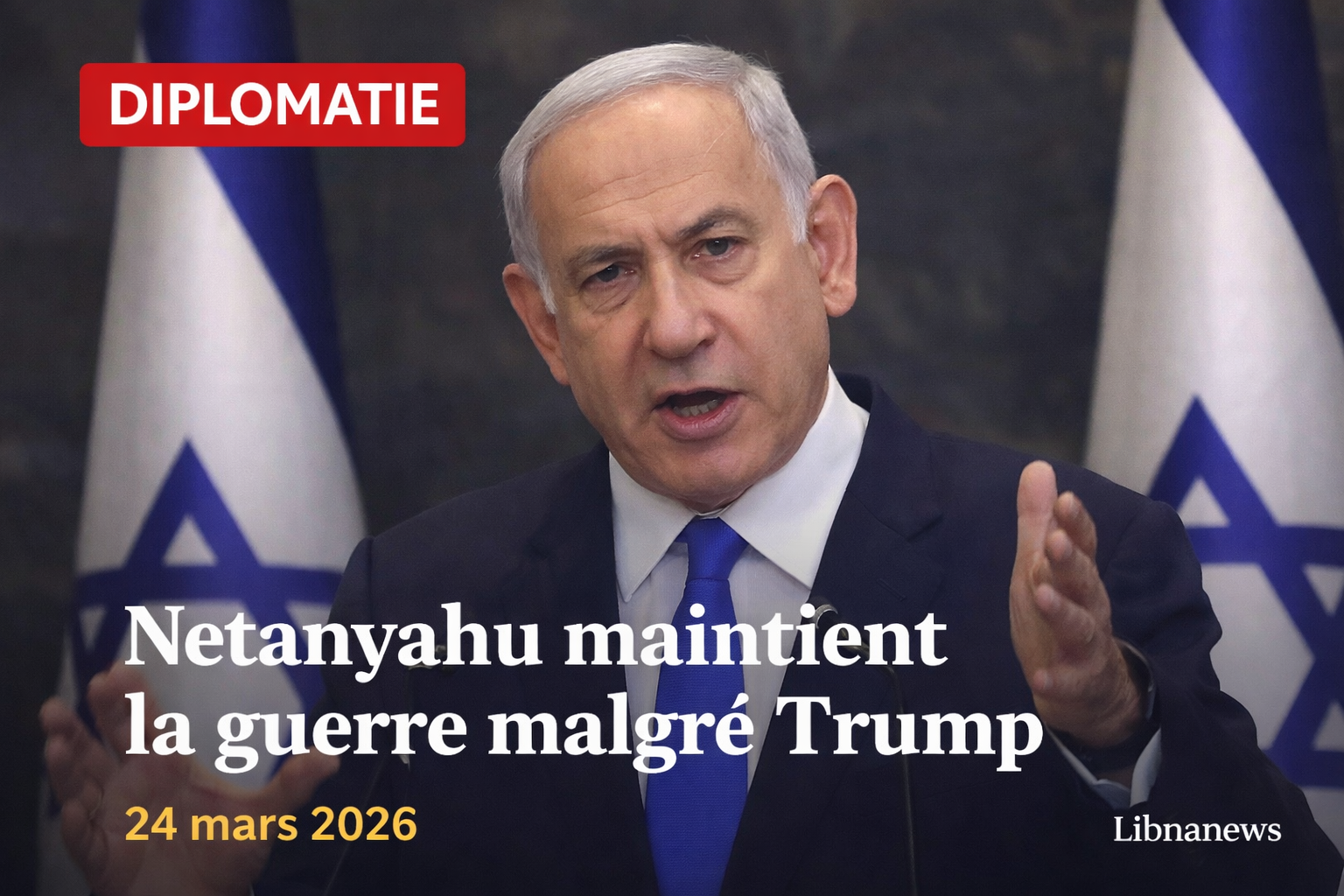
Benjamin Netanyahu chose to harden his message just as Donald Trump was trying to open a diplomatic sequence with Tehran. After an exchange with the US President, the Israeli Prime Minister assured that Israel would continue to strike Iran and Hezbollah, while saying that it wanted to preserve the « vital interests » of the Hebrew state in a possible agreement. This line confirms a growing gap between Washington’s opening and Jerusalem’s claimed military strategy.
American inflection, but no Israeli pause
The contrast is brutal. On the one hand, Donald Trump claims to have engaged in « very good » discussions with an unnamed Iranian official and has decided to postpone five days of planned American strikes against Iranian energy installations. On the other hand, Benjamin Netanyahu publicly states that Israeli operations are continuing in Iran and Lebanon. The sequence therefore does not resemble a coordinated movement towards de-escalation. Rather, it reflects two distinct political rhythms: that of a White House that tests the diplomatic option, and that of an Israeli government that intends to maintain military pressure until the end.
In a video statement broadcast on Monday, the Israeli government leader explained that he had spoken with Donald Trump. According to him, the US President believes that there is an opportunity to transform American-Israeli military gains into a negotiated agreement, provided that it protects Israel’s interests. But Benjamin Netanyahu immediately added a decisive clarification: these interests will be defended « in all circumstances » and, at the same time, Israel will continue to strike Iran and Hezbollah. In other words, the diplomatic route is not presented as an alternative to war. It appears, at best, as a possible extension of a military campaign to continue.
There’s nothing wrong with this positioning. For several days, the US executive has been seeking to show that a negotiating space remains open, despite the intensity of the fighting. But the Israeli Prime Minister’s remarks indicate that in Jerusalem the reading of the moment is different. The Israeli power visibly considers that the war has produced results that would be premature to freeze. It is precisely this point which gives its full meaning to the statement of Monday: Benjamin Netanyahu does not merely approve the idea of a possible agreement; Above all, Israel will not wait for this agreement to continue its campaign.
Benjamin Netanyahu wants to convert military advantage into political leverage
In his communication, the Israeli Prime Minister carefully articulated two messages. The first one is targeting Washington. It consists of showing that Israel is not closed to a negotiated outcome if it endorses the military achievements of the moment. The second is addressed to Israeli opinion and regional opponents. He claims that the war is not suspended and that the Hebrew state intends to continue the strikes until its objectives are achieved. This dual posture allows Benjamin Netanyahu to remain in apparent alignment with Donald Trump, while refusing that a possible American-Iranian dialogue will result in immediate restraint on the ground.
The vocabulary used counts. By insisting on Israel’s « vital interests », the head of government immediately sets a high threshold. He does not speak of calming, pause, or provisional arrangement. He suggested that no compromise would be acceptable if he allowed a lasting Iranian threat to persist. This line joins its long-standing doctrine: to refuse that a diplomatic process limits Israeli freedom of action until the strategic capabilities of the adversary are profoundly degraded. In the current context, this means that any discussion is subject to continued military pressure, not the reverse.
The formula is also useful internally. Benjamin Netanyahu has been facing a strong expectation of firmness since the beginning of the war. By repeating that the strikes « crush » Iran’s ballistic programme and nuclear programme, while inflicting heavy damage on Hezbollah, he presents the war as an unfinished but effective process. He thus refused that an American diplomatic sequence gave the impression of a slowdown imposed from Washington. For his side, the message is simple: Israel remains in control of its military tempo, even if the United States is simultaneously seeking a way out of crisis.
A divergence of method with Donald Trump
The heart of the subject is there. Donald Trump feels like he wants to test a transaction. His announcement of « very good » discussions with an Iranian official is part of this logic. It was also followed by a postponement of the American strikes targeting Iranian power plants and energy infrastructure, while an ultimatum was exhaling on Monday night around the reopening of the Strait of Ormuz. The signal sent by Washington was therefore that of a conditional stay, thought as a space to explore a compromise.
Benjamin Netanyahu speaks differently. He does not announce any suspension. He does not suggest any suspension of the strikes. On the contrary, it stresses their simultaneous pursuit on several fronts. This difference does not necessarily mean a political break between the two leaders. Rather, it reveals a disagreement of method. The US President seems to consider that the gains achieved can now feed into negotiations. The Israeli Prime Minister seems to think that they need to be further expanded before they can be transformed into an agreement. One thinks in terms of diplomatic window. The other in terms of the ratio of force to be extended.
This gap is all the more visible as Iran denies any ongoing negotiations. The name of Mohammad Bagher Ghalibaf, President of the Iranian Parliament, circulated as possible interlocutor. But he publicly rejected the idea of discussions with Washington. This contradiction weakens American narrative. If Tehran denies talking, and Israel says it continues to strike relentlessly, Donald Trump’s initiative looks less like a steady start to the process than an attempted diplomacy under fire. In such a framework, Benjamin Netanyahu can maintain his warline without appearing in frontal break with the United States, since no solid diplomatic framework is yet established.
Israeli Prime Minister takes steps to climb two fronts
One of the heaviest points in his statement is that he explicitly mentions the continuation of the strikes « in Iran and Lebanon ». The coupling is not accidental. It shows that Israel refuses to treat Iranian theatre separately from the Hezbollah issue. For Benjamin Netanyahu, the Lebanese Shia organization remains a central element of Tehran-supported regional architecture. Continuing to hit her when Washington is testing a diplomatic opening means that Jerusalem does not want an agreement limited to the nuclear issue or the Iran-Israeli front alone. Israel also intends to permanently weaken the regional relays of the Islamic Republic.
This logic illuminates the coherence of its line. The Israeli Government clearly considers that the war is not just the destruction of Iranian technical capabilities. It also aims to reduce Tehran’s strategic depth to the Levant. In this perspective, the pressure on Hezbollah is not a secondary front. It is one of the instruments of the same objective: to make any reconstitution of a system threatening Israel more costly, more difficult and more risky. The simultaneous continuation of strikes against Iran and Hezbollah thus reflects a global vision of the conflict, where deterrence involves the coordinated erosion of decision-making centres, means of strike and armed relays.
The choice of public announcement also depends on the diplomatic level. Benjamin Netanyahu sent a signal to potential mediators: no negotiation could, in his view, circumvent the issue of Iran’s regional allies. This mechanically complicates any attempt at rapid settlement. Because the wider the objectives displayed, the more difficult the conditions of an agreement become. The Israeli Prime Minister, however, seems ready to assume this cost, convinced that the military moment remains favourable to him.
Iranian nuclear at the centre of Israel’s story
Benjamin Netanyahu reiterated that the ongoing strikes were aimed at « crushing » Iran’s missile program and nuclear program. Again, the formula deserves attention. It does not refer to mere one-off deterrence. It suggests a desire for deep dismantling or, at the very least, lasting degradation. By adding that two more Iranian scientists had been eliminated « a few days ago » and that « this is not the end », the Prime Minister inscribed the offensive in the duration. It suggests that Israel will continue a targeted campaign against the programme’s human skills, even beyond the infrastructure strikes.
This point is essential to understand the Israeli attitude to Donald Trump’s announcements. If the objective is to minimize Iran’s nuclear and ballistic capabilities, then a simple diplomatic opening is not enough to suspend the operation. From Benjamin Netanyahu’s point of view, every additional warday can still produce an operational gain. The temptation is therefore strong to extend the campaign as long as the margins of strike exist. This logic mechanically pushes for the continuation of operations, even when Washington seeks to provide a trading space.
It also responds to an old political constraint. The head of the Israeli government built an important part of his credibility on his supposed ability to keep a hard line against Iran’s nuclear programme. Returning too early to diplomacy, without visible guarantees, would expose him to internal criticism. By claiming concrete military results and promising the continuation of strikes, he instead locks the story of a necessary, productive and yet unfinished war.
Tehran denies the discussions, which strengthens the Israeli line
Iranian denial plays a central role in this sequence. While Donald Trump talks about constructive conversations, Tehran ensures that no negotiations are underway. This public refusal weakens even the idea of an immediate diplomatic breakthrough. He also gave Benjamin Netanyahu an implicit argument: why slow down the war if the adversary denies talking and continues his shots? In the current context, the continuation of the strikes can thus be presented to the Israeli side as both a military and a political response to the lack of tangible evidence of an Iranian turning point.
The contradiction between Washington and Tehran further blurs the landscape. Either channels exist but remain indirect, fragile and contested. The US announcement is mainly due to an attempt at psychological pressure and energy market management. In both cases, Benjamin Netanyahu has little incentive to change his conduct. In the absence of a formal framework, the war continues to set the hierarchy of priorities. Strikes produce measurable and immediate effects. The discussions remain hypothetical and denied by one of the parties. In such a report, the head of the Israeli government logically chooses the instrument he considers most tangible: force.
This situation also feeds a form of narrative competition between allies. Donald Trump seeks to appear as the man capable of converting a military victory into an agreement. Benjamin Netanyahu wants to appear as the one who prevents an premature cessation of the war effort. Both stories are not yet incompatible, but they create an obvious tension. The more diplomacy Washington insists on, the more Jerusalem is likely to stress the need to continue the strikes until irreversible results are achieved.
A war that also becomes a test of political autonomy
Beyond military ground, this sequence speaks of the relationship between Israel and its main ally. Benjamin Netanyahu does not argue frontally Donald Trump. It even takes up the idea that an agreement could, in theory, serve Israeli interests. But he does not want to make his strategy dependent on this hypothesis. He thus asserts a clear political autonomy: Israel listens to Washington, but does not immediately subordinate its military calendar to American announcements. This nuance is decisive. It shows that the Israeli Prime Minister intends to remain in control of the war, even in a phase when the United States is testing another registry.
For Donald Trump, the stake is different. The U.S. President visibly seeks to maintain the dual posture of the warlord and the negotiator. The postponement of the strikes on Iranian energy facilities allowed him to show that he could both threaten and open a door. But Benjamin Netanyahu’s statement reveals the limits of this equation. As long as Israel continues to strike and Iran denies speaking, American diplomacy will remain trapped in a balance of power that it does not fully control.
In the immediate future, therefore, the major political fact lies less in a possible negotiation than in the willingness of the Israeli Prime Minister to prolong the war despite Donald Trump’s announcements. His message is clear: the strikes continue, the war objectives remain in force, and the assumption of an agreement only applies if Israel’s military achievements are enshrined and its security requirements met. The sequence opened on Monday does not mark a de-escalation. Rather, it establishes a more complex face-to-face, where American diplomacy tries to exist without interrupting a war that Israel does not seem ready to slow down.



