

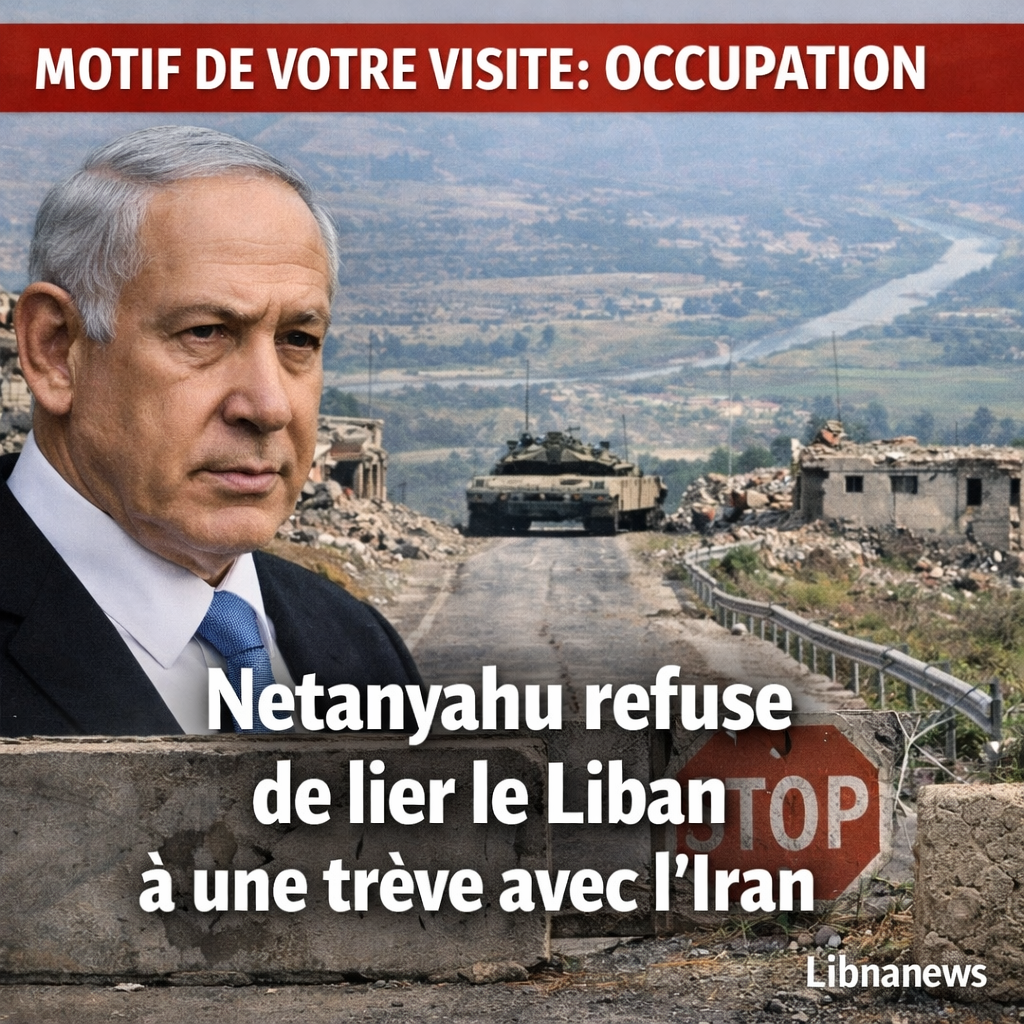
Benjamin Netanyahu hardened Israel’s position on the Lebanese issue on Tuesday, claiming that Israel was working to avoid a possible ceasefire with Iran automatically resulting in a truce in Lebanon. According to these statements, a stoppage of operations on the Lebanese front would be a separate Israeli decision. This line confirms the Israeli government’s willingness to disassociate Iranian theatre from Lebanese theatre, while Tehran is trying to link the two tracks in any ceasefire negotiations.
These statements are part of an increasingly explicit sequence of Israeli statements on the South. On Sunday, 29 March, Benjamin Netanyahu announced that he had ordered the army to expand further its operations in southern Lebanon to respond to the hezbollah’s persistent fire. Reuters reported that the Prime Minister presented this extension as a means of strengthening Israel’s security position on its northern border, as part of a broader campaign against Iran and its regional allies.
An Israeli line of separation between the two fronts
Netanyahu’s position is to establish a simple political principle: even if an agreement is reached on the Iranian-Israeli front, it should not, from the Israeli point of view, impose a halt to operations against Hezbollah in Lebanon. In other words, Jerusalem wants to keep its hands free on the northern front, regardless of the evolution of discussions around Iran. This approach extends the doctrine defended by several Israeli officials in recent days that Hezbollah remains a distinct threat, even if it acts within a regional axis supported by Tehran.
Again on Tuesday, Israeli military spokesman Nadav Shoshani stated that Israel was ready to continue its strikes against Iran for « for weeks », explaining that the army had the necessary targets, ammunition and troops. This declaration reinforces the idea of an Israeli strategy at several levels: to maintain pressure on Iran, while continuing in parallel the offensive against Hezbollah in Lebanon without being confined to a single diplomatic scheme.
Iran wants to include Lebanon in any ceasefire
The Iranian position is the opposite. Reuters reported on 25 March, citing six regional sources, that Tehran had indicated through intermediaries that any ceasefire agreement with the United States and Israel should also include Lebanon. According to these sources, Iran demands an end to Israeli operations against Hezbollah and considers the Lebanese front as an integral part of the regional power relationship. One of them summarized the Iranian line by explaining that Tehran made Lebanon a priority and would not accept a repetition of the scenario observed after the truce of 2024, when Israel continued to strike in Lebanese territory.
According to Reuters, Hezbollah has received « Iranian guarantees » of its inclusion in any broader agreement. This data sheds light on the scope of Netanyahu’s comments. By refusing that a cease-fire with Iran would mechanically lead to a ceasefire in Lebanon, the Israeli Prime Minister was in a state of failure to meet Tehran’s demand. The two camps are therefore already positioned on the very architecture of a possible agreement: for Iran, the fronts are linked; for Israel, they must remain separate.
Lebanon remains at the centre of the Israeli strategy
This dissociation sought by Netanyahu comes as Israel intensifyes its discourse on the control of southern Lebanon. On Tuesday, Israel’s Defense Minister, Israel Katz, announced that Israel was planning to establish a buffer zone in southern Lebanon to the Litani River after the ongoing war. He claimed that the army would retain control of the area, including bridges to the Litani River, that it would eliminate Hezbollah’s Radwan forces and that more than 600,000 displaced Lebanese inhabitants could not return south of the river until the security of the northern Israeli communities was assured. He also stated that all houses in Lebanese villages near the border would be destroyed.
This announcement gave a very concrete form to the Israeli line. It shows that, from the point of view of the Israeli government, the Lebanese front depends not only on the discussions on Iran, but on a specific objective of reconfiguring the terrain in southern Lebanon. The repeated reference to the Litani, already mentioned in Netanyahu’s statements on the expansion of operations, reflects this desire to establish a security depth under Israeli control.
A regional war, but decisions presented as distinct
Since 2 March, when Reuters placed the resumption of large-scale escalation after the American-Israeli strikes against Iran, Hezbollah opened an active front against Israel by firing rockets to the north of the country. However, Israel presents its operations in Lebanon as part of its own security imperatives, although they are part of a broader regional confrontation against Tehran and its allies. It is this double discourse that Netanyahu’s latest statements seek to maintain: to recognize the regional character of the war, while affirming that Israel alone will decide the time and conditions for a possible cessation of fighting in Lebanon.
This position is also diplomatic in scope. If discussions advance on a ceasefire with Iran, Israel wants to prevent an international text or commitment from automatically limiting its freedom to act against Hezbollah. The line put forward by Netanyahu therefore amounts to warning foreign mediators and partners in advance: an agreement on Iran will not, in Israel’s view, be an automatic settlement of the Lebanese case.
Hezbollah and the Lebanese file in the regional equation
For Tehran, the calculation is different. Hezbollah remains one of Iran’s main regional allies, and its inclusion in a broader ceasefire is both military and political. Reuters stressed on 25 March that the Lebanese Shia organization, weakened by recent fighting and facing increasing pressure in Lebanon on the issue of its disarmament, was counting on a regional truce to resume political space. It is in this context that Iran insists that Lebanon be included in any cessation of hostilities.
The gap between the two approaches therefore appears clearly. On the one hand, Tehran wants to treat Iran, Hezbollah and Lebanon in the same regional context. On the other hand, Netanyahu claims that a ceasefire in Lebanon must remain an independent Israeli decision. This opposition is not just about military ground. It already affects the very form of a possible agreement, its perimeter and the question of who will decide the end of the fighting on the Israeli-Lebanese border.
A statement setting the Israeli line
The latest Netanyahu statements are therefore immediate in scope: they publicly state that the Lebanese front will not automatically be included in an arrangement with Iran. They come at a time when Israel is expanding its operations in the South and its officials are increasingly talking about a sustainable control zone to the Litani. On the other hand, Iran indicates, through indirect channels, that it specifically refuses this separation between the two cases.
At this stage, diplomatic confrontation therefore joins military confrontation. Israel wants to maintain exclusive control over Lebanon. Iran seeks to protect Hezbollah by integrating the Lebanese side into any regional negotiations. Between the two, the issue of a possible ceasefire appears less like a close agreement than a new political battlefield, where each side tries to impose its own red lines.






