

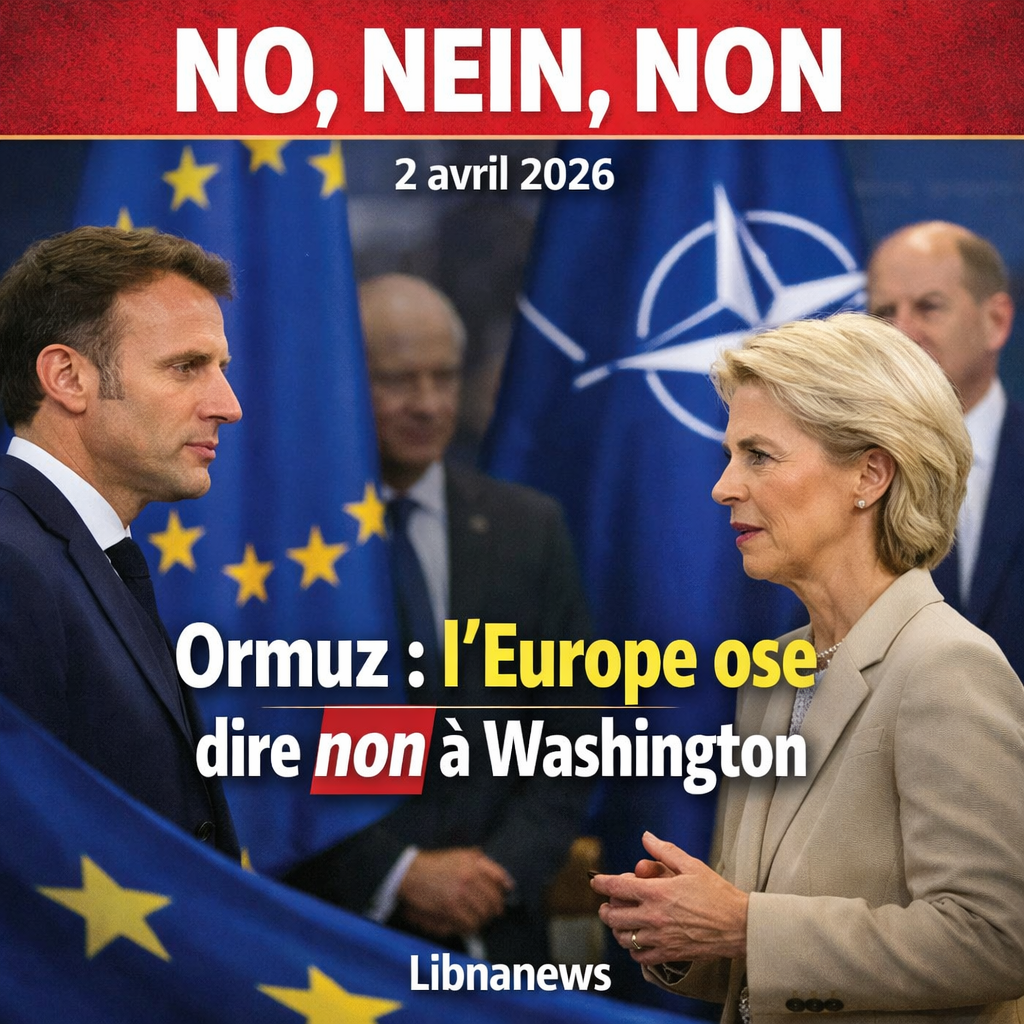
Between the Ormuz crisis, Donald Trump’s repeated threats against NATO and the rise of European rearmament plans, the transatlantic relationship is changing in nature. Several capitals now refuse to automatically align their strategic choices with those of Washington. This shift does not mean an immediate break with the United States, but it reflects a deeper evolution: Europe seeks to become again a power of decision, including when it says no to its historical ally.
The message started with a viral sequence on social networks: European countries would have, as a whole, closed their skies or bases to American aircraft and chose to ignore Donald Trump’s injunctions on the Strait of Ormuz. The formula is spectacular. The reality is more nuanced, but it is no less important. In recent days, Reuters has reported that several European allies, including France, Italy and Spain, have limited or blocked certain aspects of US or Israeli military logistics related to the conflict with Iran, while Paris has publicly recalled that NATO is not intended to serve as a framework for offensive operations in the Gulf. At the same time, Donald Trump revived his threat of an American withdrawal from the Atlantic Alliance, going so far as to call NATO a « paper tiger » if Europeans do not follow Washington in the Ormuz crisis. This sequence marks less a sudden break than an acceleration of a movement that has been engaged for several years.
What changes, indeed, is not just the tone. It is the architecture of strategic decision-making in Europe. Since the Russian invasion of Ukraine, the continent’s military budgets have increased at an unprecedented pace. The European Defence Agency estimates that defence expenditure in the 27 Member States reached EUR 343 billion in 2024, up 19% over one year, and that it could rise to EUR 392 billion in 2025, or 2.1% of GDP. Military investment exceeded EUR 100 billion in 2024, a record. The European Commission and the High Representative also launched the Readiness 2030 White Paper and the ReArm Europe Plan on 19 March 2025, designed to push states to invest more quickly in common capabilities. This new environment mechanically reduces psychological dependence in Washington, although operational dependence remains strong.
Ormuz, the teller of deeper disagreement
Ormuz Strait is not a secondary theatre. This maritime corridor concentrates nearly 20 per cent of global oil and gas flows, making it a major vulnerability to the global economy. The disturbances observed since the conflict with Iran have already fuelled tensions in the energy markets, to the point that the International Energy Agency has warned that Europe may begin to feel more clearly the shock on its growth and inflation. For Europeans, the stakes are real. But real does not mean that we must accept without debate the American framing of the problem, nor turn NATO into a tool for a campaign decided in Washington outside the Euro-Atlantic perimeter. It is precisely on this point that the political divide has opened.
Paris said with rare sharpness: the Atlantic Alliance’s mission is the security of the Euro-Atlantic space, not the conduct of offensive operations in the Gulf. Finland made a close speech explaining that the war around Iran « is not a NATO affair ». Other capitals have adopted a similar line, not because they would deny the importance of Ormuz, but because they refuse to open a strategic precedent. In their reading, admitting that Atlantic solidarity automatically extends to any crisis affecting Western energy interests would be tantamount to emptying Article 5 of its defensive logic and aligning Europe with choices of which it has no control over the timetable or objectives. This caution is also a reminder that the autonomy of analysis has become a central political marker in Brussels, Paris, Berlin, Rome or Helsinki.
This difference in reading explains the confusion created around viral messages. Yes, some European refusals have been noted. No, they do not mean that the entire continent has closed its airspace in the United States in bulk and for any use. The decisions reported concern targeted authorisations, logistical facilities, overflights or access to bases in a specific context. They have a strong political significance, but at this stage they do not constitute a general legal break between allies. This distinction is essential. It shows that the European « no » is less a gesture of divorce than a refusal of a blank cheque. In other words, Europeans continue to cooperate with Washington when their interests converge, but they increasingly allow themselves to refuse when the mandate, method or risk of escalation seems to them to be incompatible with their priorities.
The return of European strategic autonomy
The idea is not new. Emmanuel Macron has been talking about « strategic autonomy » for years. For a long time, the formula has aroused reservations, especially in the countries of Central and Eastern Europe, which saw the shadow of a weakening of the American bond at the very moment when Russia was becoming a direct threat again. The novelty, in 2025 and then in 2026, is that this concept comes out of the realm of discourse to enter the realm of instruments. The « ReArm Europe » plan aims to mobilise more than €800 billion, via expanded national budget margins, a €150 billion SAFE loan instrument for joint purchasing and enhanced support for European industry. The debate therefore no longer pits abstract supporters of a Europe-Power against their opponents. It deals with the speed, financing and governance of an already launched rearmament.
The figures measure change. In 2024, thirteen EU Member States spent at least 2% of their GDP on defence, compared with eight in 2023 and five in 2022. Capital expenditure increased to €88 billion and military research and development to €13 billion. The Council of the European Union has also highlighted a sharp increase in budgets since 2021. On the NATO side, the annual report presented at the end of March 2026 reported a 20% increase in defence spending by European allies and Canada in 2025. The movement does not erase American superiority, but it alters the psychological relationship between Europe and the United States: a Europe that invests more easily bears less to be treated as a mere performer.
What feeds European emancipation
- The war in Ukraine has made a rapid rise in European capabilities indispensable.
- Donald Trump’s repeated threats against NATO have reinforced the idea that exclusively American life insurance is no longer sufficient.
- The Ormuz crisis shows that a disagreement may arise not on the threat itself, but on the political and military framework of the response.
- The new European funding tools make a less dispersed defence effort more credible.
- Public opinion in several countries is more supportive of the idea of a Europe capable of acting without waiting for a green light from Washington.
This development does not produce a uniform European front. Poland, the Baltic States or Finland remain deeply committed to the American guarantee against Russia. But even in these countries, the idea of a more robust « European pillar » is progressing. Finnish President Alexander Stubb himself mentioned the emergence of a « more European NATO ». The formula counts. It does not defend the release of the Alliance. Rather, it proposes a rebalancing: America would remain the indispensable power, but Europeans would take a greater share of the burden, planning and decision-making. This approach is politically more acceptable in the North and East of Europe than the classical rhetoric of « strategic autonomy », often perceived as too French or too ambiguous towards the United States.
Trump faces a less docile Europe
Donald Trump’s posture accelerates this shift. Since his first term in office, the U.S. President has considered NATO less a strategic community than a transactional relationship. Its logic is simple: if allies do not pay enough or support US priorities, Washington would have no reason to guarantee their security indefinitely. In March and then in April 2026, he resumed this method with new intensity, saying that the United States did not need to be present in the Alliance and explicitly linking NATO’s value to European support in the Ormuz crisis. The problem for Europeans is twofold. On the one hand, this pressure can push for more investment. On the other hand, it undermines the confidence needed to operate a military alliance.
Legally, an American exit from NATO is not just a chin. Reuters recalls that a law passed by the US Congress in 2023 prohibits a president from unilaterally withdrawing the United States from the Alliance without the approval of two thirds of the Senate. But this protection does not extinguish the political risk. A president hostile to NATO can weaken the organisation without going to formal withdrawal: by refusing to reassure on Article 5, by blocking certain planning, by slowing down deliveries of weapons, by conditioning his support for extraterritorial concessions or by transforming each crisis into a public arm of war with Europeans. It is precisely this grey area that worries chanceries. The question is no longer just « Will America stay? », but « under what conditions and with what degree of reliability? ».
That’s why Washington’s refusals in the Ormuz file are worth more than their tactical reach. They point out that several European governments no longer want to be locked in the dilemma of following the United States or weakening the Alliance. They’re looking for a third way. It consists of defending freedom of navigation, coordinating diplomatic responses and, if necessary, security arrangements, without allowing Washington to redefine the strategic mandate alone. The summit held by London with more than 30 countries to reflect on the reopening of Ormuz, apart from the strictly American format, illustrates this search for a broader and politically better controlled framework.
A rupture still incomplete
However, it would be excessive to talk about a total freeing of Europe. Dependencies remain massive. The United States remains by far the main military power of the Alliance, the main source of intelligence, strategic transportation capabilities, missile defence, heavy logistics and nuclear deterrence within NATO. Even with the sharp increase in European budgets, the technological and industrial gap does not close in a few quarters. NATO figures show that in 2025 Europeans and Canada greatly increased their spending, but Washington continues to weigh very heavily throughout the Allied system. European self-government is therefore moving faster on a political level than on a military level.
This limit also appears in energy. Europe has an interest in defending the security of the Strait of Ormuz, but it does not have all the naval, air and diplomatic levers necessary to impose a lasting order in the Gulf alone in the short term. At the same time, the current crisis recalls that it can no longer be content with a strategic passenger role. Since 2022, the Union has already learned to reduce its dependence on Russian gas in an emergency. She now discovers that her energy vulnerability in the Middle East can also become a factor of geopolitical pressure. This awareness feeds the same reasoning as in defence: diversify addictions, pool more, decide faster.
| Indicator | Recent level | What it says |
|---|---|---|
| Defence expenditure EU 2024 | € 343 billion | Rapid increase in the European effort |
| Projection EU 2025 | €392 billion / 2.1% of GDP | Exceeding the NATO 2 % threshold |
| EU Defence Investment 2024 | EUR 106 billion | Accelerated purchase of equipment |
| SAFE Instrument | €150 billion | Joint project funding and procurement |
| Ambition ReArm Europe / Readiness 2030 | more than €800 billion available | Change of scale in planning |
| Weight of Ormuz | about 20% of world oil and gas flows | Gulf remains central to the global economy |
This rebalancing already has visible political effects. In the European capitals, the debate is no longer limited to burden sharing with Washington. It concerns the sovereignty of appreciation. Should we follow the US agenda when it departs from European priorities? Should NATO be engaged outside its original defensive vocation? Should we finance, produce and order more in Europe, even if the American industrialists are upset? On each of these points, the European response is tightening. She doesn’t always say no. But she no longer accepts to say yes by reflex. This development is probably the major political fact of the current crisis.
Europe dares say no, but to do what?
Saying no to Washington is not a strategy in itself. The real question is the project that follows. A more independent Europe must arbitrate between at least three priorities. The first is the protection of the eastern front against Russia, which remains the structural threat to many Member States. The second is the securing of supplies, from the Red Sea to the Gulf, without being involved in poorly defined interventions. The third is the industrialization of the defence effort, because the money voted only produces lasting effects if it translates into production chains, stocks, research and interoperability. However, it is precisely on this link between territorial security, economic security and the industrial base that the post-Ormuz process is taking place.
In this perspective, the current crisis acts as a life-size political test. Europeans discover that they can resist American pressure without causing the immediate collapse of the alliance. They also discover that this choice has a cost: more spending, more coordination, more responsibility. The time when US protection could be claimed, while later the construction of a real European pillar seems to be closed. So the « no » against Washington on Ormuz is not just a diplomatic gesture. It is a signal to Europe itself: assuming relative autonomy requires paying, producing, planning and deciding. As the crisis spreads, it is this requirement that goes back to the centre of the European public debate.






