

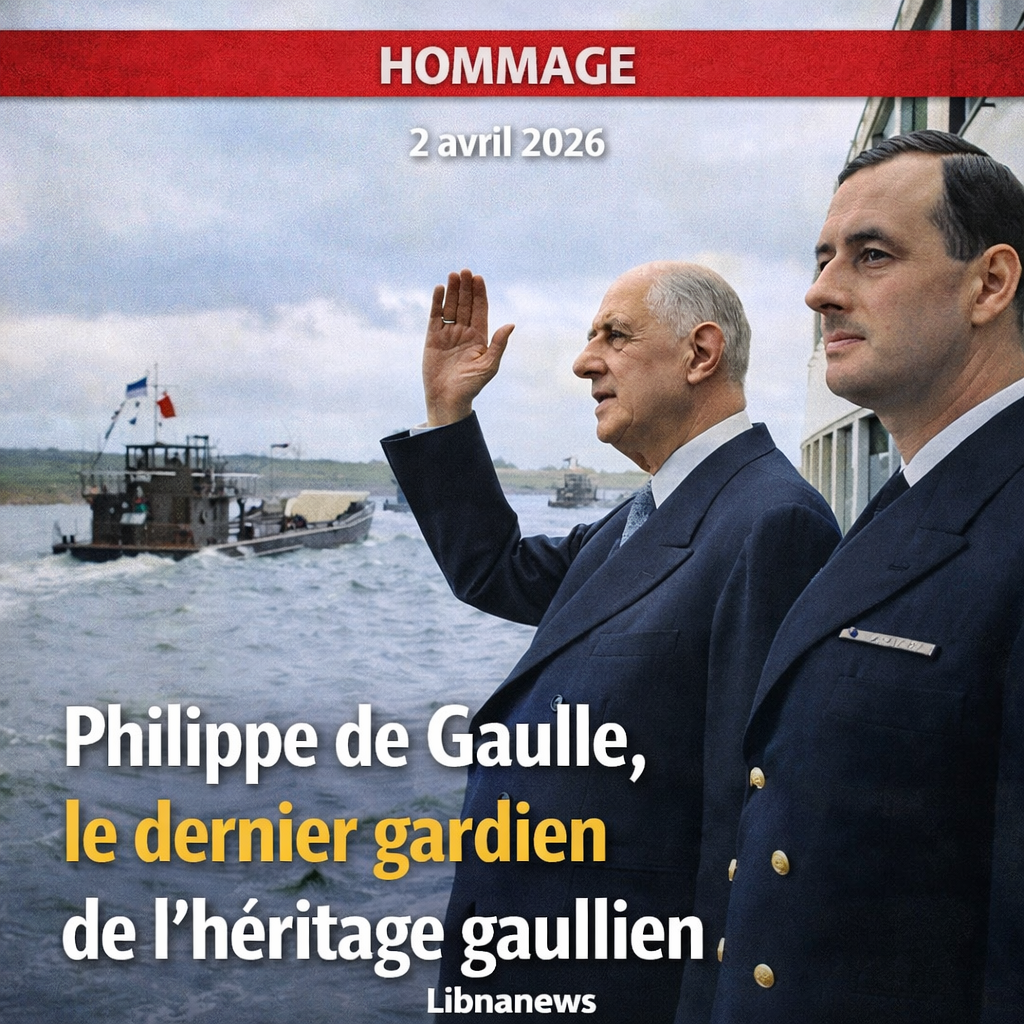
Admiral Philippe de Gaulle, the eldest son of General de Gaulle, died in Paris at the age of 102. A veteran of free France, an officer of the navy, an inspector general of the Navy and then a senator from Paris, he went through nearly a century of French history. For a long time he remained in the shadow of his father, after 1970 he had established himself as one of the principal custodians of his political, military and family memory.
Philippe de Gaulle died on the night of 12-13 March 2024 at the Institution nationale des Invalides, where he had resided for two years, according to the details given by his family. With his disappearance, both a general naval officer, a former senator from Paris and one of the last direct witnesses of original Gaullism died. Born in Paris on 28 December 1921, he was the eldest son of Charles de Gaulle and of Yvonne Vendroux. Its trajectory embraces the broad lines of the 20th French century: the defeat of 1940, free France, liberation, the wars of decolonization, the Fifth Republic, and the long organization of Gaully memory.
A son of the General who became a fighter before being heir
Philippe de Gaulle did not only bear a name. He took his part in the war very early. When his father joined London in June 1940, the 18-year-old, in turn, left Brittany with his family to win England. He discovers that June 18 has just entered history. In Portsmouth, he followed the formation of the Naval School set up by free France, and then joined the Free French Naval Forces. His entry into the war is not a symbol. She is part of the fight at the very moment when her father’s destiny is turning into another dimension.
It is at sea that he leads most of his first campaigns. He served in the Atlantic and in the English Channel, within the units of free France, before joining the marine riflemen of General Leclerc’s 2nd Armoured Division on the eve of the Allied landing. He then participated in the Liberation of Paris and then in the progression towards the East until the German capitulation. His military career during World War II earned him the cross of war and several quotations. This sequence largely founded the moral authority which he then retained in the Gaullist world: that of an heir who had fought himself.
The link between father and son was never simple. Philippe de Gaulle was often described as a man of reserve, distance and fidelity, very close physically to the General, but long kept away from any visible favour. Charles de Gaulle refused to personally decorate his own son among the Companions of Liberation. This restraint nourished, around Philippe de Gaulle, a singular image: that of a man placed in the shadow of the central character of the century, but obliged to build by himself his own legitimacy.
A career as a sailor away from the facilities of the name
After the war, Philippe de Gaulle pursued a regular career in the National Navy. He served in Indochina, Morocco, then Algeria, climbing the ranks up to the rank of Admiral. In 1980, he became Inspector General of the Navy, a position he held until his departure from the institution in 1982. This military career, which lasted more than forty years, was often presented as evidence that he had not only lived in his father’s aura. He had imposed himself in a universe where the name of Gaulle could be a weight as much as a supposed advantage.
This dimension counts in the perception that military circles kept of it. The tribute paid by the National Navy, like that of the Elysée at the time of his death, emphasized his courage, commitment and loyalty to the service of France. The naval institution recalled that it left the image of an officer with discipline, duty and combat experience. His profile wasn’t that of a standman. It was first that of a soldier trained in the test, then of a great clerk of the armies became, over time, a transmission figure.
This career also sheds light on his relationship to politics. During his uniform years, Philippe de Gaulle remained bound by a strict obligation to reserve. Nevertheless, he remained a listener in the General’s family circle, particularly during the crisis of May 68. The accounts he left of this period show a son able to speak frankly to his father at the height of the torment. This speech, rarely public at the time, later fed his memories and contributed to his installation as a privileged witness of the last years of the founder of the Fifth Republic.
The man from the post-1970s
The death of General de Gaulle in November 1970 was a turning point. Philippe de Gaulle then became, in fact, the main family guardian of an immense legacy. Material inheritance, first, around Colombey-les-Deux-Églises and La Boisserie. Intellectual inheritance, then, with the preservation and publication of the General’s writings. Political inheritance, finally, in a Gaullist space often traversed by disputes of interpretation. With his sister Élisabeth de Boissieu, he watched over a memory that had become a national issue.
This memorial mission takes a concrete form with the publication of theLetters, notes and notebooksCharles de Gaulle, a large editorial enterprise that helps structure the General’s written memory. From the 1980s, Philippe de Gaulle became a more visible voice of historical Gaullism. He speaks as an heir, but also as a direct witness. His interventions, his books and his interviews aim to defend a certain idea of France, the state and the nation, in the continuity of what he considers to be the spirit of Gaullism.
His definition of Gaullism, over the years, remains remarkably constant. He sees it as less of a partisan tradition than a national morality of independence, state authority and French permanence. This vision led him to closely monitor the political uses of the name of Gaulle. He proved to be demanding with those who demanded it, and often severe towards what he considered to be betrayals or distortions of his father’s thought. This intransigence has helped to make him a consciousness, sometimes austere, of classical Gaullism.
From the State Service to the Senate
After his military retirement, Philippe de Gaulle officially entered politics. In 1986, he was elected Senator of Paris. He will sit at the Palais du Luxembourg until 2004. His parliamentary work focuses mainly on defence issues, a field consistent with his journey. He adopted a discreet posture in the Senate, without seeking permanent exposure. This restraint does not prevent clear positions on the major debates of time. He supported Jacques Chirac in the presidential election and was hostile to the Maastricht Treaty, faithful to a demanding conception of national sovereignty.
His entry into the Senate never erases the weight of his name. But it gives it its own institutional role. He is no longer only the son of the General nor the guardian of his memory. He also became an elected member of the Republic, engaged in parliamentary life for nearly two decades. This second career, which is more felt than the former, nevertheless extends the same line: defence of institutions, sense of the state, vigilance towards the abandonment of sovereignty and fidelity to a patriotism of authority.
In this, Philippe de Gaulle embodies a rare figure: that of a man who was successively a fighter of free France, a general officer, heir to a national and parliamentary memory of the Fifth Republic. This continuity gives its journey a particular density. He never occupied the front of the stage like his father, but he accompanied, over a much longer time, the metamorphoses of the Gaulli state and his memory.
The Last Witness of a World
Philippe de Gaulle’s disappearance also closed a generational sequence. Born in 1921, it belonged to a world shaped by the First World War, matured in the 1940 disaster and structured by the great trials of the twentieth century. Its existence directly linked the memory of General de Gaulle to that of war, liberation and the beginnings of the Fifth Republic. With him is one of the last personal relays between the history of Gaul and the present.
The official tributes given after his death emphasized this dimension. Emmanuel Macron greeted a former resistor, a sailor and a senator, whose silhouette immediately reminded the General. The Senate paid tribute to the parliamentarian. The Navy recalled the course of the fighter and the military leader. All stressed the longevity of a life under the sign of duty. But beyond the ceremonial, it is a certain France that withdraws with him: a France of transmission, authority, of incarnate memory, in which history was never completely separated from biography.
Philippe de Gaulle spent much of his life getting out of the shadow of his father, then another to organize the light. This is one of the paradoxes of his destiny. Heroes of war in his own way, admiral by his journey, senator by engagement, he remained in public memory first as the son of the General. Yet his itinerary is not limited to this filiation. He also recounts the persistence over more than eight decades of a demanding relationship with the nation, service and faithfulness. His death not only marks the disappearance of a 102-year-old man. She closed a French chapter where the memory of Gaullism could still speak of a family, military and direct voice.






