

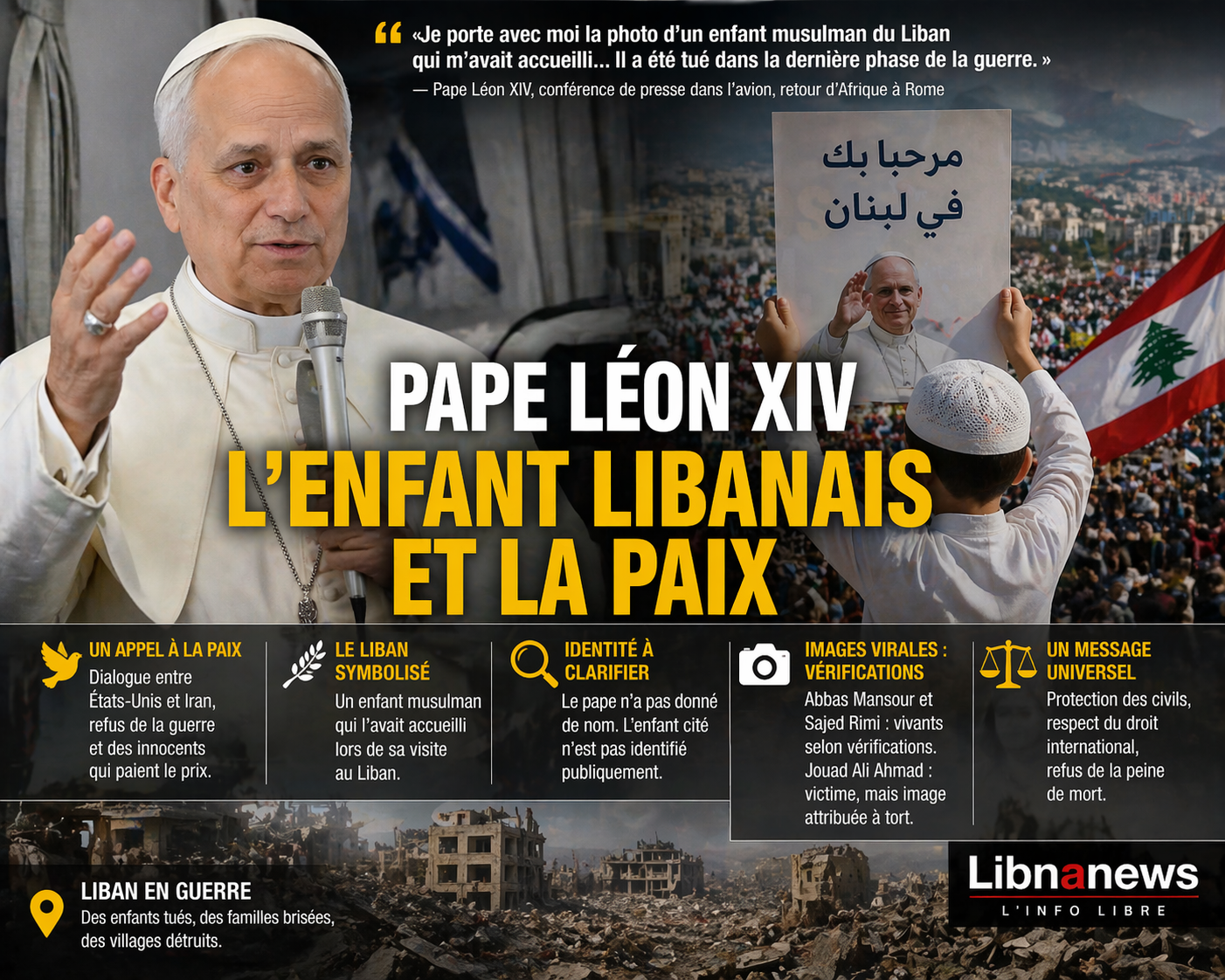
Pope Leo XIV spoke of a photo of a Lebanese Muslim child killed in the last phase of the war between Israel and Hezbollah on board the plane that brought him from Africa to Rome. The boy had been photographed during the papal visit to Lebanon, holding a welcome sign. The Pope used this memory to renew his rejection of the war and to call on the United States and Iran to resume negotiations.
The scene was reported during a back-to-country press conference, after a tour that had taken him to several African countries. The sovereign pontiff put the Lebanese case in a broader context on the protection of civilians, respect for international law, the war between the United States, Israel and Iran, and the death penalty.
The identification of the child quoted by the pope should, however, be treated with caution. The pope didn’t give a name. Audits published by a news agency have established that two children who became viral during the Pope’s reception in Lebanon, Abbas Mansour and Sajed Rimi, are alive. The name of Jouad Ali Ahmad, killed in an Israeli strike, wrongly circulated as the child of the famous photo.
A call for peace in the return plane
Pope Leo XIV spoke in front of the journalists who accompanied him on the flight between Malabo and Rome. The press conference concluded with an African tour of religious, diplomatic and social meetings. The questions covered ongoing wars, migration, executions in Iran, capital punishment and some tensions within the Church.
On the war between the United States, Israel and Iran, the pope refused to place the debate on the sole ground of regime change in Tehran. He preferred to ask another question: how to defend values without causing the death of many innocent people. This formulation allowed him to shift the discussion from the strategic field to the human cost of conflicts.
He called on the United States and Iran to resume dialogue. According to him, the negotiations are in a confused situation, with each side accepting or refusing in turn the conditions advanced. The pope also referred to the overall economic effects of the crisis, without separating them from the suffering of civilian populations.
It was in this sequence that he mentioned Lebanon. The high pontiff said he was wearing a picture of a Muslim child who had welcomed him during his visit to Lebanon. He explained that this child had been killed in the final phase of the war. The purpose of the statement was to recall that each conflict produces concrete human stories, beyond military and diplomatic decisions.
Pope Leo XIV: Lebanon as a civil symbol
Lebanon occupies a special place in the Vatican discourse. A country of religious coexistence, institutional fragility and recurrent conflicts, it often appears as a laboratory for dialogue and as a place exposed to regional tensions. Pope Leo XIV’s visit to Lebanon in 2025 had been presented as a process of peace and consolation.
During this trip, large crowds had welcomed the pontiff. Christians, Muslims and citizens with no religious affiliation had participated in public events. The images of children hailing the pope had circulated widely, especially those taken on the road from the airport and in the southern suburbs of Beirut.
These images had been read as a sign of coexistence. A Muslim child welcoming the head of the Catholic Church was a form of national message to many Lebanese. In a country fractured by the economic crisis, political divisions and war, this scene offered a simple picture: that of a common welcome despite different affiliations.
The Pope’s reminder of this photo therefore transforms the image into a symbol. It is no longer just a travel memory. The child becomes, in the pontifical statement, the face of a civilian population affected by a war that transcends the borders of Lebanon and places the inhabitants at the heart of a regional conflict.
An identity to be clarified with caution
The pope did not name the child. This absence of a name requires a distinction between what is confirmed and what remains uncertain. Several social media publications attributed the image to a child killed by Israeli strikes. Messages then associated this image with the name of Jouad Ali Ahmad, who was presented as a victim of the bombings.
An audit conducted by a news agency found that this was wrong for the most widely distributed photo. The child who held the image of the pope and who had been photographed by an agency photographer named Abbas Mansour. His family reported that he was alive and that he had not been injured by the strikes.
The same verification treated another video that became viral, showing a child crying enthusiastically during the papal visit. This child is called Sajed Rimi. His mother also reported that he was alive and had not been affected. Again, the publications that presented him as dead proved inaccurate.
Jouad Ali Ahmad was killed in an Israeli strike, according to the evidence reported by this verification. But his mother denied that he was the child of the famous photo taken during the Pope’s reception. At this stage, the child mentioned by Leo XIV is therefore not publicly identified by the Vatican. The only identification established around the viral image leads to Abbas Mansour, who is alive.
What one can say about the young boy
The most rigorous formulation is therefore the following: the pope claims to carry the photo of a Lebanese Muslim child killed after welcoming him to Lebanon, but he did not reveal his name. The images circulating online were wrongly associated with Jouad Ali Ahmad. The child of the best known photo is identified as Abbas Mansour and did not die.
This distinction is essential in a war context. The images are moving fast. The stories overlap. Real victims can be mixed with photographs of other children. A misidentification does not remove anything from the death of Jouad Ali Ahmad. It only obliges him not to give him an image that is not his.
It also recalls an important journalistic rule. Emotion is not enough to establish an identity. A name, photo, date and place must be cross-referenced. In this case, the Vatican gave a personal testimony of the pope, but did not provide the child’s name or publish the photo that he said he would keep with him.
The article must therefore retain this nuance. The young boy mentioned by the pope is not clearly identifiable from the only papal declaration. The children identified in the viral contents of the visit are Abbas Mansour and Sajed Rimi, both alive. Jouad Ali Ahmad is a confirmed victim, but he does not match the child of the photo checked.
War brought back to faces
Pope Leo XIV put this story back in a reflection on civilian victims. He reported seeing messages from families of children killed in the early days of the attack on Iran. He then expanded his remarks to Lebanon, citing this child whose picture he keeps.
This method corresponds to a tradition of papal discourse. The Vatican often speaks of conflicts through victims, families, displaced, wounded and children. The pope does not present a military solution. It seeks to move the debate towards the protection of human life and towards the obligations of States in times of war.
Lebanon’s choice is not trivial. Since the resumption of hostilities, Lebanese civilians have been paying a high price. Strikes hit houses, villages, roads, bridges and areas far from the front line. Children were killed in several areas, including areas that residents believed were safer than the border.
An agency report published before the pope’s press conference had already documented the deaths of several children in Lebanon. He mentioned 11-year-old Jouad Younes, who was killed in a strike in Saksakieh, as well as other children who died in strikes on houses. These accounts have given international attention to the civilian cost of war.
Message to Washington and Tehran
The Pope called for continued dialogue between the United States and Iran. He did not present this appeal as a diplomatic option among others. It has associated it with a moral necessity: to prevent civilian populations from continuing to pay the price of decisions taken by States and armies.
The conflict between the United States, Israel and Iran has changed regional balance. Lebanon was drawn into this sequence by the resumption of clashes between Israel and Hezbollah. The attacks, displacements and destruction in the South then placed the Lebanese file at the centre of the American mediation.
The truce in Lebanon was extended by three weeks in Washington. But this extension remains incomplete on the ground. Bombing and destruction did not stop completely. The pope therefore intervenes in a time when diplomatic announcements coexist with still unstable military realities.
His message is not just for directly engaged governments. It also targets public opinion, international institutions and religious leaders. Speaking of a Lebanese Muslim child, the head of the Catholic Church chooses an example that goes beyond religious boundaries and recalls that civilian victims are not reduced to their community.
Refusing war as a constant line
The pope summarized his position with a clear formula: he cannot be in favour of war as a pastor. This sentence is consistent with several Vatican interventions on contemporary conflicts. It does not mean that the Holy See ignores security issues. It means that its starting point remains the protection of human life.
The call for a culture of peace refers to a critique of the logic of permanent response. The Pope recalled that, in the face of a crisis, the immediate response of states often tends to be military. He opposed this logic by seeking solutions based on dialogue, international law and the protection of innocent people.
Lebanon illustrates this tension. Israel claims to carry out strikes against Hezbollah and its infrastructure. Hezbollah claims operations in response to Israeli attacks. The Lebanese State calls for an end to the bombings, the Israeli withdrawal and the return of the displaced. Civilians are in the midst of these competing stories.
The pope does not sever military responsibilities in every incident. He insists on one principle: innocent people must be protected. This position allows the Vatican to speak to several camps without entering into the operational justification of either. It also exposes the Holy See to the critics of those waiting for a more direct condemnation.
Death penalty also condemned
The press conference was not just about war. Asked about recent executions in Iran, the pope condemned unjust actions and the death penalty. He affirmed that human life must be respected from conception to natural death. This position is part of the doctrinal line reinforced under the pontificate of Francis.
Pope Francis had changed the official teaching of the Catholic Church to declare the death penalty inadmissible in all cases. Leon XIV repeats this line. It links the condemnation of war, unjust executions and deaths to the same vision of human dignity.
This part of his speech complements his remarks on Lebanon. The pope is not just talking about the victims caused by the bombings. It extends its reasoning to any State decision that unjustly withdraws life from people. The coherence of his speech rests on the refusal of death imposed as a political instrument.
This link between war and the death penalty gives the press conference a wider scope. It is not limited to a comment on Iran or Lebanon. It draws a moral line: States must also be judged in their way of protecting, or neglecting, human life.
Lebanon in the diplomacy of the Holy See
The Holy See has an ancient relationship with Lebanon. The country is considered by Rome as an area of religious pluralism and as a place where coexistence between Christians and Muslims retains regional value. Successive popes often presented Lebanon as more than just a state, but as a message of living together.
Leon XIV’s visit in 2025 reinforced this dimension. The sovereign pontiff had visited a country exhausted by the financial crisis, political tensions, destruction and security uncertainty. His displacement was interpreted as a gesture of proximity to all components of Lebanese society.
The reference to the Muslim child extends this reading. The pope does not quote a Catholic or Christian child to speak of Lebanon. He quotes a Muslim child who had welcomed him. The message is clear: peace in Lebanon is not about one community against another. It covers the whole population.
This approach also supports the Vatican’s desire to defend civilians without classifying them according to their religion. In a country where denominational affiliations structure political life, this word gives visibility to a common identity: that of citizens exposed to the same bombs, to the same displacements and to the same breakdowns of life.
An account corrected by the audit
The episode also shows the difficulty of telling the war in the era of social networks. A strong image can become viral within a few hours. It can then be associated with a name, date and death that do not match it. Corrections often arrive later, when the emotional narrative has already been installed.
In the case of the child hosting the pope, the confusion was documented. Abbas Mansour, the child of the photograph taken by a photographer from the agency, is alive. Sajed Rimi, the child of another viral video, is also alive. Joad Ali Ahmad died, but his mother denied that he was the photo boy.
This clarification does not contradict the Pope’s message about civilian victims. It makes him more demanding. To speak of the dead, we must correctly name the living and the victims. A false identification can harm the memory of a killed child, but also the security or privacy of a living child.
The Vatican could clarify the point if the photo kept by the pope did not match the images verified by the agency. In the absence of further precision, caution remains necessary. The child quoted by the pope remains, publicly, unnamed. The identifications available concern viral images, not necessarily the personal photo he says he is wearing.
A religious word in a diplomatic sequence
The Pope’s intervention occurs as several Lebanese files cross. The truce with Israel has been extended. Washington is preparing a possible high-level political meeting. The Lebanese Government calls for a complete withdrawal of Israeli forces and refuses any buffer zone. The European Union refers to increased support for the Lebanese army.
In this context, the Pope’s word does not have the same function as military mediation. It does not set a timetable, does not draw a border and does not define a mechanism for monitoring violations. It acts on another register: the moral norm, public pressure and memory of victims.
However, this word is important in the Lebanese case. The Vatican has an extensive diplomatic network. He speaks to governments, churches, religious communities and international organizations. Its positions can accompany humanitarian requests, including those relating to the protection of civilians, access to relief and respect for international law.
The reminder of the Lebanese child thus creates a bridge between diplomacy and memory. He recalled that negotiations were not only about military maps, zones and guarantees. They also concern families that have lost children, destroyed villages, forced displacement and still impossible returns.
What the episode leaves in suspense
Several points remain open after the pope’s statement. The first concerns the identification of the child whose photograph he keeps. No Vatican source gave his name. Available checks suggest that viral identifications should not be repeated without caution. The name of Jouad Ali Ahmad must be quoted as that of a child killed, but not as that of the child of the famous photo.
The second point concerns the political scope of the appeal. The pope called for a resumption of dialogue between Washington and Tehran, but negotiations remained uncertain. The regional war continues to have effects in Lebanon, where the truce remains partial and where civilians mainly await the end of strikes, access to villages and reconstruction.
The third point concerns the response of States. The Holy See calls for respect for international law and the protection of innocent people. Governments engaged in military operations claim to act in accordance with their security requirements. The gap between these two registers remains one of the nodes of the crisis.
The image evoked by Leo XIV will therefore continue to exist as a symbol, but also as a file to be checked. It refers to a child not appointed by the pope, viral images corrected by a news agency, and to a confirmed reality: Lebanese children were killed during this war, while the prolonged truce has not yet closed the sequence opened by the bombings.






