

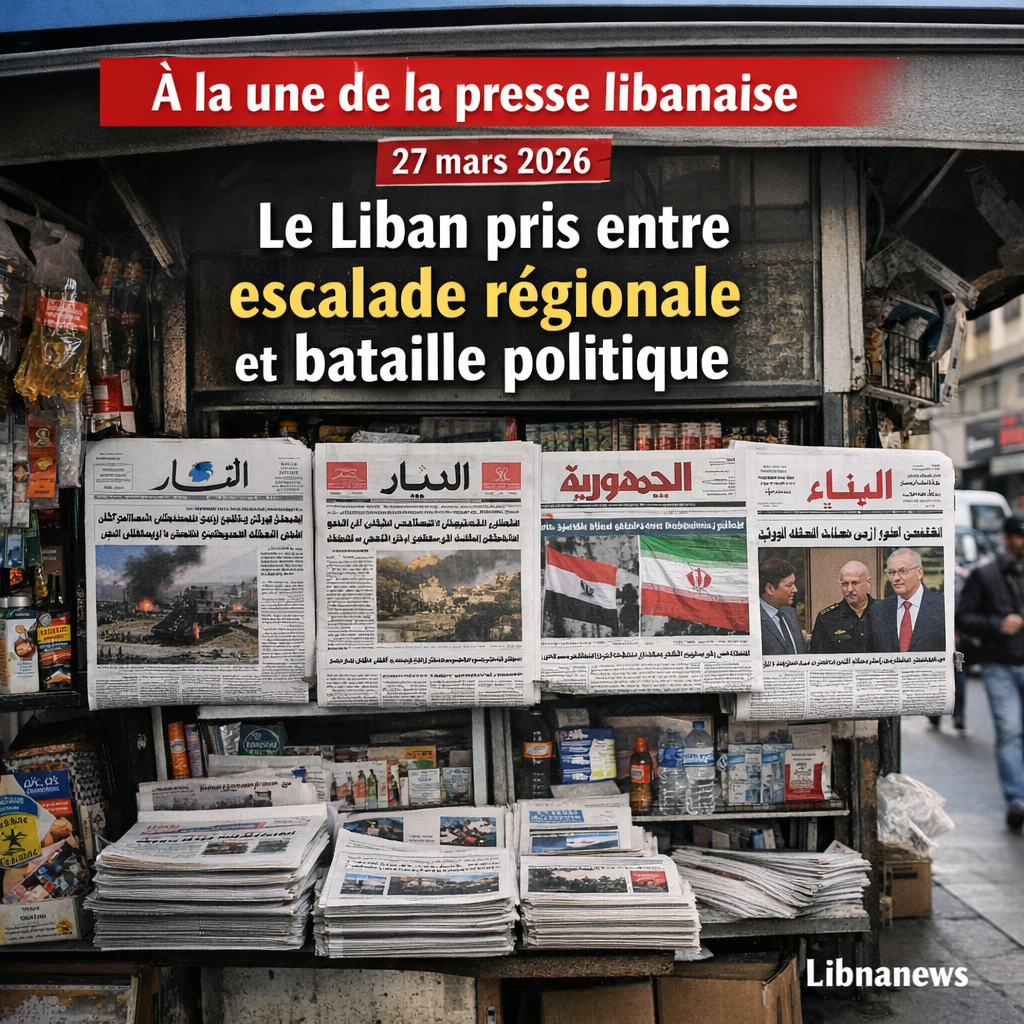
A Lebanese scene dominated by regional war and fear of internal change
In the press of 27 March 2026, the central fact is not only the continuation of the war, but also the way in which it reshaped the Lebanese political debate, the language of the institutions and the threshold of tolerance of the actors in the face of the risk of explosion. In Ad Diyar of 27 March 2026, the question of Lebanon’s place in the ongoing confrontation was brutally formulated by questioning the moment when the Lebanese state declared, de facto or de jure, the war on Iran, while the newspaper described a country in a « disaster » situation, at a time when the Israeli army was stepping up its operations south of the Litani, when hundreds of thousands of displaced persons were moving away from their homes and the controversy over the Iranian ambassador threatened to parasitize the rest of the public agenda. In the same issue, Ad Diyar of 27 March 2026 insists on another decisive point, namely Washington’s desire to dissociate the fronts, while Tehran clings to a logic of unity of the theatres of war and considers that the military power ratio must continue to weigh on any negotiations. The newspaper thus presents a Lebanon caught in a conflict that transcends it but which crosses it entirely, since the evolution of the southern front, the American pressure on Iran and the fate of Hezbollah are treated as elements of a single file. The same idea was developed by Al Bina on 27 March 2026, but from an opposite reading grid, according to Donald Trump’s main aim was to save time, calm the markets and complete his preparations, while the Lebanese government plunged into a sensitive division around the Iranian ambassador’s case. The newspaper directly links the internal institutional crisis to the intensity of the war, showing that in Lebanon the diplomatic dispute is no longer a mere protocol dispute but a choice of positioning in the regional crisis. In Annahar of 27 March 2026, the framing still differs, but the background diagnosis is close. The daily describes a country entering a more serious phase than a classical war, at a time when the international order seems suspended, when the great powers look, wait or calculate, and when Lebanon finds itself exposed to decisions taken elsewhere. This reading places the Lebanese crisis in a wider sequence of regional and international reconfiguration, making the front page a space where military urgency, the impotence of multilateral mechanisms and the fragility of the internal scene overlap.
The case of the Iranian ambassador becomes the immediate test of the relationship between sovereignty, government and religious balance
The second line of force of this one lies in the place taken by the question of the Iranian ambassador, who became the most direct revealer of the fractures of power. In Al Liwa The daily says that this approach has received a favourable reception on the Lebanese and Arab levels, precisely because it has contained the auctions and limited attempts to mobilize identity around a decision called sovereign. This reading is extended in Al Liwa, dated 27 March 2026 by the reactions of several officials received by Joseph Aoun. In particular, the newspaper reports Sami Gemayel’s approval that Iran has caused considerable harm to Lebanon, that it has transformed the country into a military base for decades and that Iranian diplomatic representation has played a role that goes beyond conventional diplomacy. Through this, the ambassador’s case ceases to be a simple administrative procedure and becomes a broader political trial of Iranian influence in Lebanon. On the other hand, Al Bina, dated 27 March 2026, presents the sequence as a test of legitimacy for the government itself. The newspaper writes that the executive risks slipping towards a loss of « mithaqiya », that is to say, a challenge to its political and community representativeness, if the arm continues. He also notes that between Baabda and Ain al-Tiné, intermediaries sought a compromise formula, without success, since the Minister for Foreign Affairs refused to reconsider his decision while the head of government did not show eagerly to step back, under external pressure. This institutional dimension is further elaborated by Al Bina on 27 March 2026, which publishes a legal argument that the Minister for Foreign Affairs does not have the power to act alone on a matter of this gravity and that any such decision must be taken by the higher political authority, i.e. the government in consultation with the Presidency. The daily thus concludes that the measure is constitutionally irregular. The one of the day thus shows a confrontation on several levels. For part of the newspapers, the ambassador’s file is an opportunity to reaffirm the sovereignty of the State and to set a limit to Iranian interference. For others, it risks opening a regime crisis at the worst moment, while institutions should focus on war, displaced people and territorial protection. Between these two readings, the same fact becomes either a restoration of authority or an additional breaking factor.
Active diplomacy, but it remains suspended from the intensity of the front and from the calculations of the powers
The third major component of the front page is the attempt to build a diplomatic net around Lebanon, while military dynamics continue to dominate. In Ad Diyar of 27 March 2026, the visit of Egyptian Foreign Minister Badr Abdelatty occupies an important place. The newspaper points out that Joseph Aoun received a message of full support from President Abdel Fattah al-Sissi and that he welcomed any efforts that could revive a negotiating initiative. Nabih Berri, according to Ad Diyar of March 27, 2026, also highlighted Egyptian efforts. The general framework is that of an Arab mediation that seeks to produce a ceasefire, or at least to reopen a political space in a sequence dominated by weapons. Al Liwa, dated 27 March 2026, repeats this diplomatic sequence by insisting that Egypt has initiated contacts with the parties able to exert pressure to stop the fighting and that it has sent messages to Israeli officials to stop operations against villages, bridges, civilian areas and their inhabitants. The newspaper also reports Egyptian hope that Joseph Aoun’s line of defence will preserve state sovereignty and civil peace, two notions that return as constant landmarks in the daily press. This diplomatic movement is not limited to Egypt in Al Liwa, dated 27 March 2026. The newspaper also mentions the support of several Western ambassadors at the initiative of Joseph Aoun, as well as the reaffirmation of the framework of resolution 1701 and the need to strengthen the State, its institutions and the Lebanese army to restore its authority throughout the territory. But the scope of this diplomatic activity remains limited by developments on the ground. Al Bina, dated 27 March 2026, recalls, in the words of Nawaf Salam, that Lebanon is facing a dynamic of territorial separation of the area south of the Litani, through the destruction of bridges, forced displacement, demolition and daily snacking of land. The newspaper thus describes an Israeli strategy that seeks not only to strike but to produce a new territorial and human state of affairs. Annahar of 27 March 2026 points out that France adopts a hard line on Hezbollah’s responsibility in training Lebanon towards war, while considering that a halt to fighting remains necessary in the short term. The daily describes a Lebanon trying to reposition itself against Iran with Arab coverage and French support, but in a context where the ability of Tehran and Hezbollah to hold remains a central factor in diplomatic calculations. A total of 27 March 2026 draws a country whose immediate horizon is locked by three simultaneous emergencies. First, regional war and its possible extension. Secondly, the internal conflict over the definition of sovereignty and the place of Iran. Finally, the search for an Arab and international diplomatic umbrella capable of curbing degradation. None of these three registers is autonomous. Each depends on the other two, which explains why the daily press treats both the front, the government, the ambassadors, the mediations and the south as a single national story under pressure.
Local politics: crisis around Iranian ambassador reveals internal struggle over sovereignty, institutional balance and the role of government
A Diplomatic Decision Becomes a Political Test for the Executive
In the Lebanese press of 27 March 2026, local politics is dominated by the same question, that of the State’s ability to impose a sovereign line without causing a major institutional breakdown. Al Liwa The newspaper insists on a « quiet management » of the dispute within the institutions, and believes that this approach has helped to contain verbal escalation, to avoid the denominational exploitation of the crisis and to keep the case in the field of a « sovereign decision » rather than in the field of partisan mobilization. This reading gives the head of government the image of a leader who seeks less confrontation than the political and legal framework of a very sensitive dispute.
Al Joumhouria of 27 March 2026 places this decision in a longer accumulation. The daily explains, on the basis of diplomatic sources, that the choice for the Iranian ambassador was not the result of an isolated incident, but rather of a series of Iranian positions and statements considered in Lebanon as direct interference in internal affairs, particularly on the issue of Hezbollah armament and Lebanon’s inclusion in regional negotiations. The newspaper points out that, in this reading, the political threshold was crossed when Tehran confirmed that any negotiations with Washington and Israel should include Lebanon, which was seen as a treatment of the country not as an autonomous State, but as an integrated map to wider negotiations.
Ad Diyar of 27 March 2026 takes a different approach. The newspaper acknowledges the existence of a political dispute, but believes that the timing is bad and that priority should remain the ongoing war, the Israeli offensive in the south and the extent of displacement. The daily talks about a Lebanon in a catastrophic situation and feels that it is not a time to remove an ambassador or block the functioning of the executive. In this perspective, the problem is not only the legitimacy of the measure, but the order of political priorities in a country under military pressure. The newspaper argues that a gesture of sovereignty can lose its value if it helps to disrupt the state apparatus when it should focus on war and its human consequences.
Al Akhbar of 27 March 2026 pushes this criticism further by presenting the case as an episode of a broader confrontation between, on the one hand, a camp determined to reduce Hezbollah, and, on the other, those who consider such a strategy to threaten internal equilibrium. The newspaper places Joseph Aoun, Nawaf Salam, the Lebanese Forces, Kataeb and other actors in the same political direction, even though their objectives and styles differ. He affirms that many of these actors have long made disarmament a priority and that the ambassador’s crisis is becoming part of that dynamic. The daily opposes this the respect by Hezbollah of the terms of the agreement of 27 November 2024 and considers that its opponents have nevertheless continued a line of political pressure.
Joseph Aoun seeks the balance between institutional firmness, Arab support and fracture prevention
In this sequence, Joseph Aoun appears in almost every newspaper as the central equilibrium point of the system. Al Liwa By widely publishing these statements, Al Liwa
At the same time, Al Liwa The daily reports that Western ambassadors have reaffirmed their support for Lebanon and the President’s initiative to end the Israeli escalation. The newspaper also refers to the Egyptian message transmitted by Badr Abdelatty, which salutes the rationality and prudent vision with which Joseph Aoun manages the case, with the aim of preserving state sovereignty throughout his territory and protecting civil peace. This articulation between sovereign firmness and concern to avoid internal discord structure the presidential image in the newspaper.
Al Joumhouria of 27 March 2026 adopts a more tense angle. The daily highlights a climate of threats, blocked negotiations and regional fire, while showing Joseph Aoun receiving the Egyptian Foreign Minister. The newspaper suggests that the presidency try to keep a Lebanese and Arab political path open in the midst of a context where the local scene is increasingly absorbed by the logics of war. It makes Baabda not only a place of protocol, but a point of coordination between internal policy and external mediation.
Al Akhbar of 27 March 2026, conversely, reads Joseph Aoun’s position with marked distrust. The newspaper recalls that, after his election to Parliament, he had referred to the need for the state to withdraw weapons, and he now registers it in a current which, according to him, seeks to take advantage of the war to change internal balances. This presentation does not reduce the President to his declared intentions alone. It seeks above all to show how some newspapers close to the resistance camp interpret every presidential act in the wake of an internal power relationship on Hezbollah. Local politics thus appears less as an ordinary competition between institutions than as an argument over the very definition of the state and its priorities.
Nawaf Salam tries to contain the government crisis without yielding to the institutional logic
The figure of Nawaf Salam also occupies a central place. Al Liwas of 27 March 2026 presents the head of government as the person responsible for internal de-escalation. The newspaper points out that its handling of the case has limited the effects of the political shock and preserved the institutions at the time when the Council of Ministers was to meet. It also shows Kuwait’s solidarity and demand for a complaint against Israel, which allows it to link the diplomatic register, the defence of sovereignty and Arab solidarity in the same political sequence.
But Al Bina, whose excerpts already visible in today’s press converge with other critical headlines, describes a government threatened by a loss of political and community legitimacy if the crisis continues. This line is extended by Al Joumhouria on 27 March 2026, which explains that the Hezbollah-Amal tandem considers the decision of the Minister of Foreign Affairs, as well as the political coverage it enjoys, as an attempt to break internal balances. In this vision, the problem lies not only in the substance of the measure, but in the signal it sends on the ability of a camp to act without consensus on an explosive dossier. Local politics then moved from the territory of sovereignty to that of the internal pact.
Al Akhbar of 27 March 2026 is even more frontal. The newspaper clearly mentions the possibility of a government fall if the process ends and presents the executive as determined to expel the Iranian ambassador, but with a suspended implementation. The daily describes a sequence in which power seems to move forward, while at the same time allowing for a delay or a possibility of freezing. This presentation suggests that the government measures the cost of a full act. It also reflects a well-known political reality in Lebanon, where the most symbolic decisions are sometimes taken, announced or partially validated in order to maintain a margin of negotiation between institutions, parties and external sponsors.
Ad Diyar of 27 March 2026 adds another dimension to the file by relaying, in the words of the Minister of Information, the idea that the government also works on security coordination, school, food supply, energy and media management in times of war. The daily quotes the Minister of Education, the Minister of Economy and the Minister of Energy, as well as the reference to the army as the reference security authority for journalistic coverage. This shows that beyond the diplomatic crisis, the executive seeks to prove that it continues to administer the country. Local politics, therefore, is not just a struggle over the Iranian ambassador. It also includes an effort to demonstrate state continuity under war conditions.
Parties use crisis to redefine internal dividing lines
The partisan reactions show that the crisis is not limited to technical disagreement. It serves to redefine the boundaries between camps. The position of Sami Gemayel, who linked the Iranian presence in Lebanon to the militarization of the country, missiles and foreign war, was strongly emphasized by Al Liwa on 27 March 2026. This wording is not only aimed at the ambassador. It reformulates the old criticism of the Iranian axis in a new context, that of a war that gives sovereign discourses a renewed audience.
In Al Akhbar of 27 March 2026, the opposing camp responded by accusing these forces of being united only by their hostility to resistance. The newspaper talks about an outsider who is sponsoring this grouping and a strategy aimed not only at disarmament, but also at the political dismantling of Hezbollah. The language used is revealing. It does not present confrontation as a democratic alternation or as a strategic debate, but as an existential struggle to maintain a central player in the Lebanese system. This way of writing local politics confirms that regional war has reduced the space for nuance between the camps.
Al Joumhouria of 27 March 2026 formulates this polarization in an institutional vocabulary. In referring to the concern of the Hezbollah-Amal tandem to defend internal balances, the newspaper shows that the response is expressed not only in the name of resistance or regional alignment, but also in the name of a certain idea of power sharing. This is an important point. In the Lebanese local scene, almost every crisis is reformulated in terms of national pact, community distribution and limits of unilateral action. The Iranian ambassador’s file does not escape this logic.
Annahar of 27 March 2026, in the more general tone of its political pages, places the debate in a wider Arab context. The daily recalls that other Arab countries have already taken action against Iranian diplomats and suggests that Lebanon, too, is now part of a redefinition of the report in Tehran. This perspective gives the local scene a regional horizon, but it also serves an internal political objective. It helps to present the decision not as an exceptional or risky gesture, but as a late alignment with a practice already observed elsewhere.
A local power under war, forced to govern while arbitrating the very meaning of the state
In essence, what the local policy of 27 March 2026 reveals is less a simple conflict over a diplomatic appointment than a battle over the meaning of the state in times of war. Al Quds Al Arabi of 27 March 2026 reports that Lebanon will file a complaint with the Security Council concerning the Israeli attacks, the destruction of bridges, residential buildings and the massive displacement of the southern inhabitants. This approach shows that part of the power intends to recall the traditional foundations of the State, namely, territorial sovereignty, the protection of civilians and the use of international law.
But this same political scene must, at the same time, arbitrate another question, more internal that one, namely how far the autonomy of national decision-making goes against Iran and Hezbollah. Ad Diyar of 27 March 2026 clearly shows this tension when he states that the country is in a dramatic situation, while cautioning against excessive focus on the Iranian ambassador. The daily thus expresses the fear that a debate of sovereignty, conducted without a stable internal power ratio, will further weaken the political apparatus.
On the contrary, Al Liwa, of 27 March 2026, argues that the best way to preserve civil peace is precisely to have the issue dealt with within the institutions. The bet of the newspaper is that sovereignty is only viable if it becomes procedural, not partisan Cree. Al Akhbar of 27 March 2026 replied that this procedure masks a deeper political orientation against resistance. Between these two readings, the Lebanese local policy of the moment appears to be a confrontation on both words and facts. Each camp claims to be state-owned. But one identifies with the sovereign takeover of the Iranian file, while the other links it to the preservation of the balances that prevent the explosion of the system.
The domestic political scene therefore remains caught between three simultaneous constraints. First, war and its daily consequences. Secondly, the need to maintain a functioning government. Finally, the pressure of the camps to impose their definition of the national moment. In the press of 27 March 2026, none of these constraints completely crush the others. This is precisely what gives local politics its current density. It is not limited to diplomacy, war, or ordinary partisan play. It has become the place where Lebanon tries, under fire, to decide who speaks in its name, according to what rules, and how far.
Quote and speech by political figures: the words of sovereignty, war and internal pact clash in a single sequence
Joseph Aoun and Nawaf Salam impose state language focused on sovereignty, civil peace and institutional framework
In the newspapers of 27 March 2026, the quotations of Lebanese officials are not merely accompanied by political facts. They are the very heart of the narrative battle. Through the words used, each camp seeks to define the nature of the crisis, the scale of danger and the role of the state. Al Liwa, dated 27 March 2026, reports that Nawaf Salam’s management of the Iranian ambassador’s case was perceived as a « quiet treatment », inscribed « in state institutions », in order to contain tension, avoid confessional excitement and remove the sovereign decision from the « bazaar of divisions ». This lexical choice is essential. He presents the head of government not as a man of break-up, but as a defender of procedural sovereignty, that is to say, a sovereignty that is only valid if it remains framed by the forms of the state.
The same newspaper, again on March 27, 2026, highlights the words of the Egyptian Foreign Minister Badr Abdelatty after his meeting with Joseph Aoun. According to Al Liwa This quotation is politically heavy. It combines the Baabda line with dual legitimacy, internal and Arab. It also suggests that the ongoing conflict should not be limited to border warfare. It calls for the very status of the Lebanese State and its ability to prevent Iran from becoming a domestic fracture.
In Al Quds Al Arabi of 27 March 2026, another government statement reinforces this direction. Information Minister Paul Morcos said that Lebanon would file a complaint with the Security Council against Israeli attacks, referring to the destruction of bridges, residential buildings and the « collective displacement » of the southern inhabitants. This quote moves the executive language to international law. It shows a power that seeks to speak in terms of violations, civilians and multilateral institutions, at a time when local politics remains absorbed by the crisis of the Iranian ambassador.
Ad Diyar of 27 March 2026 reports on Paul Morcos’ comments on government operations in wartime. The newspaper quotes Rima Karami, Minister of Education, who says that 75 per cent of students in the public and private sectors have resumed teaching at face-to-face or distance. He also mentioned the Minister of Economy Amer Bisat, who said that the food and supply stock remained sufficient in the medium term, and energy minister Joe Saddi on the fuel issue. Finally, Morcos recalls that the army is the safe reference for media coverage. This series of citations composes a government discourse of administrative continuity. It aims to prove that the state does not only speak of war and sovereignty, but that it also continues to manage school, food, energy and information.
The contrast is important. On the one hand, Joseph Aoun and Nawaf Salam are associated with words such as rationality, institutions, civil peace, sovereignty and international complaint. On the other hand, newspapers hostile to this line describe these same words as the mask of a more offensive political agenda against Hezbollah. The battle for quotations thus begins with a struggle on the credibility of the state language itself.
Iran’s adversaries make the diplomatic record a broader political trial of its role in Lebanon
The quotations from the camp against Iranian influence are much more accusing. Al Liwa, dated 27 March 2026, reproduces Sami Gemayel’s comments after his meeting with Joseph Aoun. The leader of the Kataeb states that no State has harmed Lebanon as much as Iran, transformed the country into a military base for decades, installed missiles there and dragged the Lebanese into a war that is not theirs. He adds that the Iranian embassy did not play a classical diplomatic role, but acted as a structure related to war management.
This quotation deserves to be read as a total speech. She doesn’t care about the ambassador. It reformulates all the recent history of Lebanon around the same cause, the Iranian rule. In a few sentences, Iran is designated as responsible for the militarization of the territory, the dispossession of the state, the forced regional alignment and the entry into a war. The choice of a simple, frontal vocabulary enhances the political effectiveness of the sequence. It is not a question of nuance, but of condense an indictment.
Annahar of March 27, 2026 extends this tone in a more intellectual register. In an opinion text, Gebran Tueni Zoghbi writes that the south must no longer return « from the face of the monster » to become a « platform that excites the monster », but join Lebanon as « oasis » and not as « arene ». It calls for a sovereign, strong, strong and united State capable of protecting all its citizens and bringing them together around the same framework. Although this quotation is a matter of comment rather than institutional discourse, it is part of the same semantic battle. Lebanon is opposed to the logic of advanced scene, front and permanent provocation.
In Al Joumhouria of 27 March 2026, quotes related to the executive take a more dramatic tone. The newspaper reports that Joseph Aoun was informed during Badr Abdelatty’s visit that Egypt stands alongside Lebanon « President, Government and People » in these delicate circumstances. The formula, very classical in Arab diplomacy, is valid here as a global legitimization of Lebanese institutions. She doesn’t just support a person. It devotes a centre of gravity, that of an official Lebanon that seeks to speak with one voice in the face of war and Iran.
Ad Diyar of 27 March 2026 offers a critical reading of this rise in the power of the sovereignist discourse. The newspaper states that Lebanon is in a catastrophic situation, that the Israeli army is conducting its largest offensive against the south of the country and that, in this context, « this is not the time to remove an ambassador or paralyze the government, » adding that « it is better to go back on the decision. » This formulation reverses the hierarchy of emergencies. Where others speak of regained sovereignty, Ad Diyar highlights the war, the displaced and the need to preserve government operations.
The opposite quotations therefore do not cancel. They describe two incompatible definitions of political duty. To some, speaking and acting against Iranian interference becomes the very condition of sovereignty. For others, the first duty is to prevent internal collapse during the war, even at the cost of postponing the diplomatic arm.
The resistance camp responds with a language of national legitimacy, pact and shared combat
Faced with this block of sovereignist quotations, newspapers close to Hezbollah and its allies mobilize another grammar. Al Akhbar of 27 March 2026 cites or paraphrases a constant logic among opponents of the measure against the Iranian ambassador. The daily recalls that Joseph Aoun had declared after his election that the state should withdraw the weapons, and that Nawaf Salam had placed this issue at the forefront of his government programme. The newspaper presents these positions as evidence that the ambassador’s file is part of a broader strategy for resistance. He also points out that Hezbollah, according to him, strictly respected the agreement of 27 November 2024, while its opponents continued their campaign against him, demanding the transfer of his weapons to the army and then aiming at its political dismantling.
The quotation is not direct here, but the process is clear. Al Akhbar takes previous words from the state leaders and reinserts them into the present to give the conflict a long-term coherence. This is no longer just an ambassador’s business. According to the newspaper, it is a battle over the very existence of resistance as a political and military actor. The function of this reminder is double. It delegitimizes the official presentation of the file as a mere act of sovereignty. He also seeks to bring together Hezbollah supporters around a defensive and existential reading.
Al Bina, dated 27 March 2026, gives this response an even more explicit form with Naim Kassem’s comments. Hezbollah’s secretary-general says that what is happening in the face of the Islamic Republic of Iran is « a lesson for anyone who wants to understand », that Iran has stood up to « global American-Israeli aggression » and that it will defeat, adding that « any success in confrontation with America and Israel produces a good that benefits everyone ». This quotation is crucial. She’s not just talking about the Iranian front. It universalizes resistance, presents it as a collective good and attributes to the victory against Washington and Tel Aviv a beneficial reach for all the peoples of the region.
The same page of Al Bina on 27 March 2026 further indicates that confrontation with aggression is a « national responsibility for all ». National vocabulary is central here. It aims to prevent Hezbollah from appearing as the only party involved in the war. He turns his fight into a shared duty. In the same movement, he repeats any attempt to politically restrict it as a desertion or a fault towards the country.
Al Joumhouria of 27 March 2026, although less aligned with partisan discourse, also takes up the idea of a country suspended from threats, fragile negotiations and Hezbollah’s attitude on the southern front. The daily notes that Donald Trump is seeking a halt to the fighting while threatening Iran with a major strike, and that Hezbollah continues to counter Israeli attempts to penetrate. This narrative creates a specific political effect. It places the party in a regional confrontation sequence where its military posture serves as a direct response to external threats.
The result is clear. Where Iran’s opponents speak of sovereignty, civil peace and institutions, supporters of resistance speak of national responsibility, necessary confrontation and collective benefit of victory. In both cases, each claims Lebanon. But everyone tells it with words that exclude the definition of the other.
International citations further exacerbate the polarization of the Lebanese debate
Words from outside also play a decisive role in today’s press. They feed the Lebanese camps and give each reading additional validation. Ad Diyar of 27 March 2026 reports, referring to Reuters, that Donald Trump announced a suspension of the attacks on Iranian energy infrastructure for ten days, until 6 April, adding that the discussions are « progressing very well ». Trump’s formula is typical of his style. It combines assurance, simplification and strategic pressure. For the Lebanese press, it means above all that the regional calendar remains suspended from US calculations and that Lebanon can be affected by a decision taken in another theatre.
Al Joumhouria of 27 March 2026 goes further by summarizing the US President’s line with an apparent contradiction, since he would seek a ceasefire while threatening Iran with a « great strike ». This juxtaposition is important. It allows newspapers to read Washington either as a mediator or as an actor in escalation. In the Lebanese debate, this ambiguity feeds both sides. Some see it as proof that only Arab and international coverage can contain war. Others read the confirmation that pressure on Iran and Hezbollah remains the real engine of the sequence.
Al Akhbar of 27 March 2026 cites Israeli and American reports that Israel has requested more time to strike important targets in Iran, while the Pentagon and the Central Command are planning a « decisive strike » that could include ground forces and massive bombings. Even when it is not a question of formal political quotations, this vocabulary of « decisive strike » or « massive » attack acts as a word of war. It structures the Lebanese discursive field by recalling that the interior scene is part of a sequence of extreme threats.
In Al Quds Al Arabi of 27 March 2026, Arab and regional authorities are mentioned in a completely different register. The newspaper reports the refusal of any enlargement of the conflict in the Gulf and Jordan, as well as calls for respect for borders and the refusal to use neighbouring territories for military operations. These statements not only concern Lebanon, but indirectly reinforce the legitimacy of those in Beirut who seek to lock the crisis in clear State and territorial frameworks.
The field of quotations thus becomes a saturated space. Lebanese officials speak invoking sovereignty, pact or resistance. Regional actors talk about de-escalation, support or alignment. The United States speaks of both negotiation and strike. Each foreign sentence reflects on the internal debate. Each external quotation is taken over, translated and placed in a camp.
Behind the words, a struggle to impose the legitimate definition of the Lebanese moment
What strikes in the newspapers of 27 March 2026, therefore, is not only the abundance of statements. This is the way each quote is used to impose a definition of the moment. The institutional language of Nawaf Salam and Joseph Aoun is the proof that a state still exists and that it can deal with the Iranian issue without falling into chaos.Al Akhbar, on the contrary, repeats the same statements as evidence of a campaign against Hezbollah and supported by the outside world.The words of Naim Kassem are transformed into a call for national unity in confrontation.Ad Diyar replied by recalling that the military catastrophe in the south should take precedence over the diplomatic dispute.
Even more technical declarations take on broader political significance. When Paul Morcos talks about a complaint to the Security Council, he is not just talking about a procedure. He recalled that Lebanon still wanted to exist by law.When Rima Karami says that the majority of the students have returned to school, she does not only give a figure. She participates in a state survival story.When Sami Gemayel accuses Iran of turning the country into a military base, he does not just attack a rival. It tries to fix the interpretation of the current crisis on a sustainable basis.
In this landscape, the quotation is never neutral. She’s a weapon, a proof, a flag and a framing. It is used to rally, isolate, reassure or alarm. Lebanese and regional politicians are not content to accompany the events. They produce in their words the way events will be understood. On 27 March 2026, the press showed a Lebanon where the struggle for phrases became almost as decisive as the struggle on the fronts.
Diplomacy: Egypt, Western supporters and the UN framework try to contain the war while Beirut redefines its place against Iran
Egypt imposes itself as the Arab actor most present in the attempt to de-escalate around Lebanon
In the press of 27 March 2026, the diplomacy related to Lebanon is first read through the visible intensification of the Egyptian role. Ad Diyar of 27 March 2026 puts this sequence at the forefront by headlines that Cairo is intensifying its contacts to obtain a ceasefire. The newspaper reports that Joseph Aoun welcomed any effort to reactivate a negotiating initiative, while Nabih Berri praised the Egyptian efforts. This convergence is important. It shows that at least on the diplomatic level, Egypt is received as an acceptable interlocutor by different Lebanese poles, allowing it to occupy a credible role as a mediator at a time when Beirut’s margin of action remains very limited.
Al Liwa, dated 27 March 2026, gives more details on the content of this action. The newspaper reports that Badr Abdelatty sent a message of support from Egypt to Lebanon and assured that his country was in contact with the parties able to exert pressure to stop the fighting. He also states that Cairo sent messages to Israeli officials to stop attacks on villages, towns, bridges, civilian areas and their inhabitants. The wording is indicative of a diplomacy that is not based on general statements. It seeks to intervene on specific targets of Israeli operations and to recall the human and infrastructure cost of war.
Al Joumhouria of 27 March 2026 confirms this Egyptian centrality by stressing that Joseph Aoun was informed, during the visit of the Minister of Foreign Affairs, that Egypt stands alongside Lebanon, « President, Government and People », in these delicate circumstances. The formula has a classical diplomatic function, but here it takes on a stronger meaning. It means that Cairo recognizes and supports all Lebanese institutional legitimacy at a time when the internal scene remains crossed by tensions on the Iranian side. Egypt is therefore not only a military or security mediator. It also helps to consolidate the Lebanese centre of gravity.
This Egyptian place appears even more clearly in Al Quds Al Arabi of 27 March 2026, which evokes the arrival of a security aspect of mediation. The newspaper reports that an Egyptian security envoy met with a Hezbollah delegation for several hours as part of an attempt to stop Israeli attacks. According to the daily newspaper, the Egyptians put on the table a proposal based on a ceasefire, the full deployment of the Lebanese state authority on the ground and the placement of weapons depots in the custody of the Lebanese army, with no use. Hezbollah, according to the newspaper, replied that it would transmit its position via Nabih Berri, while welcoming Egypt’s efforts to stop Israeli aggression and the withdrawal of the Israeli army from Lebanese land.
This sequence is diplomatically heavy. It means first that Egypt speaks to everyone, the presidency, the government, Parliament and Hezbollah. It then means that mediation is not only intended to suspend the fighting, but to test a political scheme of partial exit, in which the Lebanese State would regain more effective ground control. Finally, it reveals that Cairo acts on a very delicate ground, since it touches on one of the most sensitive issues of the Lebanese issue, that of Hezbollah’s weapons. Egyptian diplomacy thus advances on two lines at a time, the cessation of war and the restoration of a state centrality.
Beirut seeks Arab and Western diplomatic coverage to resume political initiative
The newspapers also show that the Lebanese authorities are trying to turn this diplomatic activity into broader political coverage. As a result, Al Liwa, dated 27 March 2026, reported that Joseph Aoun had received several Western ambassadors, including from Belgium, the Netherlands and Canada, who had expressed their country’s support for Lebanon and his negotiating initiative to end the continuing Israeli escalation. The daily insists that this sequence completes Egyptian support and gives the president a more visible outer seat.
In line with Al Liwa, dated 27 March 2026, this accumulation of support is not merely a diplomatic setting. It serves to strengthen Joseph Aoun’s position in his attempt to defend the sovereignty of the state without turning the country into an uncontrolled internal confrontation. This is also why the newspaper highlights Badr Abdelatty’s words saying that hope that the « rationality and prudent vision » with which the president leads the case will help to preserve sovereignty over the whole territory and civil peace. Diplomacy is therefore not presented as a space separate from local politics. On the contrary, it legitimizes a specific Lebanese line, that of a State that wants to regain its place without completely breaking the internal balance.
Annahar of 27 March 2026 puts this dynamic in a wider Arab context. The daily recalls that several Arab States have recently taken action against Iranian diplomats in response to actions attributed to Tehran. By inserting Lebanon into this series, the newspaper suggests that Beirut does not act in isolation, but joins a regional trend of hardening vis-à-vis Iran. This perspective is diplomatically significant. It makes it possible to present the Lebanese decision not as a lonely adventure, but as a realignment towards an Arab standard in formation.
Ad Diyar of 27 March 2026 shows, however, that this diplomatic construction remains crossed by a contradiction. The daily recalls that Washington wants to dissociate the fronts, while Tehran clings to a logic of unity of paths and theatres. In other words, the diplomatic space offered in Lebanon depends first and foremost on the strategies of the major powers and regional capitals. Arab and Western cover can support Beirut, but it does not give it full autonomy. It helps him to better negotiate his vulnerability.
In this perspective, the Lebanese diplomacy of the moment seeks less to impose a solution than to prevent complete marginalization. To receive Arab ministers, Western ambassadors, to multiply the messages to Israel, to recall international law and to maintain resolution 1701 in the official language, all this aims to prevent Lebanon from being treated only as a sub-front of regional war. The diplomatic scene then becomes a place where the state tries to restore its status as a subject, even if real power relations remain very unfavourable.
The use of the Security Council and international law serves to reaffirm a harshly tested state sovereignty
Another strong dimension of Lebanese diplomacy in the newspapers of 27 March 2026 is the return of the United Nations register. Al Quds Al Arabi of 27 March 2026 reports that Information Minister Paul Morcos announced that Lebanon would file a complaint with the Security Council against the Israeli attacks that destroyed bridges, residential buildings and caused a collective displacement of the southern inhabitants. The newspaper links this initiative to the arrival of United Nations, Turkish and Egyptian aid to the displaced, drawing a common humanitarian and legal diplomatic space.
The service of this complaint goes beyond the mere procedural act. By choosing to document destruction, attacks on civilians and displacement, Beirut seeks to recall that Lebanon is a State victim of aggression and not a mere grey zone caught between armed actors. It is an attempt to re-inscribe war in the categories of international law and to emphasize Israel’s responsibility. In a context where the Lebanese political scene is aspired by the Iranian ambassador’s crisis and the debate on Hezbollah, this approach allows the executive to restore international visibility to the damage suffered by the country.
Al Liwa, dated 27 March 2026, continues this movement by stressing the framework of resolution 1701 and the need to strengthen the State, its institutions and the Lebanese army to extend its authority throughout the territory. Even when the newspaper focuses on presidential initiatives, the substantive diplomatic message remains the same. The end of the crisis must be based on a recognized international framework, and that framework must include the combination of a ceasefire, the protection of civilians, the end of Israeli incursions and the strengthening of Lebanese legal institutions.
Al Quds Al Arabi of 27 March 2026 adds a complementary regional dimension, reporting hostile positions to any expansion of the war towards the Gulf or Jordan and opposing the use of neighbouring territories for military operations. Even if these statements do not directly concern Lebanon, they contribute to a diplomatic climate in which the preservation of borders, national sovereignty and territorial balances becomes a slogan. Lebanon can thus try to place its own cause in a wider regional demand for conflict containment.
The use of the Security Council, the reference to resolution 1701 and the emphasis on sovereignty should not be overstated. Today’s newspapers show that these instruments alone do not alter military dynamics. They mainly provide Beirut with legitimate language and limited space for initiative. In other words, UN diplomacy serves Lebanon to exist politically, to produce a dossier, to mobilize support, but not to impose an instant change in the situation on the ground.
Between mediation, US pressure and Iranian rigidity, diplomacy remains suspended from external power
The structural weakness of this diplomacy is even more evident when the newspapers place Lebanon in the great regional confrontation. Ad Diyar of 27 March 2026 reports, referring to Reuters, that Donald Trump announced a ten-day suspension of the strikes on Iran’s energy infrastructure until 6 April, while affirming that the discussions were progressing very well. The formula shows a mixture of military pressure and tactical opening. For Lebanon, it means above all that the evolution of war and negotiations depends first and foremost on the American calendar.
Al Joumhouria of 27 March 2026 summarizes this same ambiguity by writing that Donald Trump is seeking a halt to the fighting while threatening Tehran with a great strike. The daily sees evidence that the following days could be decisive both in the Gulf and on the southern Lebanese front. Lebanese diplomacy is therefore caught between hope of de-escalation and the possibility of a sudden extension of the conflict. Lebanon is not master of the rhythm. He must adapt his diplomacy to signals from Washington, Tehran and Tel Aviv.
Al Akhbar of 27 March 2026 introduced another data, that of an Egyptian initiative to reduce tensions, accompanied by a very critical reading of American and Israeli intentions. The newspaper states that the outside is pushing confrontation against resistance and treats official Lebanese diplomacy with distrust. Even when he admits the existence of a Cairo mediation, he inserts into a sequence dominated by the threat of a wider confrontation with Iran and Hezbollah. Diplomacy no longer appears as an autonomous space of compromise, but as a secondary theatre of a central confrontation.
Ad Diyar of 27 March 2026 indirectly joins this observation when he explains that Washington wants the dissociation of the fronts while Tehran insists on the unity of the course. This structural opposition locks Lebanese diplomacy in constant tension. If the Lebanese front is dissociated, Beirut can hope for a faster local de-escalation, but at the cost of a delicate redefinition of the role of Hezbollah and Iran. If the unity of the fronts prevails, then Lebanon remains exposed to a regional logic on which it almost has no control.
The diplomacy of 27 March 2026 thus appears both dense and precarious. Dense, because it mobilizes Egypt, Western capitals, the Security Council, resolution 1701 and several parallel channels of contact. Precary, because none of these steps is enough to neutralize the weight of the external military and strategic power ratio.
Lebanon is trying to become a full diplomatic interlocutor rather than a simple negotiating ground.
The main teaching of this diplomatic sequence is probably there. The newspapers show a Lebanon trying to break out of passive status. Al Liwa, 27 March 2026, insists on Western and Arab support for Joseph Aoun’s initiative. Ad Diyar of 27 March 2026 underlines Baabda’s willingness to welcome any effort to relaunch the negotiations. Al Quds Al Arabi of 27 March 2026 reports a State that seizes the Security Council and allows Egyptian mediation to be deployed in parallel with Hizbullah.
This combination of approaches does not remove internal divisions. Nor does it resolve the question of the report to Iran. But it allows Beirut to reformulate its position. The country no longer wants to appear only as a space where missiles, mediation and foreign agendas cross. He seeks to become again an actor who receives, transmits, protests, negotiates and tries to frame possible outcomes.
In the press of 27 March 2026, this ambition remains fragile. Yet it is visible. Today’s Lebanese diplomacy does not produce a decisive breakthrough. It produces something else, more modest but real, an attempt to reintroduce Lebanon into the channels of decision-making, law and mediation, at a time when war and the internal political crisis threaten to escape it.
International policy: the war against Iran recomposes US calculations, worries Asia, stiffens Arab positions and revives global strategic divides
The face-to-face between Washington, Tehran and Tel Aviv dominates the international agenda and maintains uncertainty about the outcome of the war
On the international pages of March 27, 2026, the world scene is dominated by a simple observation. The war around Iran is no longer a peripheral episode of the Middle East. It has become a global test for US military credibility, Israel’s margin of manoeuvre, Iran’s strategic strength and market stability. Al Quds Al Arabi of 27 March 2026 describes a climate of profound uncertainty about the course of negotiations and stresses that Donald Trump himself does not know when the Strait of Ormuz can be reopened or stabilized. The newspaper adds that the Pentagon is studying the hypothesis of a « decisive strike », while Iran claims to have prepared a million fighters to deal with what it describes as a « suicidal » American land war, particularly around the island of Kharg, a hotspot of Iranian oil exports. This presentation summarizes the status of the case. On the one hand, the United States maintains the highest threat. On the other hand, Iran responds by highlighting its capacity for endurance and massive mobilization.
Ad Diyar of 27 March 2026 confirms this strategic ambiguity by reporting, on the basis of information attributed to Reuters, that Donald Trump announced a temporary stop to attacks on Iranian energy infrastructure for ten days, until 6 April, while affirming that the discussions were progressing « very well ». The daily therefore insists on a dual American logic. The White House maintains pressure and the possibility of escalation, but it also provides tactical breaks to test negotiation, calm markets and keep several options open. This reading joins that of Al Bina, as it appears in the available excerpts, according to which Donald Trump « buys time » in order to contain financial nervousness and complete his preparations.
Al Akhbar of 27 March 2026 pushes this reasoning further. The newspaper evokes a race against time between Israel and the United States, while stressing that Trump prolongs a form of « energy truce ». The logic presented is clear. Washington does not want to immediately trigger a more serious energy shock, nor does it want to assume too quickly the political and military costs of a total conflagration. Israel, in this reading, seems more impatient and more eager to move towards a heavier confrontation. International politics is therefore structured around a gap between allies. The United States wants to keep pace. Israel wants to prevent negotiations from beginning its freedom of action.
Al Quds Al Arabi of 27 March 2026 sheds precise light on this point by indicating that, according to Israeli public broadcasting, there are significant differences between Tel Aviv and Washington over several clauses of the American proposal submitted to Iran. The newspaper mentions inter alia disagreements on the formulation of the future of Iran’s ballistic programme, on the possible transfer of enriched uranium and on the reduction of sanctions. These details matter. They show that the confrontation is not only about strikes or threats, but about the architecture of a possible exit from crisis. The American-Israeli disagreements reveal that, beyond the common objective of containing Iran, both partners do not consistently prioritize acceptable concessions or the cost of compromise.
Al Joumhouria, through the echoes in other sections of the daily press, sums up this contradiction of a striking formula. Donald Trump would seek a stop to the fighting while threatening Tehran with a big strike. International politics is thus locked in a dialectic of suspension and intimidation. The idea of a ceasefire is circulating. But it circulates in an atmosphere where each camp continues to prepare for the worst. This tension explains why the markets, the Gulf countries, the Asian allies in Washington and European actors all read the situation with extreme caution.
The shock wave of the war reaches Asia, the energy chains and global trade corridors
One of the most significant aspects of the international pages of 27 March 2026 is the enlargement of the crisis far beyond the Middle East. Al Arabi Al Jadid of 27 March 2026 points out that the war against Iran upsets the calculations of US allies and opponents in Asia. The newspaper notes that Washington partners, particularly in South and East Asia, fear both changes in power balances and disruption of energy supplies. The daily also mentions the concerns of allied countries like Seoul regarding the strengthening of Chinese influence, while the global energy crisis is aggravated by blockages, threats to exports and tensions around the sea lanes.
This reading is extended in Annahar on 27 March 2026 by an analysis of the vulnerability of the Chinese Silk Road. The newspaper explains that the war against Iran is affecting one of the most sensitive aspects of the global political economy, namely the corridors that Beijing is building as part of its initiative on new silk roads. In this context, Iran is not presented as a mere oil producer under sanctions, but as a geographical, commercial, financial and central energy hub for China’s strategy. The daily newspaper thus shows that the war is challenging not only oil flows, but also a wider Euro-Asian interconnection infrastructure wanted by China.
Al Bina, dated 27 March 2026, completes this table by explaining that one of the most sensitive factors behind US tactical pauses is the immediate effect of military threats on oil prices and global stock market indicators. The newspaper recalls that the experience of the previous deadline had already shown that a simple approximation of the military option was enough to shake markets. This remark puts war from strategic ground to financial ground. It confirms that international policy here is inseparable from the stability of energy circuits and investors’ expectations.
Annahar of 27 March 2026 adds another data, more directly budgetary. Daily reports suggest that military operations cost the US Treasury about $900 million a day, or $27 billion a month and about $300 billion a year if they continue. He concluded that as the war continued, political pressure to end it increased. Although this reasoning is also part of the American domestic debate, it has a clear international scope. It recalls that the world’s first military power does not operate in a financial vacuum. The cost of war is part of diplomatic, electoral and strategic calculations.
Al Arabi Al Jadid of 27 March 2026 finally addresses the issue from an even more controversial angle, saying that arms exports will not save the Israeli economy from the « Iranian quagmire ». Beyond value judgment, the idea put forward is that the war economy does not necessarily compensate for the structural costs of prolonged conflict. This analysis helps to broaden the international reading of the crisis. War is not just a matter of alliances or strikes. It is becoming a test for the economic sustainability of committed actors, including those with strong security industries.
The Arab Gulf countries, Jordan and Iraq are seeking to prevent the enlargement of the conflict to their own areas.
In the newspapers of 27 March 2026, the position of Arab capitals outside Lebanon is characterized first by a clear refusal to extend the conflict. Al Quds Al Arabi of 27 March 2026 reports that Baghdad has affirmed its rejection of any aggression or attack against the Gulf countries and Jordan. The newspaper also cites the condemnation by the emir of Qatar and the Iraqi Prime Minister of attempts to expand the war. The political significance of these positions is considerable. They mean that several Arab states refuse to become secondary theatres or logistics bases of a confrontation that would quickly exceed them.
The same precise daily newspaper about Syria, which one official stressed the need to control borders and prevent the use of neighbouring territories as a starting point for operations targeting military sites inside Syria. Again, the message goes beyond the Syrian case alone. It expresses a regional doctrine of containment. Each State tries to recall the value of its borders, not only as territorial boundaries, but as a political line of defence against the total regionalization of war.
Annahar of 27 March 2026 brings another element of context by recalling that Jordan is the last in a series of Arab and Gulf States to take action against Iranian diplomats in response to actions attributed to Tehran. This information shows that the current crisis does not arise in a vacuum. It is part of an accumulation of tensions between Iran and several Arab capitals. The diplomatic language of these countries is therefore not based solely on fear of an extension of war. It also expresses an older distrust of Iranian networks, their regional relays and their ability to act beyond traditional diplomatic rules.
Ad Diyar of 27 March 2026, relaying the warnings of Admiral Pierre Vandier in Paris, also recalls that Iran’s attacks on Gulf countries since the end of February have rekindled Western and Atlantic concerns. The newspaper notes that the NATO Transformation Commander calls on member countries to review their defence methods, accelerate the production of weapons, and take action on a transformed strategic environment. Reference to the Gulf is important here. It states that the war against Iran is no longer seen as a local problem, but as a precedent that could have a lasting impact on Western security doctrine.
International politics within the Arab world therefore appears to be crossed by two lines. The first is the fear of burning. The second is the desire to set clear limits on Iran. Arab governments do not want to be aspired by war, but they also do not want to let Tehran use its caution to expand its policy space.
Atlantic Europe and Euro-Asian space read war as an accelerator of rearmament and strategic recomposition
The international pages of 27 March 2026 are not limited to the Middle East and Asia. They also show that the Iranian crisis is combining with other hotbeds of tension to accelerate a broader recomposition of the global strategic landscape. Ad Diyar of 27 March 2026 reports that at the Security and Defence Forum in Paris, Admiral Pierre Vandier said that NATO member states must review how to guarantee their defence, that they had not all yet taken full measure of the challenge and that the production of weapons must be accelerated. He also states that « Russia has changed », which forces the Alliance to prepare for a « new enemy » and to act quickly rather than with bureaucratic slowness.
This statement is indicative of a deeper slide. The war in the Middle East does not replace the Russian-Western confrontation. She’s superimposing. For NATO, Iran, Russia, attacks on the Gulf and instability of supply chains are no longer separate issues. They comprise a unique strategic environment marked by industrial emergency, rearmament and reaction speed. International politics is then read as a continuum of crises that respond.
Al Arabi Al Jadid of 27 March 2026 confirms this impression of globalization of the fronts by mentioning both the war in Iran, Kyiv’s refusal to renounce Donbass and the signing of a treaty of friendship and cooperation between Belarus and North Korea. Although these files are distinct, their juxtaposition in the day pages is not neutral. It gives the image of a world where the poles of tension multiply, where alliances reinforce in camp logic and where each regional crisis refers to a more fragmented global architecture.
In this landscape, China appears to be a less noisy actor militarily, but strongly concerned economically and geopolitically. Annahar’s analysis on silk roads shows that Beijing sees Iran as an essential link between energy, trade, logistics and reducing dependence on the Western system. This means that any lasting destabilization of Iran or the Strait of Ormuz also indirectly affects the Chinese projection strategy. International policy is therefore developing here at several speeds. The United States and Israel are acting through military pressure. China is mainly affected by structural disruption. Atlantic Europe reacts with rearmament.
An increasingly polarized world, where each regional crisis becomes a revealing of global fracture lines
The newspapers of 27 March 2026 finally show an international policy in a state of high polarization. Al Quds Al Arabi describes opaque negotiations, a Pentagon who reflects on a heavy strike, a distrustful Israel against American proposals and an Iran that responds by mass mobilization and militarization of discourse. Al Arabi Al Jadid shows concerned Asian allies in Washington, a China exposed by its trade corridors and a world where the war against Iran alters the balance far beyond the region. Ad Diyar highlights the combination of Iranian threat, Gulf concerns and NATO doctrinal change. Annahar recalls the American cost, the fragility of Chinese trade routes and the Arab hardening of Iranian diplomats.
What emerges from this set is less the image of a world cut into two simple blocks than that of an interlocking tension system. The United States wants to maintain the initiative without bearing the full weight of the war alone. Israel wants to prevent a compromise from reducing pressure on Iran too much. Tehran wants to turn its vulnerability into a strategic nuisance. The Arab capitals want to avoid burning up while containing Iranian influence. Asia fears the energy shock and the Chinese rise in the vacuum left by Washington. Atlantic Europe sees this as an additional reason for accelerating its rearmament.
The international policy of 27 March 2026 thus appears dominated by a harsh truth. The war against Iran is not just a regional crisis. It acts as a revealing of the fractures of the global system, energy dependencies, commercial vulnerabilities, the limits of American deterrence and differences within alliances.
Economy: War exacerbates pressure on households, strengthens Lebanon’s structural fragility and links the local crisis to global energy shocks
The immediate cost of war begins with prices, purchasing power and the daily lives of households.
In the pages of 27 March 2026, the economy does not appear as a separate file from the war. It is one of the most visible and concrete effects. Al Arabi Al Jadid of 27 March 2026 devotes an entire article to the idea that the war « empts the pockets of the Lebanese ». The daily newspaper describes a country that is under increasing pressure on living standards, with rising prices of goods and services, rising costs of fuel and domestic gas, as well as a direct effect on essential expenditure up to bread prices. The newspaper also insists on the interplay between food security, price volatility and continuity of agricultural production, which shows that the economic crisis is not only monetary or commercial. It affects the most basic reproductive conditions in society.
This approach is important because it puts the economy back at household level. The war is not measured here first in billions, but in the daily lives of families, in the ability to buy something to heat, feed, move and hold on. Al Arabi Al Jadid of 27 March 2026 stresses that the increase in costs is not only the result of a spontaneous movement of the market. It is linked to a war context that weakens supply chains, increases commercial nervousness and pushes up prices in a country already weakened by a long structural crisis.
Ad Diyar of 27 March 2026, even when he does not treat the economy as a main heading, gives a valuable indication of this reality when he quotes the Minister of Economy Amer Bisat to say that food and supply stocks remain sufficient in the medium term. The very fact that such a message is put forward is revealing. In a country where war increases the fear of breaking supply chains, stock insurance becomes a central economic word. It aims to avoid buying panics, to stabilize expectations and to remind that a minimum of continuity still exists in public action.
Today’s press shows a very concrete war economy. Price increases, fuel, bread, fear of supplies, and the need for the government to reinsurrection on stocks reflect the same dynamic. War not only destroys bridges and houses. It also degrades the domestic budget, access to essential goods and consumer confidence. In Lebanon, where the population has already absorbed years of depreciation, loss of savings and decline in public services, this new shock is affecting an already exhausted society.
The Lebanese economy cashes the conflict with a vulnerability accumulated for years
The interest of the articles of 27 March 2026 is that they do not describe the current crisis as an isolated accident. On the contrary, they show that it strikes an already extremely weakened tissue. Al Arabi Al Jadid of 27 March 2026 insists on the « frailty » of the Lebanese economic context. This term sums up the situation. Price increases and pressures on agricultural production become as serious only because they add to an already disorganized economy, to an already compressed purchasing power and to a State with very limited budgetary and administrative margins.
The fact that the food supply becomes a subject of official communication, noted in Ad Diyar of 27 March 2026, confirms this structural vulnerability. In a more robust economy, a one-time impact on energy or transport would cause tension. In Lebanon, it is rapidly becoming an existential issue, as economic resilience has been triggered by previous crises. War acts as a multiplier of accumulated weaknesses. It weighs on imports, transport costs, distribution, consumption and confidence, without a powerful public shock absorber to quickly correct these effects.
This fragility is also seen in the background of other sections of the press. When Al Quds Al Arabi of 27 March 2026 reports the arrival of UN, Turkish and Egyptian aid to the displaced, he indirectly recalls that the Lebanese economy cannot absorb the human cost of the war alone. External humanitarian assistance then becomes a component of internal economic survival, especially for displaced households, pressured municipalities and saturated solidarity networks.
The economy of Lebanon on 27 March 2026 is therefore characterized by a severe paradox. The country is not in full arrest. Stocks still exist. Circuits still work. The school continues in part. The State is trying to give guarantees of continuity. But this continuity is spread on an extremely vulnerable basis. Each price increase, logistics cut, population displacement or bridge destruction adds a layer of risk to a structure that already bears the weight of a prolonged crisis.
The global energy shock weighs directly on Lebanon through imported inflation and rising cost of living
The newspapers of 27 March 2026 also show that the Lebanese economy cannot be understood without the global energy environment. Annahar of 27 March 2026 sums up this relationship very clearly by explaining that a $10 increase in the price of oil increases inflation by 0.2 percentage points and that a barrel of $100 pushes inflation beyond 3.5 per cent. The daily newspaper adds that gasoline prices have already risen by 33 percent. Although this analysis is partly aimed at the United States and international balances, it has a clear resonance for Lebanon, an importing economy, sensitive to fuel prices and exposed to externally transmitted inflation.
For a country like Lebanon, oil growth has a chain effect. It increases the cost of transportation, distribution, agricultural production, generator costs, domestic gas and, eventually, the price of most goods. This mechanism is precisely what Al Arabi Al Jadid of 27 March 2026 describes when it links fuel increases to the overall cost of living increase. The newspaper does not only provide a photograph of prices. It shows how regional war turns into imported inflation in an already exhausted country.
Annahar of 27 March 2026 further expands the framework by recalling that the increase in oil is not limited to inflation. It also curbs economic activity, reduces consumption and feeds political pressure to end the war. The newspaper notes that rising gasoline prices can reduce consumer spending by tens of billions of dollars a year in large economies, which ultimately affects employment and government popularity. Transposed into Lebanon, this reasoning takes an even more acute form. In a survival economy, the slightest contraction in consumption is immediately felt in businesses, services and family incomes.
The energy issue is therefore not abstract. It is at the heart of Lebanon’s pressure. The war around Iran affects oil markets, financial expectations and trade routes. Lebanon, which does not control oil prices or major geopolitical decisions, is still suffering the full impact. Its energy dependence turns into an inflationary dependency. And this dependency affects households first.
The war also reveals Lebanon’s integration into an increasingly unstable regional and global economy
The economic articles of the day finally show that the Lebanese crisis is becoming more destabilized. Al Arabi Al Jadid of 27 March 2026 explains that the emerging Asian economies, with the exception of China, are already paying the price of the war because of their dependence on energy supplies from the Gulf and Iran. The newspaper thus highlights a global contagion effect. When energy is threatened in the region, it is not only the neighbouring countries that are affected. Industrial chains, markets and distant countries also depend on these flows.
Annahar of 27 March 2026 goes further by stressing that the war also endangers the corridors of the Chinese Silk Road. The daily describes Iran as an essential geographical, financial and commercial node for Beijing. This point is important for Lebanon, not because it would be at the centre of this architecture, but because it suffers the indirect consequences. When energy and trade routes are weakened, peripheral or already fragile economies become even more vulnerable to delays, cost increases, logistical uncertainties and major powers’ trade-offs.
Al Arabi Al Jadid of 27 March 2026 also notes that the Asian allies of Washington, like Seoul, fear the geopolitical repercussions of the war and the rise of Chinese influence. This observation confirms that the Iranian conflict is not confined to a local confrontation. It disrupts energy, financial and strategic calculations on several continents. For Lebanon, this means a simple but heavy thing. Its economy suffers not only from its own weaknesses, but also from an international environment that has become even more unstable, where prices, flows and trade-offs can change very quickly.
This integration into an unstable world also weighs on prospects for recovery. An economy like Lebanon needs visibility, investment, regional stability, sustainable energy costs and confidence. The newspapers of 27 March 2026 describe the opposite. They show nervous markets, oil prices under pressure, threatened trade routes and international actors suspended at the choices of Washington, Tehran and Israel. Lebanon has no control over any of these parameters, but it bears the bill.
The economy of the day is that of a country that tries to hold, without yet having a real structural shock absorber
What emerges from all the items is therefore the image of an economy that holds more than it recovers. Al Arabi Al Jadid of 27 March 2026 shows a population hit by rising prices, food pressure and the war that reduces household survival. Ad Diyar of 27 March 2026 and government statements relayed in the press indicate that the executive is at least trying to reassure on stocks, a sign that it is seeking to prevent a switch to a panic economy. Annahar of 27 March 2026 links the Lebanese crisis to the global oil shock and the inflationary logic created by the war. Finally, Al Quds Al Arabi of 27 March 2026 recalls, through the humanitarian register, that external aid remains indispensable to support an displaced and fragile society.
The economic material available in the newspapers of 27 March 2026 does not yet make it possible to build a section focused on Lebanese business results, detailed rankings or complete macroeconomic indicators. On the other hand, it allows a clear line to be drawn. The Lebanese economy is now experiencing a triple shock. A war shock on infrastructure, displacement and trust. A price shock on fuels, essential goods and purchasing power. An external shock related to the war against Iran, oil tensions and instability on world trade routes.
In this landscape, the priority is not yet recovery. She’s the outfit. Maintenance of stocks. Household maintenance. Maintenance of essential circuits. Maintenance of a country that is cashing in a regional war with economic, social and institutional reserves already under way.
Culture: the disappearance of Ahmad Kaabour dominates the cultural scene and revives the memory of a committed, popular and transgenerational Lebanese song
The death of Ahmad Kaabour imposes itself as the major cultural event of the day in the Arab and Lebanese press
In the newspapers of 27 March 2026, culture was largely dominated by the same event, the death of Ahmad Kaabour at the age of 69. This disappearance structures the cultural coverage of several daily newspapers and gives rise to a series of texts that go beyond the obituary announcement to reconstruct an artistic, political and emotional trajectory. Annahar of 27 March 2026 announces the disappearance of the artist by recalling that he was the singer of « Ounadikom », sufficient formula to immediately situate his place in the collective Arab imagination. The newspaper not only presents the loss of a singer. He reports the disappearance of a voice associated with a precise historical sequence, that of committed singing, the Palestinian cause, the Lebanon war and a culture of resistance through music.
Al Quds Al Arabi of 27 March 2026 develops this framework by talking about the death of the « Lebanese singer Ahmad Kaabour » and recalling that he remained bound, in public memory, to his committed songs. The daily emphasizes the role of « Ounadikom » as an emblematic title, but it also highlights the relationship between singing, political commitment and the wider Arab scene. This choice is significant. It shows that Kaabour is not only a Lebanese cultural heritage. It also belongs to a transnational memory, built between Beirut, Palestine and the Arab space of militant chant.
Al Arabi Al Jadid of 27 March 2026 takes up this idea by calling Ahmad Kaabour » », i.e. author and performer of an engaged song. The newspaper insists that his death marks the disappearance of one of the most famous voices of this current. Treatment is not limited to tribute. He links his work to a precise aesthetic and historical function. The committed song is not presented as a simple musical genre. It appears as a tool for mobilization, consciousness and transmission.
On 27 March 2026, Al Liwa, for his part, insists on the age of the artist, 69, and on the reputation of his patriotic and committed songs. The daily newspaper highlights the coexistence of several registers at Kaabour. There is the national registry, linked to Lebanon. There is the Arab register, carried by Palestine and regional solidarity. And there is the popular register, that of a singer recognized beyond militant circles.
Al Akhbar of 27 March 2026 finally gives this disappearance a particular emotional depth by writing that « the nightingale of the children of Lebanon and Palestine has left ». The formula is strong. It shows that Kaabour’s memory is not just about a repertoire of politicized adults. It also affects childhood, sentimental education, family and school transmission, as well as a form of collective tenderness that coexists with the serious tone of the committed song.
The place given to this disappearance in several titles therefore confirms a key point. The culture of the day is not dispersed. It focuses on a unique figure whose death serves as a meeting point between Lebanese memory, Arab commitment, musical heritage and collective emotion. It is this convergence that gives the cultural section its coherence.
Ahmad Kaabour is presented as a voice of the committed song, but also as a figure of popular memory
Most newspapers don’t just recall Kaabour’s name or his most famous title. They’re trying to define exactly what he meant. Annahar of 27 March 2026, directly linking his name to « Ounadikom », underlines the power of this identification. In some artists, a work dominates so strongly that it ends up summarizing the person. Here, this association means that Kaabour is inseparable from a song that has almost become a political and sentimental emblem, taking over from generation to generation.
Al Quds Al Arabi of 27 March 2026 also insists on this song, but the daily strives to place the singer in a wider landscape of Arab culture engaged. He shows that his reputation is based not only on a title, but on a coherent artistic posture, that of a musician who has made the scene a place to express collective causes. This presentation avoids the pitfall of pure nostalgia. She recalls that Kaabour’s celebrity was built in a time when the song assumed a much more direct social and political function than today.
Al Arabi Al Jadid of 27 March 2026 deepens this reading by making Kaabour one of the clearest incarnations of the committed song. The paper suggests, in a hollow, that with his disappearance he is also a whole model of creation that moves further away, that of music directly linked to collective struggles, political speech and an immediate relationship between artist and people. This idea gives Kaabour’s death a historical significance. It makes it not only the loss of a person, but of a type of cultural presence.
Al Akhbar of 27 March 2026 adds another dimension, referring to the « nighting of the children of Lebanon and Palestine ». This expression moves the reading of commitment to intimate memory. She recalls that Kaabour’s songs accompanied children, schools, houses, camps and exiles. His repertoire is therefore at the intersection of politics and familiarity. He spoke of national causes, but he did it with melodies and words that found place in the ordinary life of thousands of families.
Al Sharq of 27 March 2026, which announces the holding of the funeral in Dar el-Fatwa after the noon prayer, gives this memory a ritual and collective form. The passage from the musical scene to the funeral scene reflects a classical but important shift from the artist to the heritage figure. Culture is no longer expressed only here in the work. It also goes through the rites of departure, public recognition and the place given to the disappeared in the symbolic spaces of the country.
Thus, today’s press builds a very complete image of Kaabour. He is both singer, symbol, memory and heritage. It belongs to the committed song, but also to the popular culture. He is a Lebanese figure, but also Arabic. And he’s both stage man and transmission man.
The centrality of « Ounadikom » shows the lasting strength of a song that has become a historical and emotional landmark
The headline that comes back with the most insistence in the press is « Ounadikom ». This return has nothing to do with anecdotal. It shows that some songs do not only remain in the music archives. They become reference points for collective memory. Annahar of 27 March 2026 immediately identifies Kaabour with this title. Al Quds Al Arabi of 27 March 2026 does the same. This repetition of one newspaper to another speaks of the symbolic density of the work. She’s known without a long explanation. Its evocation is enough to activate an entire universe of memories and references.
The strength of « Ounadikom » lies in several elements. First, its inclusion in the Palestinian cause, which gave it lasting political significance. Then his musical accessibility, which allowed him to circulate very widely. Finally, his ability to articulate pain, call and hope in a simple and memorable language. The press does not always explain these three dimensions, but it suggests them by the place given to the song in almost every tribute. When a title becomes the required shortcut of an artist, it means that he has exceeded the status of success to become a historical tag.
Al Akhbar of 27 March 2026, by associating Kaabour with the children of Lebanon and Palestine, suggests that the artist’s songs did not circulate only in militant spaces. They lived in homes, in family memory and in intergenerational transmissions. This is precisely what transforms a committed song into a popular heritage. It is no longer solely linked to a production context. It becomes a material of emotional continuity between generations.
Al Liwa, dated 27 March 2026, recalling Kaabour’s patriotic and committed songs, further expanded this reading. « Ounadikom » is not an isolated summit. It is part of a collection of works in which patriotic, national and activist respond. This makes it possible to avoid the reduction of Kaabour to a single title, even if this title remains the main entrance to public memory.
In contemporary Arab culture, few songs retain such a powerful reminder. The constant presence of « Ounadikom » in the press of 27 March 2026 shows that the work continues to serve as a symbolic gathering point, even as the region passes through a new sequence of war, displacement and polarization. The memory of the song reacts all the more as it resonates with the present.
The funeral, the tributes and the cross-coverage of the newspapers consecrated Kaabour as Lebanese heritage figure
Another clear feature of the March 27, 2026 newspapers is the immediate transformation of the disappearance into a heritage moment. Al Sharq of 27 March 2026 announces that the funeral of Ahmad Kaabour will take place in Dar el-Fatwa after the noon prayer. This detail, apparently practical, actually has a strong symbolic significance. He inscribed the singer’s departure in a recognized religious, civic and national space. It gives a public and institutional form to tribute.
Annahar of 27 March 2026, by the sobriety of his title, participates in this same heritage building. By naming him directly as « the singer of Ounadikom », the daily determines the formula by which he will enter the collective memory of the day. The press plays a canonical role here. She decides the words by which an artist will be recalled, transmitted and summarized in cultural history.
Al Quds Al Arabi of 27 March 2026 and Al Arabi Al Jadid of 27 March 2026 add an Arab dimension to this heritage. The first emphasizes the Lebanese artist of the committed songs. The second on one of the major voices in this register. Together, these two daily newspapers show that Kaabour is not only wept in Lebanon. It is recognized in a larger Arab cultural space, where its name remains associated with a moment of political chanting and the relationship between art and collective cause.
Al Akhbar of 27 March 2026 gives this tribute a more emotional and militant tone. The formula of the « nighting of the children of Lebanon and Palestine » enshrines the missing in a tender memory, but also in an imaginary of fidelity. The newspaper does not only speak of a famous singer. He speaks of a familiar, almost domestic presence whose disappearance affects a very broad community of memory.
This cross-coverage is essential. It means that the cultural event is not locked in a single political or editorial line. Very different newspapers agree on the importance of Kaabour and the major character of his disappearance. It is often this type of convergence that signals the entry of a figure into the shared heritage. The artist ceases to belong to a particular camp or audience. It becomes a common feature of national and Arab memory.
The cultural scene of the day remains dominated by the memorial register more than by the event news
The cultural material available in the newspapers of 27 March 2026 clearly shows a domination of the memorial register. Cultural news is not structured, on that day, by exhibitions, concerts or literary releases of comparable magnitude. It is almost entirely absorbed by the disappearance of Ahmad Kaabour. This does not reduce the wealth of the section. On the contrary, it gives him strong unity. Culture appears as space where the country and several Arab newspapers suspend for a moment the noise of war to return to a figure of creation, memory and commitment.
Annahar, Al Quds Al Arabi, Al Arabi Al Jadid, Al Liwa Everyone does it with its tone. Annahar favors immediate recognition by the flagship work. Al Quds Al Arabi highlights the Arab and committed dimension. Al Arabi Al Jadid places Kaabour in the history of the militant song. Al Liwa Al Akhbar highlights emotional and generational memory. Al Sharq recalls the ritual and public translation of the tribute.
Together, these treatments make up a dense portrait. Ahmad Kaabour appears there as an artist whose work has made the link between song, cause, childhood, memory and nation. Its disappearance also reveals the current lack of a federative cultural production capable of occupying a comparable place in the public space. Perhaps this is one of the lessons of this cover. Her generation’s committed culture has left such a deep mark that her disappearance itself becomes a political, emotional and heritage event.
The cultural section of 27 March 2026 is therefore less that of an agenda than that of an actual memory. It shows how a country and several Arab newspapers remember together a voice that has long put music at the service of a collective speech.






