

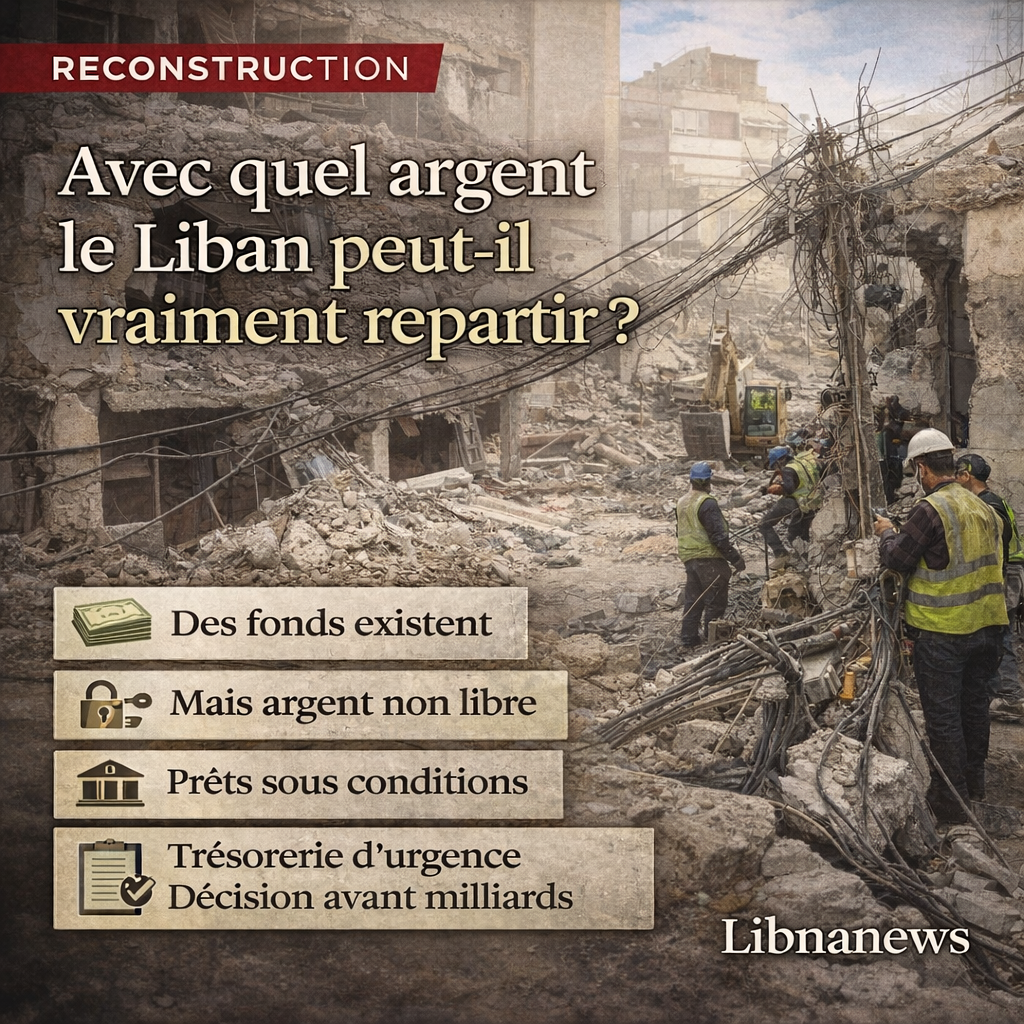
The truce moves the question of war to that of financing
The ceasefire did not only stop, at least temporarily, the pace of the strikes. He moved the centre of gravity of the national debate. As long as the war occupied all space, the emergency was first read as death, destruction, displacement and threat of recovery. As soon as the fire drops, another question arises with almost equal brutality: with what money will the country hold, repair, relocate, reconnect, rebuild. The truce does not suppress the crisis. It translates it into another language: amounts, arbitrations, loans, deposits, financing lines and the real capacity of an exhausted State to cope with a new burden.
This translation is crucial. It reveals that the war in Lebanon never ends on military ground alone. It is immediately extended in the public accounts, in the emergency hierarchy and in the old issue of available cash. Families return to damaged homes. The networks must be repaired. Roads, telecommunications, buildings and basic services require immediate resources. Yet reconstruction does not begin in a blank space. It begins in a country already plunged for years into monetary collapse, banking crisis, fiscal weakness and uncertainty about the very role of the Treasury.
The question must therefore be asked in all its hardness. Is Lebanon really short of money to the point of being unable to finance the first emergencies, or is it suffering mainly from a clear lack of resources and needs? The available evidence suggests a more complex response than the usual account of absolute lack. There are funds. There are loans. There are support circuits. There are discussions with donors. But none of this automatically produces a policy. What the truce reveals is not just the scarcity of money. This is the lack of consensus on how to use it.
Money exists, but it is not free
The first illusion to be ruled out is that of a completely empty state. The image of a Lebanon without any mobilised resources is politically convenient, but it does not say everything. Several amounts already exist, in different forms. Money is in the treasury. Loans have been negotiated previously. Other lines may be redeployed or reassigned. Social arrangements already have partial funding. International donors are working on intervention schemes. The real problem is elsewhere. This money is not free. It is either affected, politically contested, legally supervised or technically slow to mobilise.
This is where the node of the problem is played. A country in or out of war does not need only accounting resources. It needs politically available liquidity. Availability is not a purely financial concept. It depends on the will to arbitrate. Can we draw from a reserve when other fiscal or monetary gaps already exist. Can we redirect a loan for an area to a war emergency? Can funds be used without reopening a conflict over priorities, the Bank of Lebanon, the losses inherited from the crisis and the government’s credibility vis-à-vis donors.
In other words, Lebanon is not facing a blank page. It is faced with a strain of resources. This distinction is decisive. If the country had nothing, the question would be tragic but simple. But he has something. Just not enough authority, readability and coherence to quickly turn this something into public doctrine of recovery. The truce therefore acts as a revelation. It shows that the problem is not only the absence of a caisse. This is the absence of a clear chain linking the body, decision and enforcement.
The first level of reconstruction does not look like a big plan
When it comes to reconstruction, the political imagination often turns to major conferences, billions promised, structural projects and long-term announcements. Yet, the post-threshold begins much lower, almost at ground level. Telecommunications must be restored. We need to restore connections. Lines must be repaired, access reopened, buildings secured, affected areas cleaned, goods restored to a minimum, essential services operated. Reconstruction therefore begins with survival expenses, not with monumental projects.
That is precisely why the question of money arises so quickly. Major plans can wait a few weeks. The return of the inhabitants does not wait. The need for network, water, electricity, clearing, initial repairs and support for families is immediate. The funding required in this phase is not that of a national overhaul in several years. It is that of an emergency economy. But this emergency economy requires simple circuits, quick decisions and a truly activating cash flow.
In many countries, this phase is carried by a public apparatus capable of deploying an emergency fund, centralizing damage, advancing sums, and then negotiating refinancing with donors. In Lebanon, this pattern remains very fragile. Administrative capacity is uneven. State authority is weakened. The memory of the financial crisis makes any decision on politically flammable money. The result is a paradoxical situation. The country needs quick money for modest but decisive tasks, while its decision-making channels are structured for slow, disputed and often opaque compromises.
This contradiction is expensive. It transfers part of the shock on families, on municipalities, on private self-help networks and on technical operators trying to revive what they can even before the general financial framework is clarified. In this sense, the first money of reconstruction is not only that of the main international lines. It is the one that helps to prevent society from bearing the burden of immediate recovery alone for several weeks.
The return of the World Bank and donors does not solve the political emergency
The other common illusion is that the existence of loans or international partners will solve the problem in advance. In reality, the return of donors raises as many questions as it does. Lines of credit exist or may be extended. Social programmes may be strengthened. Loans for infrastructure can be mobilised. International meetings and contacts with financial institutions clearly show that Lebanon will not be left behind in the opening phase. But this must not mask the essential: a loan is not immediate and neutral money. It is a tool with its temporality, its conditions, its procedures and its own logic.
A loan can finance rehabilitation. It can support a social programme. It can serve as a basis for a revival. But it does not replace a national doctrine. He doesn’t say what should be a priority. It does not automatically cut between immediate relief and heavier reconstruction. Nor does it remove the question of absorption capacity. A weakened country can obtain financing without being able to quickly transform it into visible achievements, because the administrative, technical and political chain from lending to the field remains too slow or too fragmented.
Lebanon is fully aware of this risk. Recent history has shown that it can be the subject of promises, conferences and commitments without these amounts necessarily becoming a lever of coherent transformation. War adds another problem. It reinforces the temptation to redirect existing envelopes to the emergency, which is understandable, but can also deprive their meaning of programmes already designed for other needs. Arbitration becomes even more difficult. Should funds be used for structural policies in order to respond to the immediate shock, or should these envelopes be preserved in the hope of obtaining specific funding for the war. There is no simple answer, but there is an obligation: to decide.
What is missing most in Lebanon, in this phase, is perhaps not external money in itself. It is the political capacity to order it. Without this capacity, each support line remains valuable but partial. It helps without structuring. It relieves without prioritizing. It prevents complete collapse, but does not yet create the coherence of a credible recovery.
The real question is that of arbitration, not just that of the amounts
This is where the debate becomes more uncomfortable. For it requires asking a question that many prefer to avoid: if resources exist, why does the feeling of vacuum remain so powerful. The answer is in arbitration. Any exit from war requires a choice. Choose between social expenditure and infrastructure expenditure. Between direct support to households and network rehabilitation. Between visible public presence and safeguarding certain financial margins. Between relief financing and addressing the imbalances inherited from the banking and monetary crisis.
These choices are particularly formidable in Lebanon, because they do not take place in a peaceful institutional space. Each arbitration bears the memory of the other crises. Touching the money of the Treasury is reopening the question of the role of the state in the financial crisis. Redeployment of a loan means reopening the question of donor confidence. Strengthening social assistance means reopening the question of criteria, clientele and distribution capacity. Building on infrastructure is a risk of letting the most affected households wait too long. Everything’s holding up.
War therefore has this particular: it simplifies the need, but complicates the decision. Everyone sees that money is needed. No one can claim that there is no emergency. However, agreement on the order of priorities remains difficult. And it is precisely this order that is missing. A country can be poor and clear. It may also be less poor than it is said, but unable to politically order its means. In the current sequence, Lebanon is more like the second case.
This means that the battle for reconstruction will not only be won in international conferences or in global figures. It will play in the ability of power to establish a legible hierarchy. What do we finance first? How do we justify this choice? What funds can be mobilized immediately. What funds must be negotiated. What costs must be socialized. What deadlines are acceptable. Without this clarification, even an influx of resources may be lost in indecision or dispersal.
Reconstruction begins with a state treasury, not a billion-dollar dream
The public debate loves large numbers. They reassure or frighten. They give the impression that we are approaching reality. Indeed, the reconstruction of Lebanon will not begin with the promised billions, let alone a heroic narrative of rebirth. It will begin with a more trivial and decisive thing: the ability of the Treasury to advance money for the first emergencies. Without this capacity, everything else will remain suspended. Donors will expect clearer plans. Services will be within their means. The inhabitants will bear the burden of their own return longer. International promises will produce conferences, not effects.
Cash must therefore be put at the centre of the discussion. Not as an accounting subject reserved for specialists, but as a matter of practical sovereignty. A state exists first when it can cope with a shock without asking its society to carry the gap between disaster and external financing alone. A state exists when it can transform a budget line, a mobilizable deposit or a reserve available into real action. If he does not, he remains dependent on a time which is not that of the inhabitants.
This is probably the toughest point of the post-threat. Lebanon cannot wait until a major reconstruction plan is finalized to begin repairing, rescue, reconnecting and supporting. Nor can it act in a blurry state without risking aggravating budgetary and political confusion. He therefore needs an urgent doctrine. Not yet a doctrine of complete refoundation. But at least one doctrine of immediate use of its available resources.
This requirement seems technical. It is deeply political. She will say whether the ceasefire really opens a state phase or whether it only transfers to society, once again, the burden of surviving until better.
The country may not need more money first, but more decision-making
At the end of this observation, an idea is needed. Lebanon will obviously need external money, loans, aid, refinancing and international mobilisation. But in the immediate future, his major handicap may not be the pure lack of resources. This is the absence of a sufficiently clear decision on resources already there, or quickly accessible. As long as this political lock doesn’t jump, every discussion of the billions of futures masks the central weakness: the inability to make money available a useful money at the right time.
The truce therefore imposes a simple truth. Reconstruction is not first of all a contest of promises. It’s a government test. The country will have to show whether it can order its funds, prioritize its emergencies, operate its treasury, speak clearly to donors and send money down to networks, services and families. If it succeeds, the external supports will have an anchor point. If it fails, future funding may add to the long list of resources pledged and poorly transformed.
With what money to rebuild Lebanon after the truce. The most honest answer is therefore twofold. With money already there, if it is finally mobilized with clarity. With external money, if it then strengthens a credible national hierarchy. In the opposite order, the country would risk increasing support without ever building the political chain that gives them meaning.






