

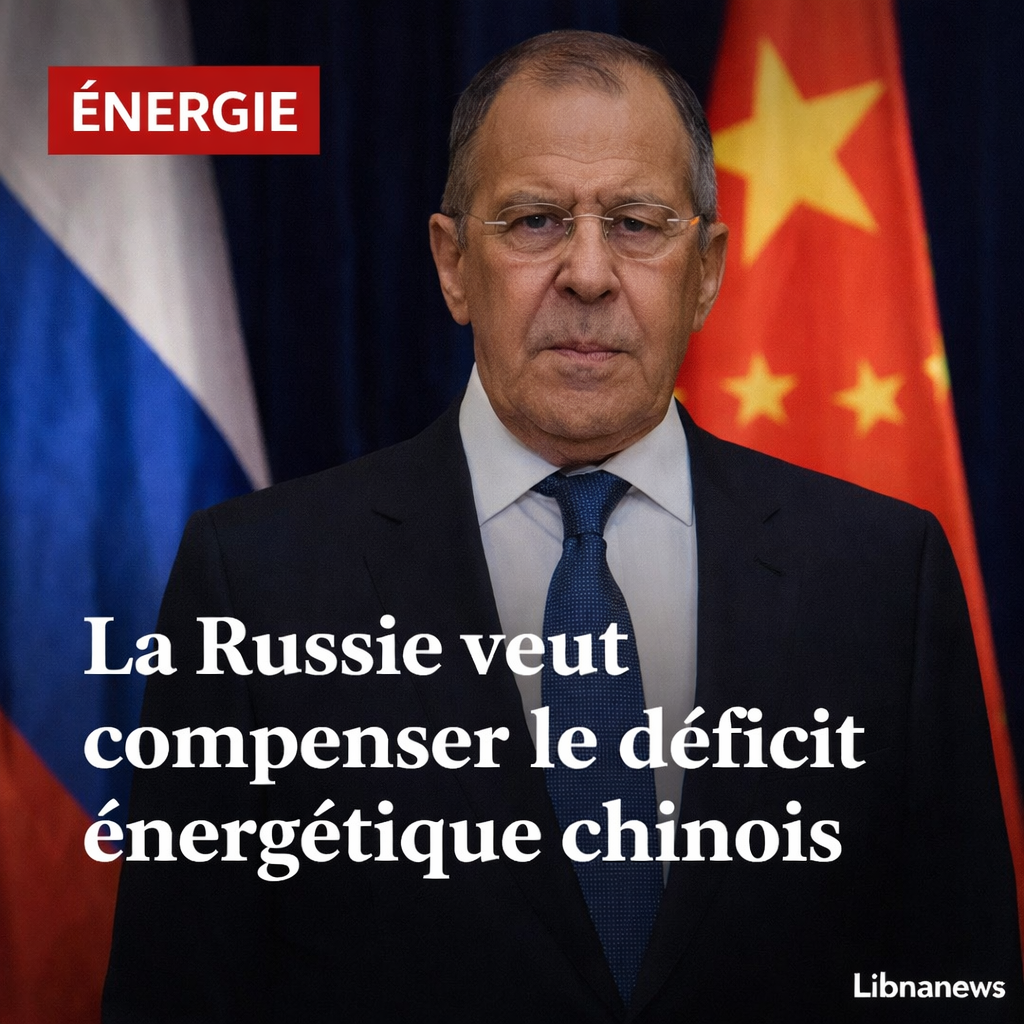
In Beijing, Sergei Lavrov not only repeated the usual formulas on friendship between Moscow and Beijing. The Russian Foreign Minister has chosen a much more concrete field: energy. By saying on Wednesday 15 April that Russia was prepared to compensate for the deficit suffered by China and other countries as a result of the war in the Middle East, he gave his visit an immediate strategic scope. In the same movement, he confirmed that Vladimir Putin’s visit to China would take place in the first half of 2026. Behind this sequence, Moscow seeks to demonstrate that it can be both a political partner, a crisis provider and an essential actor in a period when Xi Jinping is also preparing to receive Donald Trump.
A calibrated visit for a major geopolitical sequence
Sergei Lavrov’s visit is part of a dense diplomatic moment. Received by Xi Jinping at the Grand People’s Palace after interviews with Wang Yi, the head of Russian diplomacy has staged a bilateral relationship presented as stable, solid and useful in the face of the upheavals of the international system. On the Chinese side, the message was similar. Xi emphasized the « stability » and « certainty » of Sino-Russian relations, judging these qualities all the more valuable as the international environment became more unstable. The vocabulary is not a bad thing. Beijing and Moscow want to show that their coordination goes beyond the economic situation and resists external shocks, whether they come from Western sanctions, the war in Ukraine or the Middle East crisis.
In this staging, the announcement about Vladimir Putin is central. Lavrov confirmed that a visit of the Russian president to China was planned in the first half of 2026. This perspective gives an additional dimension to the Minister’s visit. It prepares the political ground, sets a horizon and recalls that the structuring decisions in the Russian-Chinese relationship remain marked by the personal link between Xi Jinping and Vladimir Putin. It also places Beijing at the centre of a singular international agenda. Donald Trump is scheduled to make a state visit to China on 14 and 15 May, the first US president in the country in eight years. Xi could therefore soon receive the two leaders who today, each in its own way, embody global strategic rivalry.
Why Moscow Speaks of Energy Now
If Moscow chooses to talk about energy with such insistence, it is first because the Middle East crisis has deeply shaken the flow. In 2025, the Middle East still accounted for about 52 per cent of Chinese oil imports. But since the outbreak of the war and the disruption of the exit roads of the region, this part has been brutally contracted. Between January and May 2026, crude exports from the Middle East to China fell by 28 per cent compared to the same period of the previous year, bringing the regional share to 31 per cent in May. For Beijing, therefore, the issue is not an abstract discourse on cooperation. It concerns the feeding of an economy which remains the largest oil importer in the world and whose energy needs weigh on all industrial arbitrations.
The tension is not just about oil. Chinese imports of refined fuels from the Middle East collapsed, while LNG and LPG purchases from the Middle East declined by 43% over the first five months of 2026. China has stocks and diversification margins, but the deterioration of the regional context has revealed a vulnerability that Beijing cannot ignore. It is in this breach that Moscow sniffs. By promising to « compensate » the deficit, Lavrov is addressing real concern. It offers China not only additional volumes, but also a geopolitical reading: faced with the instability created around the Gulf, Russia presents itself as a more predictable supplier than the sea routes today under tension.
This Russian offer is based on a simple logic. Since the invasion of Ukraine and the lasting break with the European market, Moscow has accelerated its momentum towards Asia. China has become the central market for oil, coal, gas and an increasing part of Russian exports of raw materials. The stakes are economic, but also political. Russia needs to show that it is not isolated. China, for its part, has an interest in keeping a neighbouring supplier, massive and less exposed than the Gulf to maritime hazards. This convergence does not mean that both countries are equal. Rather, it shows that each has a specific advantage in a more fragmented world.
What Russia Can Really Provide
Oil as the fastest response
Oil remains the most flexible tool in this relationship in the short term. In recent days, Sinopec has purchased between eight and ten shipments of Russian ESPO crude oil to replace disturbed Middle Eastern supplies. Each shipment represents approximately 740,000 barrels. This movement is important for two reasons. First, he points out that major Chinese groups are ready to return to the Russian market when circumstances so require. Then it shows that Russian logistics circuits to East Asia can be mobilized quickly. Chinese sea imports of Russian crude oil already reached 1.82 million barrels per day in March and 1.92 million barrels per day in April at this stage. In other words, Russia does not offer a theoretical promise: it increases already installed flows.
However, talking about total compensation would be excessive. The numbers say something else. In 2025, China imported nearly 3.6 billion barrels of crude oil, about 1.9 billion of which came from the Middle East. Russia can increase its deliveries, but it cannot replace only a regional package that weighed even more than half of China’s oil supplies last year. Moreover, data from 2026 show that, despite the increase in volumes from Russia and Brazil, total Chinese imports of crude oil continue to fall by around 10% over the first five months of the year. This means that Beijing continues to suffer from the shock and that it compensates for it through a mixture of diversification, stocks and demand adjustments.
| Indicator | Observed level |
|---|---|
| Middle East share of China’s crude oil imports in 2025 | 52 % |
| Share of the Middle East in China’s crude oil imports in May 2026 | 31 % |
| Decrease in crude exports from the Middle East to China between January and May 2026 | -28% |
| Chinese maritime imports of Russian crude oil in March 2026 | 1.82 million barrels/day |
| Chinese maritime imports of Russian crude oil in April 2026, at this stage | 1.92 million barrels/day |
Benchmarks arrested on 15 April 2026.
Gas as a more structural pillar
Gas adds another depth to this relationship. In 2025, Gazprom delivered 38.8 billion cubic metres of gas to China via the Power of Siberia pipeline, slightly more than the contractual level of 38 billion. This volume represents an increase of about 20% over 2024. Above all, it confirms that the Russian-Chinese infrastructure has now reached a high level of capacity. For Moscow, this is proof that an increasing share of its gas exports can be redirected to Asia. For Beijing, this is an additional safety net in a context where purchases of liquefied gas from the Middle East have declined. The pipeline does not respond to the emergency as a crude cargo, but it offers a continuity that counts over time.
However, this rise in power must not mask the limits of partnership. The Power of Siberia 2 project, which is regularly presented as the next major step in the energy rapprochement, remains constrained by price and trade negotiations. Progress was made in 2025, including an agreement to increase the volume of the existing axis and the signing of a legally binding memorandum on the future link via Mongolia. But Beijing holds hands. China knows that Russia has lost most of its European gas market and needs a new long-term customer. This asymmetry gives Beijing an advantage in tariff discussions and explains why political announcements do not always immediately translate into fully finalized contracts.
A strong but increasingly asymmetric partnership
The overall economic relationship also illustrates a reality more nuanced than it seems. In 2025, trade between China and Russia declined for the first time in five years. Bilateral trade fell to 1.63 trillion yuan, or $234 billion, down 6.5 per cent from the record of 2024. Chinese exports to Russia decreased by 9.9%, while imports from Russia fell by 3.4%. This decline does not undermine the political strength of the Sino-Russian axis. However, it recalls that a strategic relationship does not only live by symbols. It remains exposed to commodity prices, market slowdowns and sanctions constraints.
That is precisely why energy is now becoming the backbone of partnership. When other segments of the trade are hit, oil and gas retain a stabilizing function. For Moscow, they offer essential recipes and influence. For Beijing, they represent partial insurance against supply disruptions. Russia also benefits directly from the rise in prices caused by the regional crisis. The International Monetary Fund increased its growth forecast for the Russian economy to 1.1 per cent in 2026, compared with 0.8 per cent previously, due to higher oil and raw materials prices. In other words, the war in the Middle East reinforces both Russian export earnings and the geopolitical value of its energy supply.
The other issue is diplomatic. In receiving Lavrov, Xi Jinping again called for closer strategic cooperation, the defence of common interests and the unity of the « global South ». The Chinese authorities insist that both countries must assume their responsibilities as major powers and permanent members of the UN Security Council. This language is not just a dress. It allows Beijing and Moscow to present their rapprochement as a pillar of a more multipolar international order. Energy plays a political role in this narrative. It symbolizes the ability of both countries to help each other without going through Western-dominated circuits.
Lavrov pushed this idea further by saying that Russia and China had all the means to avoid dependence on what he described as US efforts to disrupt global energy markets through the Middle East conflict. The formula says a lot of Russian argument. Moscow is not just promising oil or gas. It proposes a form of common strategic autonomy. For the Kremlin, providing more energy to China also means demonstrating that US sanctions, trade pressures and diplomatic initiatives no longer prevent the emergence of alternative circuits between revisionist and non-aligned powers.
Xi between Trump and Putin
Beijing, however, does not reason in an exclusive logic of alignment. China is strengthening its ties with Russia, but at the same time maintains a much wider network of contacts. In recent months, Xi Jinping has received several Western and Asian leaders who want to revive or consolidate their relations with Beijing. This multi-storey diplomacy explains why Donald Trump’s visit, announced in mid-May, counts as much. For Xi, the challenge is to maintain control of balance. It is a matter of dialogue with Washington without weakening the partnership with Moscow, while avoiding a regional energy crisis reducing its room for manoeuvre.
In this game, Russia represents for China a useful but not exclusive solution. Russian crude can replace some of the Gulf flows. Siberian gas provides a basis for stability. Land lanes reduce dependence on maritime bottlenecks. But Beijing continues to diversify its purchases to other regions, including South America, and to mobilize its stocks. This means that China does not seek to substitute one dependency for another. It seeks to multiply options. This is why Lavrov’s offer has more value as a lever of resilience than as a total shift in China’s energy system.
The timetable gives this sequence a rare political significance. If Donald Trump arrives well in Beijing on 14 May and Vladimir Putin goes there in the first half of the year, Xi Jinping will be able to present himself as the only leader able to receive, within weeks, the two antagonistic poles of the world scene. For China, this centrality feeds the image of a power that has become indispensable to all. For Russia, it is a reminder that, despite Ukraine and sanctions, it remains at the heart of Beijing calculations. Lavrov’s visit therefore prepares more than a bilateral meeting: it organises a sequence where energy, crisis diplomacy and competition between major powers overlap.
Perhaps the most revealing reason is that Moscow today speaks of compensation even though China does not want to appear to be dependent on external relief. Beijing prefers to show that he arbitrator, whom he chooses, he negotiates. Russia needs to show its usefulness. Between the two, the agreement is real, but its nature is clear: China absorbs, sorts and redistributes; Russia offers, secures and values its resources. As long as the war in the Middle East continues to upset markets, this equation will continue to favour a deepening of the energy axis. The real question is how far this rapprochement of crisis will turn into a lasting dependency, as Xi seeks to calibrate, between Trump and Putin, the real hierarchy of Chinese interests.






