

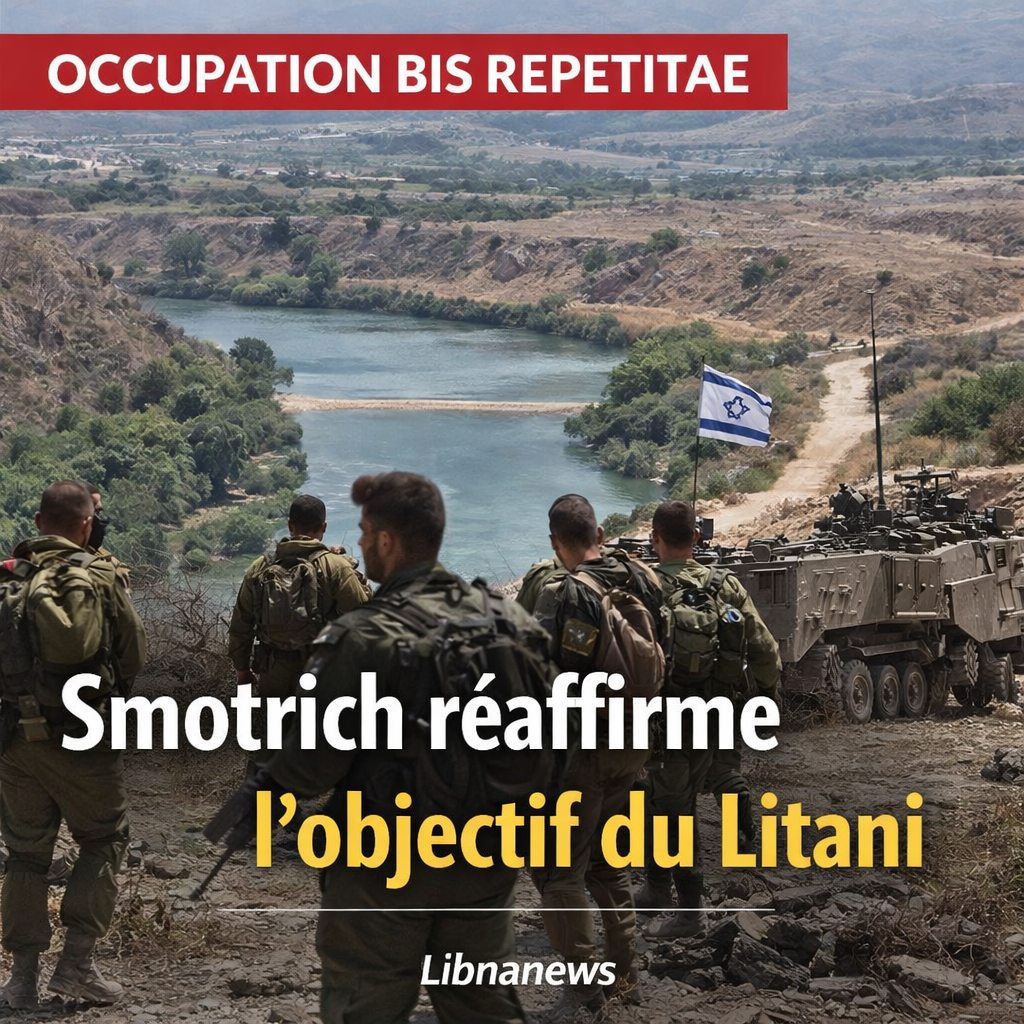
Bezalel Smotrich again posted on Monday a maximalist line on the Lebanese front. The Israeli Finance Minister declared that Israel was « committed to making the Litani the new security border of Israel at the end of this war, » presenting this objective as a promise made to the people of northern Israel. In his remarks, he linked this line to the idea of permanently removing the threat and allowing Israeli border communities to return to normal life.
This new declaration is part of an already very clear sequence. On 24 March, Smotrich had already claimed that the Litani River should become « the new border » with Lebanon, comparing this perspective with other buffer zones defended by Israel on other fronts. So Monday’s speech is not a break. Rather, it marks a public reaffirmation of a political objective already set a few days earlier and now placed at the heart of the Israeli government’s discourse on South Lebanon.
The choice of words matters. Smotrich is not just talking about a one-off military operation or a simple temporary defensive device. By referring to a « new security border », it gives this line a wider political scope. It is no longer just a question of repelling Hezbollah or securing some exposed Israeli localities. The aim is to impose a new territorial reality in southern Lebanon, with the Litani as a strategic reference line.
A line already advanced by other Israeli officials
Smotrich’s words don’t arise in a vacuum. They are extending an orientation already made publicly by other Israeli officials in recent days. Israel’s Defense Minister, Israel Katz, declared on 24 March that the Israeli army planned to control a band from southern Lebanon to the Litani and to establish a so-called security zone there. Several media also reported that the Israeli army presented the Litani as the new boundary of an expanded buffer zone.
This convergence between Smotrich, Katz and military spokespersons gives the sequence political coherence. The Finance Minister, the central figure of the Israeli far right, is pushing an openly expansionist line. The Minister of Defence outlines an operational logic of field control. The military apparatus speaks of an advanced defensive line. The vocabulary changes according to the actors, but the general idea remains the same: making the Litani the geographical threshold of a new security architecture imposed by Israel in the South Lebanon.
For northern Israelis, Smotrich presents this as a guarantee of sustainable return. He quoted the localities of Kiryat Shmona, Metula, Shlomi and other border settlements, saying that this time their inhabitants would return « to stay ». Again, the formula is not trivial. It seeks to transform a military operation into an internal political commitment, addressed directly to an Israeli electorate that has been living for months under the threat of the northern front.
The Litani, much more than a military landmark
The Litani is not just a topographical detail. The river crosses southern Lebanon at a significant distance from the Israeli border and has long been a central reference in the discussions on Lebanese security, sovereignty and the presence of Hezbollah in the south of the country. To refer to the Israeli defensive logic as a « new security border » is to move far north. For Lebanon, this would mean that a large part of the South would be treated as a space of military control or permanent pressure.
This point explains the regional scope of the declaration. Smotrich not only describes a tactical objective. It takes up an idea that, seen from Beirut, looks like a unilateral redefinition of the terrain. The Associated Press noted that this logic revived Lebanon’s fear of prolonged occupation comparable to that carried out by Israel between 1982 and 2000. The historical memory weighs heavy, as any lasting Israeli advance south of the Litani or up to the Litani immediately reactivates this precedent in the Lebanese debate.
In fact, Smotrich’s vision also echoes concerns arising from the destruction of bridges, road strikes and Israeli ground advances identified in recent days. Several reports pointed out that Israeli military pressure on the South was no longer limited to targeted strikes, but accompanied by a logic of land transformation. In this context, the Litani no longer appears merely as an abstract line. It becomes a political objective.






