

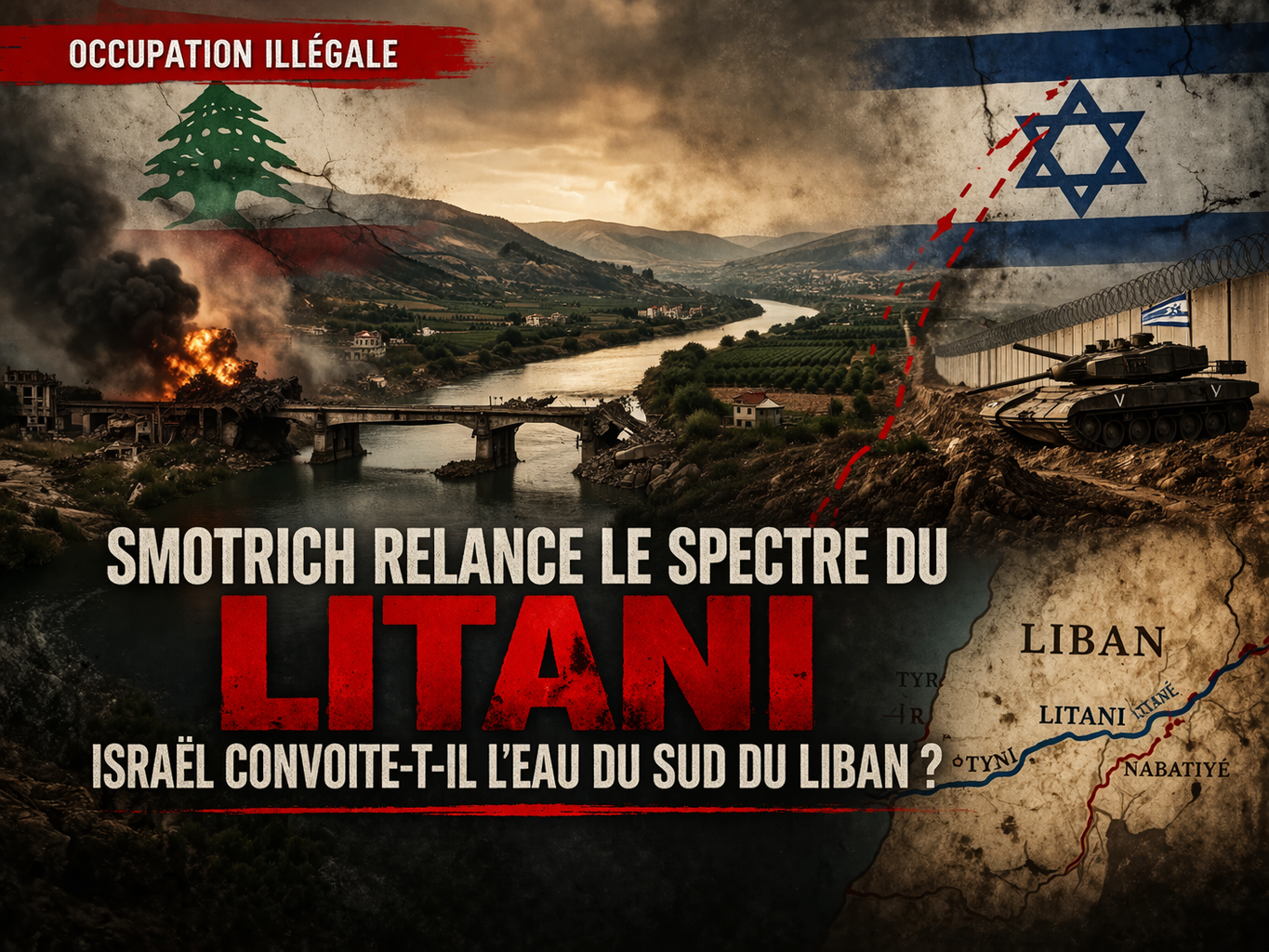
Bezalel Smotrich’s call to annex southern Lebanon to the Litani immediately revived an old concern in Lebanon: behind the military objective against Hezbollah, does Israel also seek to get hold of the South? The Israeli Finance Minister said that the military campaign must end with a « totally different » reality and that the « new Israeli border » must be the Litani. At this stage, this is the most explicit statement by a member of the Israeli government in favour of a lasting redistribution of the Lebanese border. It intervenes when Israel also hit bridges on the Litani and ordered the accelerated destruction of infrastructure to the south of the river.
The formula chosen by Smotrich is politically explosive for a simple reason: the Litani is not just a geographical landmark. It is the main river entirely Lebanese. It irrigates an essential part of the southern part of the country, feeds agricultural, hydraulic and electrical uses, and has been central to Lebanese strategic imagination for decades. Britannica recalls that the Litani River is Lebanon’s main river, while academic reference works stress that it flows entirely within Lebanese territory, making it a particularly sensitive national asset.
The question raised today is therefore not marginal. Yet it deserves a rigorous response. Yes, the idea of an Israeli interest in the Litani has long existed in historical and geopolitical literature. Yes, Smotrich’s call directly reactivates this old file. But no, the evidence available at this stage does not make it possible to state, as an established fact, that the current offensive would first aim to capture water from southern Lebanon. What can be said, on the other hand, is that the explicit reference to the Litani, together with the destruction of infrastructure and the idea of a new frontier, gives the centre an old suspicion: that of a war that would not only be waged on security, but also on the sustainable control of strategic resources.
The Litani, a strategic river far beyond the military map
The Litani is not just a stream. It is a major natural infrastructure for Lebanon. Its basin is at the heart of irrigation, hydropower and water supply projects, and its economic importance far exceeds the only southern border. Britannica recalls that the river irrigates one of the most important agricultural areas in the country. The Litani Authority continues to present the river as a central lever for Lebanese water and energy projects. In a country affected by shortages, power failures and climate pressures, this dimension further enhances its strategic value.
This centrality explains why the Litani exceeds, in the Lebanese public debate, the only military reading. When an Israeli official speaks of the river as a future border, he does not only designate a defensive line to the north. It also refers to a space containing water, agricultural land, roads, bridges and vital infrastructure. The striking of several bridges on the Litani in recent days accentuates this feeling. Officially, Israel says it wants to prevent Hezbollah from moving fighters and weapons south of the river. But for Lebanon, these attacks on bridges and roads also affect the material conditions of civilian life and reinforce the idea that the Litani becomes a total strategic object.
It should also be noted that the value of Litani is not limited to raw water. Controlling a river, or even simply the surrounding area, is a burden on trade, access, crossings and the organisation of space. The battle around the Litani therefore concerns both hydrology, mobility and territorial sovereignty. This makes Smotrich’s sentence heavier than a statement of circumstance. It touches on a line where geography, war and the political economy of the South join together. This reading is an inference based on the function of the Litani in Lebanese space and on the recent sequence of Israeli strikes on its bridges.
An old geopolitical obsession comes back
The idea of an Israeli interest in Lebanese waters, and in particular in the Litani, is not dated today. Ancient academic works, but still cited in the literature, recall that the Litani has long occupied a place in some Zionist and Israeli reflections on the regional water. As early as 1993, geographer Hussein Amery wrote that the desire to gain access to Litani waters had marked part of Israeli strategic thinking in the 20th century. The JSTOR summary of his article explicitly notes that David Ben-Gourion mentioned, as early as 1941, the importance of Litani from a regional perspective.
This past must not be used lightly. Between historical ambition, strategic debates, war memories and current government policy, there is always a gap that must be carefully documented. But this background explains why Smotrich’s statement caused such an echo in Beirut. It does not fall on neutral terrain. It reactivates an ancient imagination in which the South is not only seen as a depth of security for Israel, but also as a space with coveted resources. It is this hydropolitical memory that today gives the sentence on the Litani a much stronger charge than just a slogan of war.
It should also be noted that this memory is not only Lebanese. It belongs to all the hydropolitical history of the Middle East, where rivers, groundwaters and watersheds have often been at the heart of conflicts, sharing projects and power strategies. The Litani, because it is entirely Lebanese but close to Israel, has always occupied a singular place in this debate. The brutal return of his name to the political foreground was therefore not annoyed. It reconnects the ongoing war on a long regional history of rivalries around the water. This last sentence is a historical synthesis from the academic sources consulted.
Smotrich speaks of a border, not explicitly water
This is where an essential nuance must be introduced. In public statements, Smotrich does not explicitly refer to water, irrigation or hydraulic capture. He speaks of a border, annexation and a new territorial state of affairs. Reuters points out that his appeal is part of an intense war sequence and a manifest desire to produce a « different reality » in southern Lebanon. In other words, the official Israeli speech put forward in this phase remains first of all security and territorial.
To say that Israel « covets the water of southern Lebanon » must therefore be formulated as a credible political and historical hypothesis, not as evidence already established of the immediate objective of the offensive. This is crucial to avoid shortcuts. There are now proven facts: Smotrich’s call for an annexation to the Litani, the strikes on the river bridges, the destruction of infrastructure and military intensification in the south. There is also a historical background on Israeli interest in the Litani. But between these two levels, the direct link must be presented as a reading, not as an Israeli official document already produced black on white. This caution reinforces the analysis rather than weakens.
This does not prevent an important political conclusion from being drawn. Even if not directly speaking of water, making the Litani a « new border » is tantamount to placing under threat an area whose water constitutes one of the main strategic issues. The result for Lebanon would be the same in terms of sovereignty: the pressure would not only be on a band of territory, but also on one of its main hydraulic assets. In this sense, water is well present in the case, even when it is not named in the face. The last sentence relates to an inference based on the nature of the Litani as a major national resource.
The destruction on the Litani reinforces suspicions
Smotrich’s statements don’t come in a vacuum. They add to a series of military actions directly targeting the Litani space. On 18 March, Reuters reported the destruction of two bridges on the river, and on 22 March, the Israeli Defense Minister ordered the destruction of all the Litani bridges and the accelerated demolition of homes near the border. These facts are major, because they show that the Litani is not only invoked in the discourse: it also becomes an axis of military action.
Officially, Israel presents these strikes as a means of preventing Hezbollah from transferring weapons and fighters to the south. But on the ground, their effect far exceeds this stated objective. Destroying the Litani bridges amounts to disrupting civilian traffic, complicating evacuations, slowing down relief and further isolation of certain localities. This reinforces the idea, which is very present in Lebanon, that the campaign affects the very structure of the southern territory. When, in this context, an Israeli minister refers to annexation to the Litani, many logically see it more than an anti-terrorist operation. They read the drawing of a new territorial order.
It is this combination of discourse and acts that today feeds the thesis of a lust for water. Not because an official Israeli document would already say that it wants to pump the Litani, but because the river is treated as a military, political and infrastructural line. The more the Litani becomes the object of a territorial battle, the more inevitable its hydraulic dimension becomes in Lebanese reading of the war. This proposal is an analytical synthesis based on the sequence of Israeli strikes and statements.
Israel has changed since the great water battles, but the suspicion remains
Another element must be taken into account to avoid too much mechanical reading. Today’s Israel is not that of decades when access to regional freshwater more acutely structured its vulnerability. The country has developed desalination and water technologies massively, to the point of being often cited as a very advanced regional player in this field. Recent analyses of the region recall that desalination has become a central part of Israeli and Middle Eastern water security.
This does not mean that water has ceased to be strategic. Rather, this means that Israel’s argument for an immediate and vital water need must be handled with more nuance than in the past. Interest in the Litani, if it exists today, could be less of an absolute need for supply than a broader logic of territorial control, geopolitical pressure and securing a space deemed strategic. In other words, water remains a power factor, even when it is no longer the only engine. This distinction is essential to understand the current debate.
That is precisely why the phrase « Israel covets the water of southern Lebanon » must be understood as a political reading grid, not as a self-sufficient slogan. It refers to a real history, a real resource and real statements about the Litani. But it must be linked to the evolution of Israeli water capacity and the current centrality of the security registry. The strongest analysis is therefore that of a possible convergence between security, territory and resource, rather than that of a war reduced to a single hydraulic mobile.
What Smotrich’s sentence really reveals
In essence, Smotrich’s sentence may say less explicit hydraulic intent than a desire to reconfigure southern Lebanon in a sustainable manner. Making the Litani the « new border » means moving the Israeli security line far north. This potentially implies a profound transformation of the territory: emptied villages, cut roads, destroyed infrastructure, return of the inhabitants made more difficult and Lebanese sovereignty amputated. In such a scenario, water is not a detail. It is part of what would be lost or placed under threat.
Therefore, the question of water cannot be separated from annexation. Even if the Israeli objective remains military, the effect of annexation to the Litani would also affect the resources, agriculture, hydropower and autonomy of an already weakened South. The Litani line is not a diplomatic abstraction. It is a very concrete threshold of sovereignty. To speak of it as a new frontier is indeed to open a debate on the control of space and what it contains. The last sentence is an inference drawn from the strategic nature of the Litani Basin for Lebanon.
The right conclusion today, therefore, is that:Israel does not officially say that it wants water from southern Lebanon, but by making the Litani a border to be annexed, it de facto places this water at the heart of the battle.This explains the strength of the Lebanese suspicion, and this gives Smotrich’s statement a much heavier scope than a simple verbal auction.






