

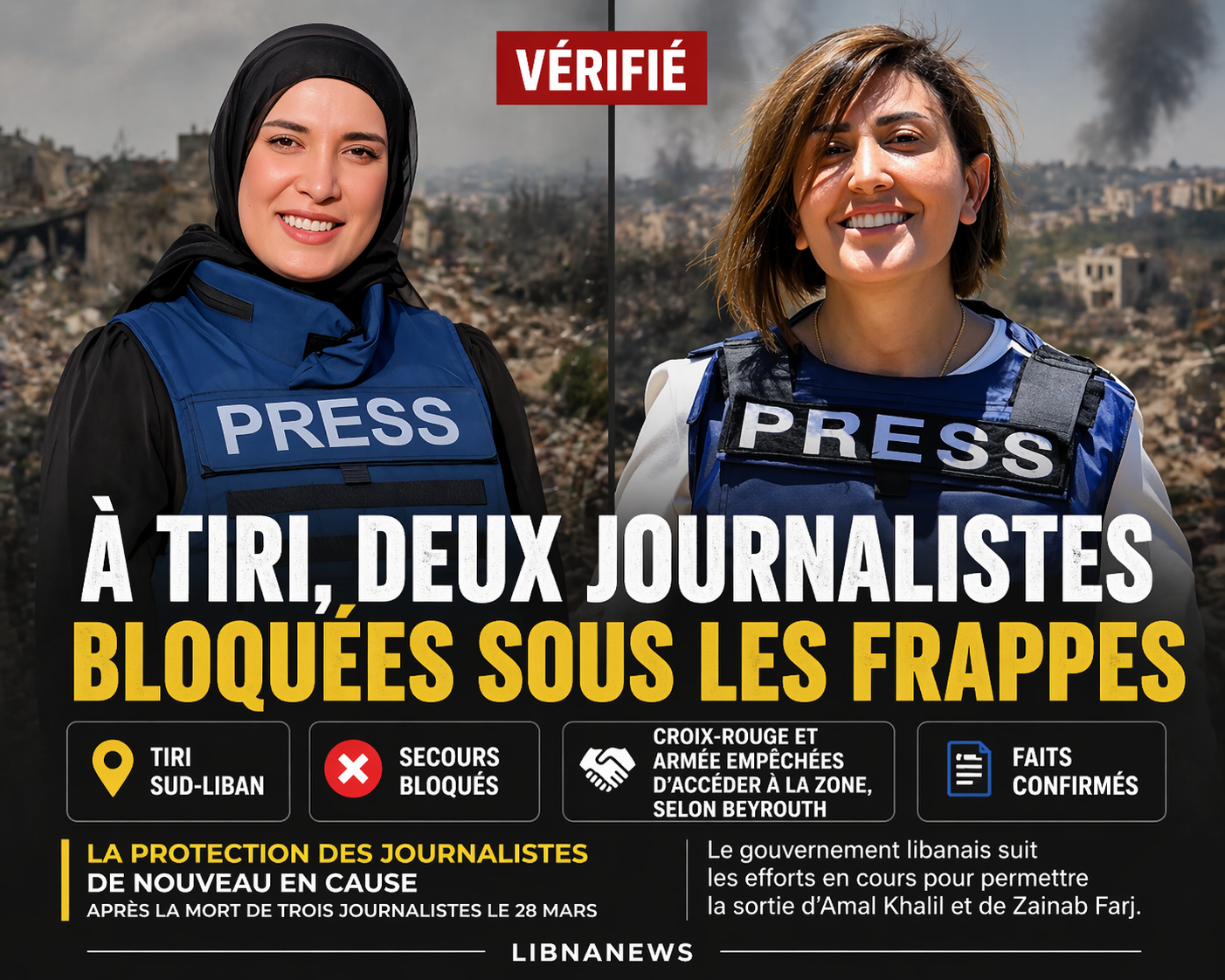
The information that circulated on Wednesday afternoon about the situation of two journalists blocked in the town of Tiri, in southern Lebanon, was numerous, sometimes fragmentary, sometimes contradictory. However, the evidence publicly confirmed at this time provides a clear basis. Two Lebanese journalists, Amal Khalil and Zainab Farj, were blocked in the Tiri area as Israeli strikes hit the area. Lebanese news minister Paul Morcos said that Israel was preventing the Lebanese Red Cross and the Lebanese army from reaching them. The Lebanese Government has indicated that it is following the contacts that are under way to allow them to exit. On the other hand, several details widely disseminated throughout the day, including the exact chronology of several strikes, on the precise road cut and on the final outcome of the evacuation, were not yet subject, at the time of writing, to full and converging confirmation by all the official channels consulted.
The incident is part of an already very heavy sequence for journalists in South Lebanon. Since the war resumed in March, information professionals have been paying an increasing price on the ground. On 28 March, three journalists were killed in an Israeli strike in the south of the country. A few days later, the Minister of Public Information had resumed contact with UNIFIL to discuss mechanisms to protect the press teams. Then, on 15 April, he wrote to the relevant UN Special Rapporteur, via the Ministry of Foreign Affairs, about the targeting of journalists. It was in this context that media security deteriorated sharply that the Tiri episode occurred.
Two journalists blocked in the Tiri sector
The names that come back in all the stories available are those of Amal Khalil and Zainab Farj. The two journalists were on Wednesday in the town of Tiri, Bint Jbeil district, when the area was hit by Israeli strikes and access to the area became extremely difficult. The central point confirmed by a public statement by the Lebanese Minister of Information is that the two journalists were then out of immediate reach of relief.
According to Paul Morcos, Israel besieged the two journalists in Tiri and prevented the Lebanese Red Cross and the Lebanese army from joining them. This statement is, at this time, the clearest official element on the operational situation on the ground. It confirms both the existence of a blockade, the role of the two journalists, their general location and the difficulty of humanitarian or security access to the area.
In the afternoon, Lebanese media broadcast more detailed versions, including a second strike that cut off a road to prevent the arrival of ambulances, followed by the entry of a Red Cross team into the locality to evacuate the two journalists. These elements circulated rapidly and were relayed in many local channels. However, at the time of writing, not all had been corroborated with the same degree of accuracy by the official channels consulted.
Caution is therefore required on the exact sequence of strikes and the final status of the evacuation. What is confirmed, however, is that the two journalists were blocked in an area under fire, that the aid could not reach the area freely according to the Minister of Information, and that efforts were under way to allow their exit.
The Lebanese government is following the exit efforts
In the local news broadcast on Wednesday, it was also reported that Prime Minister Nawaf Salam, with UNIFIL command, was following efforts to allow the exit of the journalists detained in Tiri. This clarification was relayed by Lebanese audiovisual media. It is part of a context where Nawaf Salam was actually in Paris for a series of diplomatic talks with the French authorities.
In strictly factual terms, this information adds to Paul Morcos’ statement on the blockade of the Red Cross and the Lebanese army. She suggested that the monitoring chain should not be limited to the Ministry of Information, but should also involve the Presidency of the Council and UNIFIL. At this time, the element fully confirmed by accessible sources remains the existence of ongoing contacts and efforts to get journalists out. The full outcome of these efforts was not yet documented in the same way in all official channels consulted.
The role of UNIFIL in such a situation was not unusual. The UN mission is regularly requested to facilitate access to certain areas, to carry messages between the parties, to secure windows of movement or to support the movement of rescue teams in the most exposed areas. In this case, however, no detailed mission release, available at the time of writing, yet provided an exhaustive timeline of the incident or its outcome.
A new episode in an already deadly war for the press
The Tiri incident occurred less than a month after one of the most serious episodes for the media in Lebanon since the war resumed. On 28 March, an Israeli strike in the southern part of the country killed Ali Shoeib, a journalist for Al-Manar, as well as Fatima Ftouni, a journalist for Al-Mayadeen, and her videographer brother Mohammed Ftouni. The chains concerned claimed that their vehicle had been hit while covering the fighting.
The Israeli army acknowledged that it targeted Ali Shoeib, whom it presented as a member of a Hezbollah intelligence unit, without providing any public evidence to support this accusation in its initial communication. She did not claim the death of the other two journalists in the same speech. The Lebanese authorities have condemned a crime against civilians protected by their professional status.
As a result of the March strike, information minister Paul Morcos stepped up his efforts. He publicly denounced what he described as repeated attacks on journalists. The NNA then reported on a Minister’s meeting with UNIFIL on concrete measures to protect journalists while travelling to the South. Then, on 15 April, the agency reported that an official letter had been sent to the UN Special Rapporteur on the issue of targeting journalists.
The file is not only Lebanese. On 2 April, UN experts called for an independent international investigation into Israeli attacks against journalists in Lebanon. This took place a few days after the death of the three journalists on 28 March. It has strengthened the international dimension of the topic, already relayed by several press organisations.
Recent precedents around Amal Khalil
The name of Amal Khalil does not appear for the first time in the security alerts of journalists. Already in September 2024, Al-Akhbar’s journalist had publicly stated that she had received a threat from an Israeli number ordering her to leave southern Lebanon. This threat was then relayed by Lebanese media. This background does not allow a direct connection to the Wednesday incident in Tiri, but it sheds light on the particular vulnerability of long-standing reporters on the front line.
Since March 2026, the situation has worsened significantly. Reuters reported on 28 March that the Committee for the Protection of Journalists had already identified several media professionals killed in Lebanon, Iran and Gaza since the beginning of the regional war opened in late February. Professional organizations and press associations have, for their part, increased their warnings about the increasing risks faced by journalists who continue to work in southern Lebanon.
To this are added the physical constraints of war. Roads cut off, restricted access areas, destruction, repeated strikes, the presence of drones, traffic restrictions and difficulties of coordination with relief, make each field cover a high-risk operation. Tiri’s episode is part of this increasingly dangerous daily reality.
A zone under permanent tension
The town of Tiri and, more broadly, the Bint Jbeil area are in an area where Israeli military operations and movement restrictions have intensified since mid-April, despite the announced temporary truce between Israel and Lebanon. Israel has issued new maps calling on the inhabitants of several sectors of southern Lebanon to stay away from areas that it considers dangerous and not to approach the Litani. In this context, many localities have remained partially inaccessible, either because of strikes, destruction or military bans or warnings. For both journalists and relief workers, this situation complicates any rapid intervention. Ambulances, rescue teams and sometimes even Lebanese Army units must negotiate access to areas where the front line remains moving.
The Tiri incident, in this context, shows how journalistic coverage in southern Lebanon now depends on an extremely unstable environment. It also shows that the issue of protecting journalists is no longer limited to direct strikes against press teams. It also concerns access to the injured, the possibility of evacuation and the ability of relief personnel to enter a bombed area.
The Tiri episode adds, in any case, a new issue to the already heavy litigation between the Lebanese state, press organisations and Israel on the protection of journalists in war zones. At that time, Beirut had already seized the United Nations on this issue and the security mechanisms supposed to limit the risks to the media were still under consideration with UNIFIL a few days earlier.






