

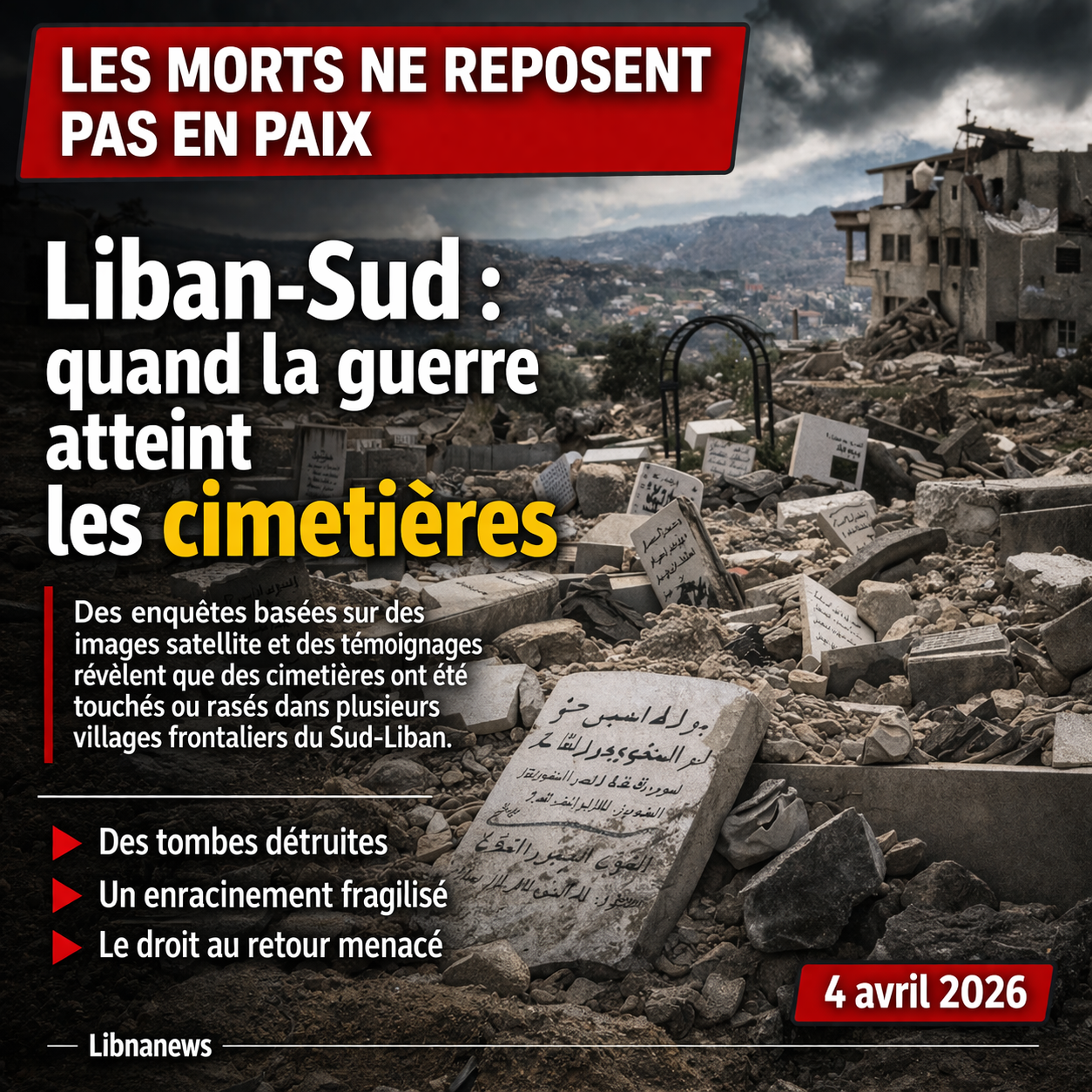
In southern Lebanon, destruction no longer affects only houses, roads, orchards or mosques. Surveys based on satellite images and testimonies also indicate that cemeteries have been damaged or razed in several border villages. This shift changes the very nature of what people perceive. When a war is also taken at graves, it not only destroys the building. It reaches the most intimate landmarks of a community: filiation, memory, right of return, bond to the ground. Taken with Israeli statements on the destruction of border villages and the maintenance of control up to the Litani River, these facts fuel an increasingly clear reading in Lebanon: beyond the military objective against Hezbollah, it is also the very possibility of territorial, social and symbolic continuity that is being sought.
Cemeteries now included in the destruction map
For months, images from the South showed broken houses, high streets, olive groves turned by bulldozers. But another element has gradually emerged in documented field investigations: cemeteries are also among the damaged or destroyed sites. Amnesty International wrote in its August 2025 survey that affected structures in southern Lebanon included houses, mosques, cemeteries, roads, parks and football fields. The organisation relies on verified videos and satellite analysis of 26 border municipalities between the end of September 2024 and the end of January 2025. It also claims that in several cases the destruction was carried out by means of manually laid explosives and bulldozers while Israeli forces were already controlling the areas concerned.
One of the most precise passages concerns Odeisseh. Amnesty writes that satellite images show that between 12 October and 7 November 2024, the village centre and other peripheral areas were destroyed, « including a mosque and a cemetery ». In Kfar Kila, the organization also reports the testimony of a resident that her grandparents’ house, her relatives’ houses, their orchards, « her parents’ graves » and a mosque were destroyed. Taken in isolation, these elements could be referred to the general brutality of the war. Taken together, they make up something else: a scheme in which the spaces of the dead are not spared, even though they have a family, religious and territorial value that goes far beyond their funeral function.
The word cemetery has, in this context, a stronger reach than that of a simple damaged civilian site. A grave is not just a physical trace. It is the visible inscription of a line in a place. In the villages of southern Lebanon, she connects a family to land, local history, a cycle of seasons, bees, visits and rituals. When the cemetery disappears, it is not only a piece of the landscape that disappears. It’s evidence of rooting that’s flickering. And that is precisely what gives these destructions a political and symbolic burden so heavy in the eyes of the displaced inhabitants. This interpretation is an analysis of the social meaning of such destruction; It does not replace the judicial establishment of responsibilities, but it helps to understand why these images produce in Lebanon a shock distinct from that caused by the destruction of an ordinary building.
The question is no longer only military
Israel justifies part of its destruction in the name of military necessity. According to Reuters, the Israeli army and authorities claim that certain houses, infrastructure or civilian areas were used by Hezbollah for weapons, firing positions or tunnels. But the same dispatch also reports that Israel’s Defense Minister, Israel Katz, declared on 31 March that Israel would destroy « all houses » in Lebanese villages close to the border and that security control would be maintained to Litani, while displaced inhabitants would not be allowed to return south of the river until security in northern Israel was guaranteed. A Stanford Law Professor quoted by Reuters believes that such widespread destruction does not meet the threshold of « absolute military necessity » required by the law of war.
Here the destruction of cemeteries takes on a different meaning. A house can be presented by an army as a suspicious site. A road can be described as a logistics route. An orchard can be seen as a screen or corridor. But a cemetery is much less suitable for this general argument, especially when it is destroyed in a wider range of demolitions that already target homes, religious places, public spaces and civil infrastructure. Amnesty also notes that in Maroun al-Ras, the Israeli army has itself shown that it can in some cases neutralize an underground infrastructure near a cemetery by filling it with cement, without mass destruction on the surface. This does not invalidate any military argument in any circumstances, but it shows that there are less destructive alternatives.
In other words, the debate no longer focuses solely on the existence of a specific military objective. It covers scale, method and overall logic. When whole villages are methodically razed, residents are prevented from returning and political statements explicitly evoke a lasting control of space up to Litani, the destruction of cemeteries ceases to appear as marginal damage. It is part of an environment where the material transformation of the territory itself becomes an instrument of war. It is this articulation between discourse, means and effects that today feeds the thesis, very present in Lebanon, of a strategy of de facto occupation and denial of local identity. This thesis is a political reading based on converging indices; its possible legal qualification depends on the competent authorities.
Clearing the dead means weakening the right to return
In contemporary conflicts, return never depends solely on a ceasefire. It depends on the existence of a house, a road, a water network, a school, a mosque, a town hall. But it also depends on an invisible tissue: the markers that tell a family that it is at home. The cemetery is one of these landmarks. There are parents, grandparents, sometimes entire generations. We come back for funerals, commemorations, religious holidays, gestures of memory. When these places are destroyed, the return becomes more difficult to imagine, even if the war stops. We do not return in the same way to a village where the dead no longer have a clearly preserved place.
International humanitarian law goes in this direction. The International Committee of the Red Cross recalls, in its basis on customary law, that « deaths must be treated with respect and their graves respected and properly maintained ». The ICRC also stresses, in a document on the protection of the dead in conflict, that the dignity of the deceased and the preservation of places of burial are not merely a moral issue: they are part of the obligation to protect families, the identification of bodies and the social fabric itself. Destroy or alter graves, therefore, not only touches stones. It also compromises the continuity of family memory and, sometimes, future possibilities of truth and identification.
In Lebanon, this dimension is even more sensitive. The country has already experienced prolonged displacements, empty border villages, houses rebuilt and again threatened. In this context, the grave often acts as the last stable sign of a presence. Even when the houses were destroyed, the families still say: our dead are there. If this marker disappears in turn, the link to the place becomes more vulnerable. That is why, in many conversations in the South, the destruction of cemeteries is understood not as degradation among others, but as an attempt to achieve what remains when everything else has already been struck. It is a very strong social and political perception, which feeds both documented facts and the experience of the displaced.
A territory reshaped by the bulldozer
The term bulldozer continues to be used in investigations in southern Lebanon. Amnesty claims that many of the destruction was carried out by heavy devices and explosives, including after the November 2024 ceasefire came into effect. The organization estimates that more than 10,000 structures have been severely damaged or destroyed in the areas studied. In some municipalities, more than half of the building has disappeared; In Yarin, Dhayra and Boustane, more than 70 per cent of the buildings were destroyed, according to his analysis. This is as important as the final assessment. A strike can destroy. A bulldozer reconfigures. It erases the frame of a place, flatens the contours, removes familiar boundaries, turns a village into an available surface.
The destruction of cemeteries is precisely in line with this logic of remodeling. A cemetery is not a mere plot. It is a space ordered by names, links, the topography of memory. The shave is to produce a vacuum that exceeds the immediate material effect. It is making it more difficult for those who lived there to re-appropriate the place. It is also, in some cases, blurring the traces. In a report on the mass graves in Iraq, the OHCHR pointed out that any disturbance of a funeral site can compromise its probatory value and weaken the prospects for justice and accountability. The case is not identical here, but the principle remains: touching the places of the dead also has consequences on the future ability to document, identify, commemorate and claim.
This territorial dimension is reinforced by recent Israeli political statements. Reuters reported that the announced target includes a security zone to Litani and a return ban for displaced persons from southern Litani until Israeli security conditions are met. When a military power claims to want to destroy all villages close to the border and keep control of the land, the disappearance of cemeteries no longer appears as a peripheral accident. It is becoming one of the signs of a wider enterprise of requalification of space: less a temporary front than a territory to make uninhabitable, or at least difficult to rehabitable, for its original inhabitants.
Destroy symbols, reach identity
Another element reinforces this reading. Amnesty’s investigation of Maroun al-Ras devotes several passages to the destruction of the « Iranian garden », a leisure and walking park that included a replica of Al-Aqsa Mosque. The organization cites an Israeli military document describing this destruction as « a significant operational, symbolic and mental achievement ». Amnesty points out that she found no evidence that the garden was in itself a military objective, and considers that its destruction should be investigated as a war crime. This passage is important because it shows that, in at least one documented case, the assumed issue was not only tactical. It was also a symbol.
A cemetery is, by definition, a symbolic place. It condenses religion, kinship, transmission, the continuity of the village. When such a space is destroyed in a campaign where other civil and cultural elements are also erased, the hypothesis of a war also waged against identity markers becomes difficult to rule out in Lebanese public debate. Here again, caution is required: only judicial work can attribute a specific intention to each act. But in the political and sociological analysis of the conflict, the question is now asked openly. Destroying graves, is it only destroying a physical space, or is it attacking the presence of a group in the long time? The elements gathered in the South are inviting more and more votes to retain the second reading.
The idea of « evacuation » is not alien to the international vocabulary on the destruction of cultural property. UN experts have, in another context, warned that the deliberate destruction of sites, objects and institutions of historical and religious significance may be the result of an attempt to erase identity. The parallel is not an automatic qualification of the Lebanese case. It simply indicates that the international community has long recognized that some destruction is not neutral. They target communities in what they transmit, not just in what they own. It is this register that is particularly affected by the destruction of a cemetery.
South Lebanon facing a long-term war against its ties
What is happening in the South today is not only the survival of villages under fire. It is also the ability of these villages to remain villages, i.e. places named, inhabited, told, recognized. Reuters reports that more than 1.2 million people have been displaced in Lebanon since the offensive launched on 2 March 2026. In such a context, the question is not only of the number of internally displaced persons, but of what they will find, or not, when they return. A destroyed house can sometimes be rebuilt. A road can be redone. But when places of memory, graves, religious landmarks and common spaces disappear at the same time, reconstruction becomes infinitely heavier. It’s not just about walls anymore. It concerns membership.
Article 115 of the customary law recalled by the ICRC seems almost minimal in the face of the magnitude of the shock: to respect the dead, to respect their graves, to maintain them properly. Yet, in the crash of war, this rule says something essential. It sets a limit. It recalls that there is a threshold beyond which violence no longer affects only combatants or even civilians, but the possibility of a society continuing to tell itself. This is the threshold that many Lebanese feel they are crossing when southern cemeteries are reached. To them, we don’t just destroy a past. We are preparing a future without a simple return, without obvious continuity, without any certainty of still finding evidence of the link to the ground.
That is why the destruction of cemeteries resonates with a particular intensity. Because it touches the point where the war ceases to be only an armed confrontation and becomes a battle over the very presence of a community. The dead in South Lebanon are not outside the conflict. They become one of the last material witnesses. And when these witnesses are in turn erased, it is the whole question of territory, of the sovereignty lived and of the local identity that is brutally posed, beyond the lines of the front.






