

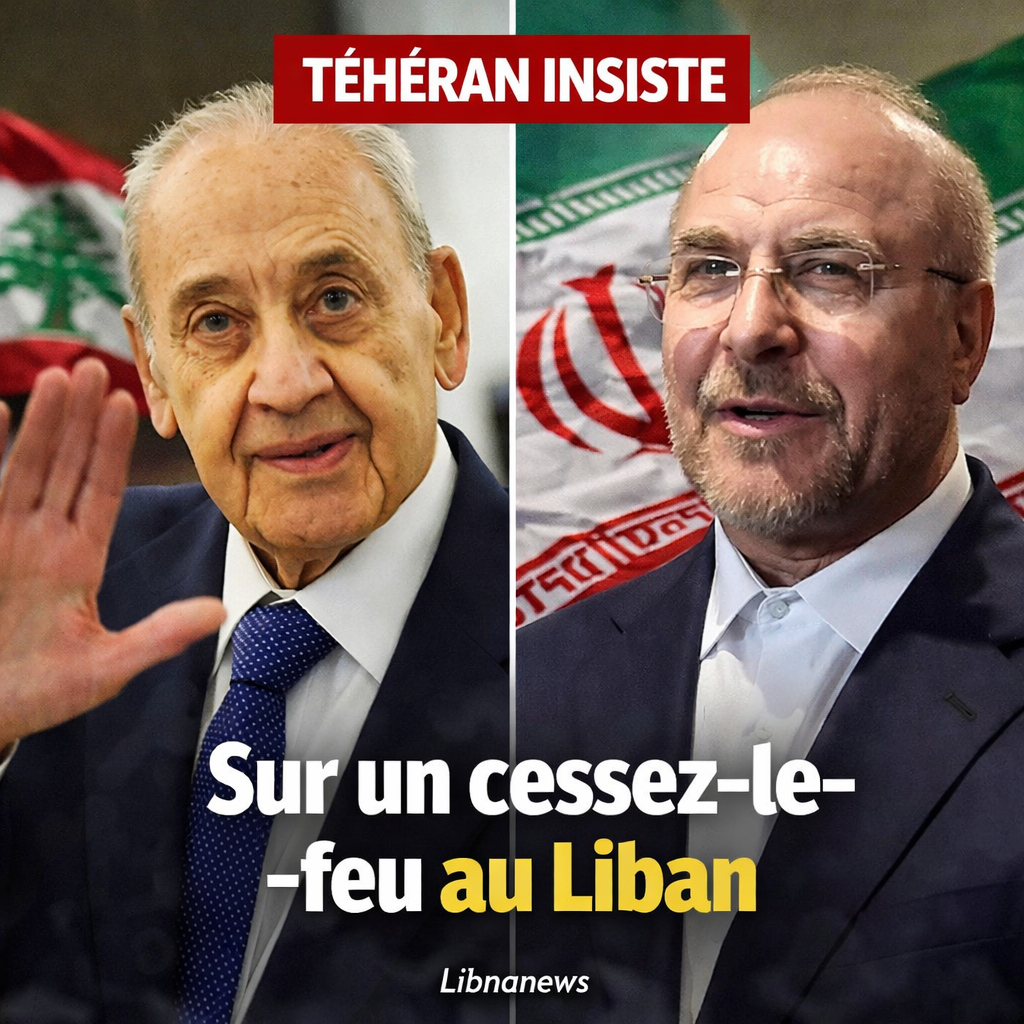
Lebanon has returned to the heart of the regional game with a sentence from Tehran. In claiming that a ceasefire in Lebanon is « as important » as it is in Iran, the President of the Iranian Parliament Mohammad Bagher Ghalibaf put the Lebanese front in the middle of a diplomatic sequence that initially seemed structured by the confrontation between Washington, Tehran and Israel. The message, published after an exchange with his Lebanese counterpart Nabih Berri, comes at a time when discussions on regional de-escalation remain uncertain, fighting continues in southern Lebanon and a direct channel between Lebanese and Israeli officials has just opened in Washington. In this context, the Iranian declaration was not a peripheral comment. She recalls that, for Tehran, the Lebanese question cannot be treated as a secondary theatre.
The weight of this sentence lies as much in its content as in the moment chosen. Since the break of 8 April between the United States and Iran, there has been a dispute of interpretation between the protagonists. Iran and Pakistan argue that Lebanon is part of the logic of the ceasefire. On the contrary, Washington and Israel claim that the Israeli campaign against Hezbollah is another matter. Between these two readings, Beirut tries to assert a simpler and more urgent position: to get the strikes stopped, to relieve humanitarian pressure and to put the country’s security in a state framework. By publicly bringing Lebanon back into the equation, Ghalibaf does not only speak to his opinion. He speaks to the mediators, Lebanese officials and Iran’s allies in the region.
The ceasefire in Lebanon becomes a regional test
In the current sequence, the Ghalibaf formula has a very precise function. It aims to prevent the truce concluded on 8 April from being presented as a sufficient de-escalation while the Lebanese front continues to burn. As long as Lebanon remained absent from the heart of the diplomatic announcements, it could appear as an annex, although serious, but managed separately. By saying that a ceasefire in Lebanon is as important as in Iran, Tehran challenges this hierarchy and asserts that there is no credible regional stabilization if South Lebanon remains subjected to shelling, ground operations and permanent instability.
This position does not arise from anywhere. The Iranian authorities had already indicated in the previous days that they considered the ceasefire in Lebanon as one of the essential parameters for any serious discussion with Washington. The novelty is elsewhere. It is due to the fact that this message is now publicly assumed, and formulated in an exchange with Nabih Berri, one of the most central figures in the Lebanese system. Tehran points out that the Lebanese front is not only a matter of ideological solidarity or support for an ally. It becomes a constituent element of regional negotiation itself.
This also changes the way the ceasefire is perceived in Beirut. For several days, Lebanese officials have been trying to impose a clear logical order: first to stop the strikes, then to open a broader framework for discussion. Ghalibaf’s speech goes in the same direction on a fundamental point: it refuses to allow Lebanon to negotiate while it is still under continued military pressure. The agreement is obviously not complete between Tehran and the Lebanese State on the final objectives, on Hezbollah’s place or on the type of settlement desired. But the Iranian sentence gives weight to an idea that Beirut too defends: no serious discussion can produce lasting effect if the ceasefire is not first given priority.
Ghalibaf is no longer a secondary actor
The identity of the messenger counts almost as much as the message. Mohammad Bagher Ghalibaf does not hold a protocol function without real effect. Former commander of the Revolutionary Guards, former mayor of Tehran and now president of Parliament, he has been a prominent figure in the Iranian diplomatic phase for several days. According to the French press and several international agencies, he played a direct role in preparing exchanges with Washington and in defining Tehran’s red lines before any in-depth discussion. His speech on Lebanon cannot therefore be read as a mere political commentator.
This centrality gives its statement a wider scope. When an official of this stature claims that the Lebanese ceasefire counts as much as the Iranian ceasefire, he sends several signals at the same time. He speaks first to the Americans, telling them that Iran does not accept a truce with variable geometry. He then spoke to the Israelis, reminding them that their operations in Lebanon could not be treated forever as an autonomous element, without effect on the rest of the regional negotiations. Finally, he talks to his allies, including Hezbollah, to show that Tehran does not separate its own security from the situation of its partners.
Telegram’s choice adds to this logic. The message did not leak by accident. It was published voluntarily in a highly monitored political communication space in Iran and the region. In other words, Tehran wanted to make this line visible, freeze it in public space and give it official value. This means that the question of Lebanon is no longer dealt with in the margins of the discussions. It becomes a visible element of Iranian posture. And the more publicly affirmed this posture, the more difficult it becomes for other actors to claim that Lebanon would be outside the mechanics of de-escalation.
Nabih Berri crossing Lebanese lines
The fact that Ghalibaf is reporting an exchange with Nabih Berri is no less significant. President of Parliament, leader of the Amal movement and a structuring figure in Shia political life, Berri remains a central interlocutor when it comes to southern Lebanon, Hezbollah and relations between the Lebanese state and external mediators. He is neither the chief executive nor the President of the Republic, but he remains one of the men through whom the sensitive balances of the country pass. In crises related to Israel, its position is often both institutional, community and diplomatic.
This status explains why Tehran continues to treat him as a leading relay. In addressing him, Ghalibaf does not completely bypass the Lebanese state, but he chooses a figure that speaks both the language of the institutions and that of the regional power ratio. This reflects a reality unique to contemporary Lebanon: on issues of war, truce and security in the South, the map of power is never reduced to constitutional hierarchies alone. Formal channels matter, but they coexist with political, partisan and community mediations that remain essential.
The exchange between the two men also takes place while Beirut seeks to defend a specific official line. The Lebanese Presidency and the Government stressed the need for a ceasefire prior to any useful discussion. They also reiterated that open contacts in Washington should not be equated with political normalization. This position aims to preserve the authority of the State while taking into account the rejection expressed by Hezbollah and some of the opinion. Berri’s place in this sequence illustrates the Lebanese difficulty: to assert a state line without being able to erase the weight of actors who, on the ground or in communities, remain decisive in any exit from crisis.
Three readings of the same ceasefire
Ghalibaf’s statement became very meaningful when it was placed in the battle of interpretation opened since 8 April. The first reading is that of Iran and Pakistan. For them, the de-escalation initiated between Washington and Tehran only makes sense if it also covers Lebanon. This approach is based on a simple idea: the fronts are now linked, and peace on one cannot be proclaimed while the other continues to suffer from war. It also allows Iran to avoid a limited agreement being presented as a complete American success.
The second reading is that of the United States and Israel. Washington suggested that the conflict between Israel and Hezbollah did not fall within the scope of the American-Iranian truce. Israel pushed this logic further by saying that it would continue its operations against Hezbollah, including at a time when there were few direct contacts with Lebanese representatives. This position gives the truce a narrow range. It protects, from the American and Israeli point of view, the possibility of negotiating with Tehran without at the same time imposing immediate coercion on the offensive in Lebanon.
The third reading is that of official Lebanon. It does not completely repeat Iranian logic, nor, of course, Israeli reading. Beirut stresses above all the need for a ceasefire to allow for a diplomatic and humanitarian sequence. In other words, Lebanon does not seek first to redraw the regional truce for doctrinal reasons. It seeks to put an end to a war that destroys its territory, massively moves its population and worsens its internal fractures. But this position is difficult to make as long as the other actors use the Lebanese front as part of their own negotiations.
Washington wants to decouple, Tehran wants to connect
That is where the political node of the moment lies. The United States has an interest in presenting the April 8 truce as a first success, even partial, in de-escalating with Iran. In order to do so, they need to limit the scope of the ceasefire and avoid that it is immediately assessed on all fronts where Iranian influence is engaged. Lebanon then became a problematic case. If it is included, Washington must push Israel more clearly towards a halt or reduction of its operations. If excluded, the truce seems incomplete and weakens the American diplomatic narrative.
Iran defends exactly the opposite. Tehran seeks to show that de-escalation is only valid if it also applies to its regional allies, or at least to their main theatres of confrontation. From this perspective, Lebanon is a test. If the bombings and the fighting continue, the truce of 8 April becomes, from the Iranian point of view, a partial formula that does not yet deserve the name of regional stabilisation. Ghalibaf’s sentence is therefore part of a liaison strategy. It obliges the Americans to take on the fact that they want, for now, to decouple the files.
This tension also illuminates Pakistan’s role in the sequence. Islamabad was one of the mediators of the truce and gave signals towards the inclusion of Lebanon. Its positioning reinforces the Iranian thesis that the Lebanese question is not a late invention of Tehran, but a point discussed in the very construction of the agreement. On the contrary, Washington speaks of a misunderstanding or divergence of interpretation. This disagreement is not semantic. It determines what may be required of Israel and what remains outside the framework.
Hezbollah observes, unbound
In this configuration, Hezbollah’s position remains decisive. The movement rejected direct talks between Lebanese and Israeli representatives in Washington, D.C., and stated that it did not consider itself bound by their possible results. This refusal considerably complicates the task of the Lebanese State. It means that even an agreement negotiated by the official authorities alone would not suffice to stabilize the ground if the main armed actor on the southern front refused to recognize it. Hezbollah thus maintains its capacity to pose as an autonomous actor of war and truce.
Ghalibaf’s statement is also intended to speak to this camp. It responds to a latent concern in the circles close to Hezbollah: that of seeing Iran get for itself a strategic breath while leaving Lebanon exposed. In reaffirming that the Lebanese ceasefire is a priority, Tehran seeks to prevent this trial from being abandoned. The message is clear: Lebanon is not sacrificed to save the only Iranian case. Politically, this assurance is important because Iran’s regional credibility depends in part on its ability to convince that it does not treat its allies as mere adjustment variables.
This does not mean that Tehran and Hezbollah alone dictate the sequence. In Lebanon, criticism of the movement grew stronger as the war escalated. Many blame him for bringing the country into a logic that goes beyond the national interest. But on the military ground, and in the capacity to block or accept a truce, Hezbollah remains indispensable. It is this reality that the Lebanese State is trying to circumvent without being able to completely erase. And that is also why the slightest sentence from Tehran on Lebanon is read in Beirut as a concrete political signal, not as a mere rhetorical posture.
Human cost puts Lebanon in an emergency
If the Iranian statement has been so commented on, it is also because it comes as Lebanon continues to pay a very heavy price. According to reports from international agencies, the ongoing war has already killed more than 2,000 people in the country and displaced more than one million people. These figures do not say everything, but they are sufficient to explain why Beirut seeks to impose the ceasefire as an absolute prerequisite. Lebanon has not been discussing since a theoretical position. It negotiates under pressure from a human, territorial and institutional emergency.
South Lebanon remains the visible heart of this pressure. The fighting remains intense, especially around several border localities, while Israel claims to want to maintain an area for Hezbollah fighters south of the Litani River. This prospect is all the more worrying in Beirut as it suggests not only the continuation of the war, but also a lasting transformation of the ground, with delayed returns of displaced persons and even more fragile Lebanese sovereignty. In this context, Ghalibaf’s sentence touches just because it points to a very simple reality: there is no credible détente in the region as long as Lebanon remains the place where the war continues.
This human dimension also explains the insistence of official Lebanon on the ceasefire above all else. The open discussions in Washington are not just about diplomatic principles. They concern the possibility of loosening up on cities, villages, infrastructure and displaced families. From this point of view, the Iranian word meets, at least partially, Beirut’s immediate interest. But it has done so since a regional logic that is not exactly that of the Lebanese state. And that’s all the ambiguity of the moment.
Lebanon returns to the centre without taking over
Ghalibaf’s statement therefore has a double effect. It gives Lebanon a centrality that some actors sought to relativize. But it also recalls that this centrality is still largely defined by others. The country returns to the centre of the regional conversation, but it does not control it. Iran talks about Lebanon to weigh on Washington. The United States is talking about Lebanon to manage its relationship with Israel and its truce with Tehran. Israel speaks of Lebanon in terms of security, the disarmament of Hezbollah and the buffer zone. And Beirut is trying, in the midst of these agendas, to secure recognition of a national interest that remains the most immediate of all: to stop the war on its own soil.
This dependence on external calculations is basically the great Lebanese weakness of the sequence. The country has an official word, a president, a government and a parliament. He even obtained the opening of a direct, rare channel with Israel under American mediation. But it does not yet have the capacity to give priority to its own definition of a ceasefire over that of external actors. In this sense, Ghalibaf’s sentence is diplomatically useful in Beirut, because it challenges the exclusion of Lebanon. But it also underlines, despite it, the extent to which the Lebanese question remains embedded in a balance of power that goes beyond it.
For the moment, there is nothing to say that Washington and Israel will agree to include Lebanon fully in the logic of the April 8 truce. There is also no evidence that Hezbollah will feel bound by open contacts in Washington. But one point is already needed in the regional debate: as long as Lebanon remains the front line where the war continues as other actors negotiate, each announcement of de-escalation will be seen as an incomplete, precarious and contested agreement.
Exact number of body words:2747
Keyword:ceasefire in Lebanon
Keywords Secondary SEO:Mohammad Bagher Ghalibaf, Nabih Berri, Iran, Hezbollah, Washington, South Lebanon, regional de-escalation
Description:Tehran claims that a ceasefire in Lebanon is as important as it is in Iran, relaunching the debate on the real scope of the April 8 truce.
Extract:
By claiming that a ceasefire in Lebanon is « as important » as in Iran, Mohammad Bagher Ghalibaf has put the Lebanese front back at the centre of a confused diplomatic sequence. His statement, published after an exchange with Nabih Berri, comes as Washington, Tehran, Beirut and Israel defend divergent readings of the April 8 truce. Behind this sentence, it is Lebanon’s entire place in regional de-escalation that is again at stake, as fighting continues in the South and direct contacts open in Washington.
Five alternative titles:
- Tehran wants to include Lebanon in the truce
- Lebanon returns to the centre of the ceasefire
- Ghalibaf revives debate on the Lebanese front
- The truce of 8 April still hits Lebanon
- Beirut at the heart of an incomplete de-escalation
References and links
[1] Statement by Mohammad Bagher Ghalibaf after an exchange with Nabih Berri, and debate on the inclusion of Lebanon in the logic of the ceasefire. (Reuters)
[2] Previous Iranian position making the ceasefire in Lebanon a prerequisite for in-depth discussions with Washington. (Reuters)
[3] American and Israeli reading that the campaign against Hezbollah is not covered by the April 8 truce. (Reuters)
[4] Lebanese position in favour of a ceasefire prior to broader discussions with Israel, with American mediation sought by Beirut. (Reuters)
[5] Hezbollah rejects direct talks in Washington and refuses to consider itself bound by their results. (AP News)
[6] Data on the human cost of war in Lebanon and the extent of displacement. (AP News)
[7] Israeli objective of a closed Hezbollah area south of the Litani River and continued operations in southern Lebanon. (Reuters)
[8] Libnanews analysis of Lebanon as a test of truce truth and differences of interpretation between Washington and Tehran. (libnanews.com)






