

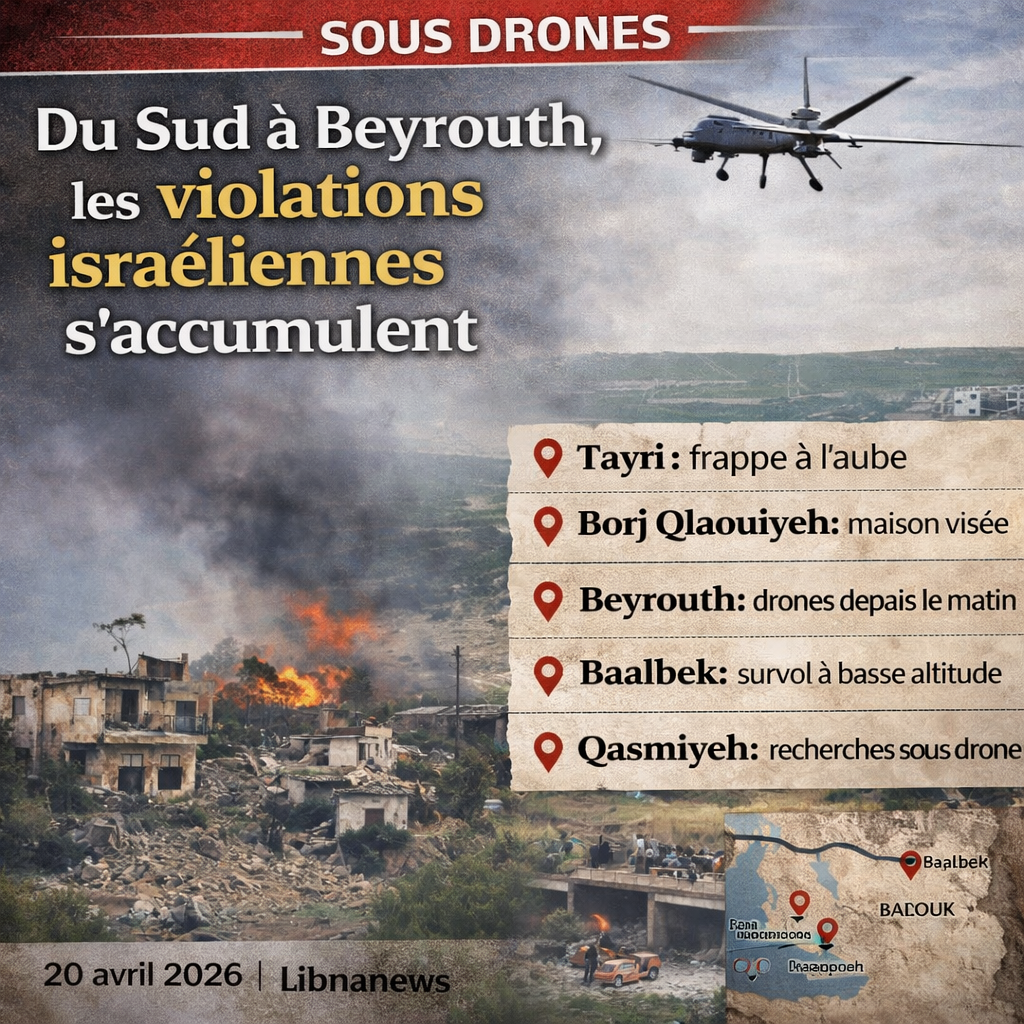
As the morning of 20 April progresses, the ceasefire in Lebanon is becoming more and more like a solid pause and an empty environment. The events reported since dawn draw a continuous sequence of Israeli military pressures, from the south to Beirut, through the Bekaa. Seen from the field, the logic is clear: the front is not really frozen, it is kept under stress.
The table of last hours is not limited to an isolated incident. It includes low-altitude drone overflights, targeted strikes, destruction of residential buildings and a persistent aerial presence over civilian areas. Taken together, these facts give the ceasefire a misleading appearance. In political law, the truce still exists. In the daily practice of the inhabitants, it is already begun.
The day began in the South with a series of offensive actions which recall that Israeli military pressure did not stop with the entry into force of the truce. Even before mid-morning, several locations in the south had already been targeted or under aerial surveillance. This is all the more important since the current period, in theory, should allow for a return to normal, the recovery of bodies, the evaluation of destruction and the gradual reopening of certain areas of life.
It is precisely this return to normal that seems to be prevented today. When drones fly low over Beirut and its southern suburbs since the morning, when Baalbek is also flying at low altitude, when houses are targeted at dawn and when body search operations are carried out under the eye of an Israeli drone over the Qasmiyeh bridge, the message is not that of de-escalation. It is one of continued military superiority, displayed and used to the heart of civilian and humanitarian activities.
A chain of violations from night to late morning
The sequence observed on Monday is distinguished first by its continuity. From night to dawn, the Israeli army detonated several residential buildings in the towns of Chamaa, Naqurah and Bayyada in Tyre District. This precision is essential. This is not an ongoing fire exchange or a shot presented as an immediate response to an identified threat. These are the destruction of buildings in a period supposed to be governed by the ceasefire.
The destruction of residential buildings has nothing to do with secondary detail. In any sequence of truce, it acts as a message to the inhabitants as well as to the military actors. It means that the time of return remains suspended at the will of the Israeli army. It also means that war can continue to produce material effects, even when diplomatic vocabulary speaks of pause, disqualification or ceasefire.
To this was added, at dawn, a strike on the locality of Tayri, in Bint Jbeil district. Another drone attack targeted a house in Borj Qlaouiyah in the early morning. Again, the importance of these facts is not only due to their immediate military dimension. It is due to their political value in a day when Lebanon was supposed to breathe a little. A house touched at dawn in a southern village is not just a point on a map. It is a reminder that the cease-fire can be violated at the very moment when people are thinking of finding some security margins.
The Tyre area also continued to be subjected to reconnaissance flights and low-altitude drones over the city and its villages. This point extends the others. Strikes and demolitions produce destruction. Overflights organise sustainable insecurity. They keep the population in a nervous wait, where every propeller noise can announce either a simple intimidation, a strike or a new targeting phase.
The announcement of the planned mourning at Tayr Debba in the afternoon adds a human layer to this sequence. As the town prepares to bury its dead, the other villages on the southern coast live at the rate of night destruction and morning overflights. The contrast is brutal. On the one hand, communities are trying to close an episode of violence by burying their loved ones. On the other hand, air pressure and destruction say that the episode is not closed.
The South remains treated as an open space for Israeli action
What these events reveal is the persistence of an Israeli reading of southern Lebanon as a space for action. The ceasefire does not appear to be a clear political border. Rather, it resembles a margin left to Israel to maintain pressure, continue destruction, monitor the pace of civilian return and recall its ability to strike at any time.
This logic is not only military. It’s territorial. Destroying buildings in already affected localities, at the same time as the inhabitants begin to assess the damage and consider a return, amounts to prolonging the war by other means. The houses here are not just a decor. They are the material support for return, local life, agriculture, trade and social ties. To blow them up during a period of truce is to weaken the very possibility of stabilization.
The geographical dispersion of the facts should also be noted. Chamaa, Naqoura, Bayyada, Tayri, Borj Qlaouiyeh, Tyre and its surroundings do not draw a unique and punctual scene. They draw an arc of pressure. This suggests less a blunder than a practice. A practice of keeping several points of the South under simultaneous threat in order to prevent a real normalisation zone from being reestablished.
This dispersion has another effect: it broadens the perception of danger. A population can adapt psychologically to a clearly localized front. It is much more difficult to adapt to a series of scattered foci of insecurity. When the risk appears to reappear in several villages at once, the truce ceases to be experienced as a place of protection. It becomes an anxious parenthesis.
Beirut and Baalbek also placed under surveillance
One of the most significant elements of the morning is precisely this overflow outside the southern front alone. At 0923 hours Israeli drones were reported at low altitudes over Baalbek and its area. Then, at 1134 hours, the continuation of drone flights at low altitude was reported over Beirut and the southern suburbs since the morning.
This information counts more than it seems. They show that Israeli pressure is not only exerted on the directly bordering localities or on the villages just out of the bombing. It extends to areas with a high symbolic and political burden. Baalbek represents a space deeply linked to the Shiite hinterland and the eastern depth of the country. Beirut and its southern suburbs bear an obvious political, demographic and security burden. Overflying them at low altitudes, continuously, is not a mere technical gesture of monitoring. It’s a demonstration of domination.
In a ceasefire sequence, the continued overflight of the capital and its southern periphery has an immediate effect on daily life. It disturbs the feeling of respite. He maintains the fear of a sudden strike. It also revives the memory of previous campaigns, when drone flights were often the prelude to tougher operations. The noise counts as much as the weapon. In Beirut, the sound occupation of the sky acts as a psychological prolongation of the war.
The Baalbek case has a comparable dimension. Again, low-altitude flight has a pressure function. Even without immediate warning, the presence of hostile drones indicates that the truce does not really protect the interior of the country from the Israeli airway. In other words, the ceasefire may suspend certain strikes at certain times, but it does not suspend intimidation or intrusion.
Ceasefire no longer protects civilian space
This is probably the heaviest point this morning. A truce began to lose credibility when civilian populations no longer perceived a clear difference between the time of war and the time of the ceasefire. That is exactly what the facts of the day say. The people of the South are being demolished and struck. Those in Beirut and the southern suburbs have been hearing drones since the morning. Baalbek’s people saw them flying low over their area.
The problem is not only safe. He’s political. The ceasefire should, at a minimum, give civilian space a relative autonomy over the military field. This autonomy does not appear. The sky is still busy. Houses remain vulnerable. The localities remain monitored. Even body search operations are carried out under duress.
This reduction of civilian space to a space under constant surveillance eventually alters the very nature of the truce. It is no longer defined as a clear decline in war, but as a relative decrease in some forms of direct violence. It’s much more fragile. And it’s much easier to break.
Qasmiyeh, or the shadow of war on research operations
One of the most telling facts of the late morning is the Qasmiyeh bridge. At 1129 hours, an Israeli drone was reported over the area as two bodies were being searched in the river. This episode alone summarizes much of the Lebanese reality of post-bombing: even the recovery of the dead does not escape the logic of pressure.
This overview cannot be read as an anecdotal element. Body research is a basic humanitarian phase. They involve time, minimal security, stable access to the ground and the ability of teams to work without immediate threat. The fact that an Israeli drone is present above the bridge during these operations blurs this minimal boundary between military action and humanitarian need.
The symbolic scope is considerable. A society that is still looking for its dead has not emerged from the war. A society that seeks them under drones does not really benefit from a ceasefire. The Qasmiyeh case shows what the other facts tell us: the truce does not protect return, burial, relief operations, or even the simple right to close an episode of violence.
The place itself is not neutral. The Qasmiyeh Bridge in the South is at the junction of several issues of traffic, access and recent memory of the bombings. Seeing an Israeli drone during a body search, it is recalled that even civilian infrastructure related to relief and passage remain included in Israeli surveillance.
Air pressure also becomes moral pressure
This is often underestimated. Yet, in a country exhausted by war months, the permanent presence of drones not only poses a tactical risk. It acts as a moral pressure. It forbids release. It prevents mourning from closing. It warns rescuers, divers, families and residents that the enemy remains present until the most elementary gestures of the day after the war.
This moral pressure is particularly visible in research operations. Searching for bodies, identifying victims, organizing funerals, reopening houses, cleaning streets: all these acts imply a minimum of civil continuity. When a drone dominates the scene, this continuity breaks. Even without firing, even without striking, the humanitarian workspace is re-integrated into the military power ratio.
That is why the violations reported on Monday exceed the only material balance sheet. They produce a disorganization of social time. The South does not only live with destroyed buildings. He lives with schedules suspended from what the sky permits or forbids. The cease-fire, instead of restoring civilian time, leaves a slow war period to survive.
Destroy during the truce, a strategy of fait accompli
The explosions of buildings in Chamaa, Naqoura and Bayyada alone deserve a specific reading. For destroying residential buildings during a ceasefire is not only a violation of political commitment. This also allows for the establishment of new realities on the ground, before any serious discussion on the return, reconstruction or security status of the area.
A house destroyed in a war period is a matter of rural violence. A house destroyed during the truce is also a fait accompli. It removes a point of concrete support from the inhabitants. It lengthens reconstruction time. It increases the cost of return. It feeds on the implicit message that some southern communities must remain in a state of vulnerability or greed.
This logic joins what many inhabitants have feared for weeks: that the truce should not be used to close the war but to organize the control of space. Night destruction is part of this fear. They don’t just say: we can still hit. They also say: we can still transform the ground before politics slices anything.
In this regard, it is striking that the violations observed on Monday combine three complementary registers. First, the destruction register, with demolitions and strikes. Then the surveillance register, with the drones over the South, Beirut and Baalbek. Finally, the register of indirect obstruction, with the pressure exerted up to the body searches in Qasmiyeh. Together, these registers make up a method.
What these violations are already changing for Lebanon
The first effect is immediate: it weakens the credibility of the ceasefire. A truce is not just a text or an announcement. It is based on the perception of those who live below it. But the events on Monday give the inhabitants a reverse perception. They tell them that war can come down at any time, on several points of the territory, with varying forms.
The second effect is the return of displaced persons. A return is never a purely administrative gesture. It depends on an intimate risk assessment. If the inhabitants see that buildings are still destroyed in the South, houses are struck at dawn, drones remain ubiquitous over Beirut, Baalbek and Tyre, they delay their return, or return after returning. A truce can thus be emptied without being formally broken.
The third effect is institutional. Each violation increases the difficulty of the Lebanese State in defending the idea of gradual stabilization. The authorities can talk about negotiations, implementation, security and institutional presence. But the field speaks in more direct language. He said that Israeli violations continued, that the margins of the cease-fire remained narrow and that Lebanese sovereignty remained pierced by the enemy air presence.
The fourth effect is the widening of the pressure perimeter. In the same morning, the South experienced demolitions and strikes, Baalbek was flown at low altitude, Beirut and the southern suburbs were kept under drones, and Qasmiyeh witnessed a body search operation under aerial surveillance. This simple chaining is enough to show that the ceasefire is no longer only fragile on the front line. It is in its ability to recreate a breathing civilian space across the country.
Repetition weighs more than one incident
It would be tempting to read each event separately: an overflight here, a strike there, a demolition further. That would be a mistake. What weighs today is not only every fact taken in isolation. It is their repetition, their geographical dispersion and their sequence on the same morning. This is what transforms the finding into diagnosis.
The diagnosis is simple. The cease-fire is not respected in its spirit or in its practical effects, and less and less in its letter as strikes, demolitions and air pressure continue in several regions. The expression of violation is therefore not a rhetorical choice. It follows from the facts reported.
At this stage, the question is no longer even whether a wider resumption of hostilities will take place. It is already clear that the current truce operates as a fragile framework in which Israel continues to shape the ground, monitor civilian space and keep Lebanon under tension. If this logic continues in the afternoon and the following night, the ceasefire may be more than a diplomatic word on a country where drones have never really left the sky.






