

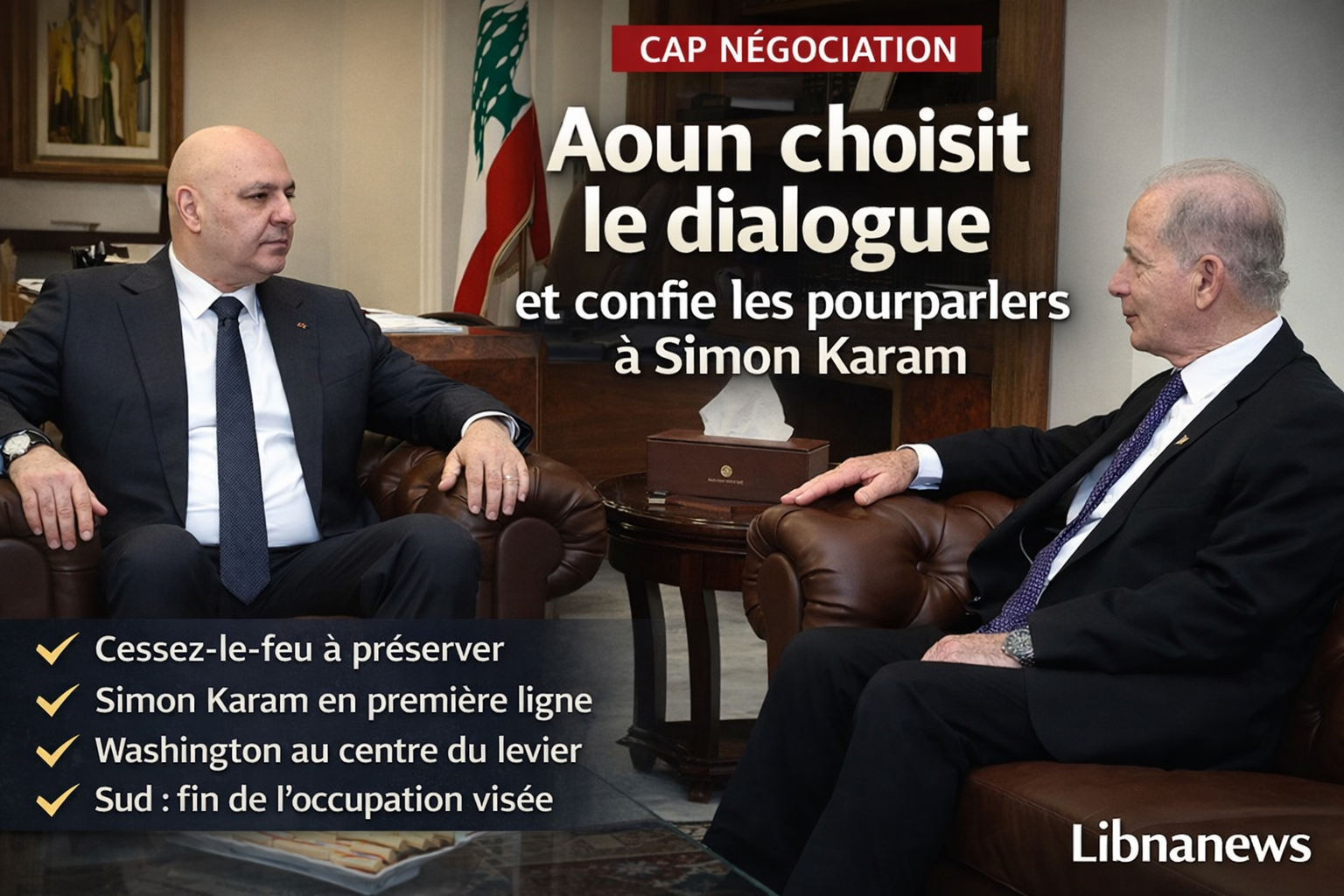
The President of the Republic, Joseph Aoun, gave Monday a clearer political course to the sequence opened by the ceasefire. By successively receiving the United States Ambassador to Lebanon, Michel Issa, and then a delegation from the Sovereignty Front, the Head of State drew a three-point line: to maintain the ceasefire, to launch a bilateral negotiation led by Lebanon itself, and to make this negotiation the framework for ending the war, the Israeli occupation of southern areas and the restoration of State authority to recognized borders.
The presidential message deserves to be read carefully because it exceeds the only institutional chronicle of a day in Baabda. It is taking place at a time of great fragility, as Israeli violations of the ceasefire continue, the return of internally displaced persons remains uneven, and the question of southern Lebanon remains suspended both from the military power ratio and from Lebanon’s ability to impose its own political framework. Through his remarks, Joseph Aoun did not just comment on the situation. He sought to resume the initiative on a matter which, for months, has largely escaped Lebanese institutions.
The president first placed the relationship with Washington at the centre of the arrangement. According to the official report, the meeting with the US Ambassador focused on recent developments, his discussions with Donald Trump and Marco Rubio, as well as on the post-meeting phase held last week in the State Department. Above all, the discussion focused on ways to preserve the ceasefire. That is essential. It means that Lebanon does not treat the truce as an achievement, but as a still precarious balance, which requires permanent contact and continued diplomatic pressure.
At the same time, the Head of State wanted to establish a Lebanese architecture for the continuation. In front of the Sovereignty Front, he claimed that the bilateral negotiations would be taken over by Lebanon through a delegation led by Ambassador Simon Karam. He also insisted on a highly political point: no one will participate in this mission instead of Lebanon, and no one will substitute for it. Behind this formula is a clear objective: to reaffirm that the issue of war and de-escalation in the South is first and foremost the responsibility of the Lebanese State, not of intermediaries, partisan formations or regional actors acting in its place.
In Baabda, a double message to Americans and Lebanese
Monday’s sequence staged a double recipient. The first one is outside. In receiving the American Ambassador, Joseph Aoun recalled that Washington remains the indispensable actor in influencing Israel, influencing the holding of the ceasefire and preparing a framework for discussion. The second recipient is interior. Speaking of the future negotiation process before a Lebanese political delegation, the President addressed the opinion, parties, institutions and all those who feared that Lebanon would be dragged into a negotiation that it would not really control.
This double address explains the tone used. Joseph Aoun did not speak as a diplomatic relations technician. He spoke in chief of state about linking international support and national sovereignty. Perhaps the most significant passage in his statements concerned the separation between the role of the United States and the Lebanese conduct of negotiations. On the one hand, Donald Trump is presented as having shown understanding of Lebanese demand and as having intervened with Israel to obtain the ceasefire. On the other hand, the President insists that Lebanon will itself assume the forthcoming negotiations.
This is politically decisive. It allows Baabda to say two things at the same time. First, that Lebanon needs real American support to contain the front line and open a political path. Secondly, that this support should not become a dispossession of the Lebanese file. In a country where the slightest negotiation affecting the South, the border or security is immediately read through the prism of external influences, this precision is not incidental.
It also responds to widespread concern. Every time Lebanon enters into a phase of discussions on an armed conflict, the same question comes up: who speaks on behalf of the country, with what legitimacy, and under what mandate? By designating Simon Karam as head of the delegation from the outset, Joseph Aoun sought to close the ambiguities. It gives an institutional face, title and entry point to the process.
The choice of anchoring is also a way of reminding that the folder should not be absorbed by the regional vcarm. Lebanon remains affected by the broader confrontation between Israel, Iran and the United States. But the president here says that the upcoming negotiations are separate from all the others. It’s a heavy sentence of meaning. It means that Baabda wants to prevent the fate of South Lebanon from being diluted in wider regional bargaining.
Simon Karam, face of a negotiation taken over
The name of Simon Karam is no coincidence at the heart of the presidential statements. By placing him at the head of the future arrangement, Joseph Aoun seeks to turn a war issue into a state file. In a Lebanon where parallel channels, informal mediation and competing decision-making centres have long blurred official speech, the appointment of a head of delegation has a strong institutional scope.
It first establishes a principle of method. The negotiation will not be abandoned to an improvised logic, nor carried by multiple voices. It will be led by an identified representative, appointed by the Presidency, and attached to the State chain. This centralization is important, because the issue that is opening is not only about a cessation of hostilities in the strict sense. It affects the end of Israeli occupation of southern areas, the deployment of the Lebanese army to the recognized border, and the full restoration of State sovereignty in the South.
These objectives, as formulated by Joseph Aoun, also draw up a more ambitious road map than a mere technical consolidation of the ceasefire. It is not just about avoiding a resumption of fire. It’s about getting out of an abnormal state. The war cannot end on a lasting basis if the land remains partially occupied, if the Lebanese army cannot fully deploy, and if State authority is not restored throughout its territory.
The presence of Simon Karam at the head of the future process therefore serves to give coherence to this ambition. Lebanon does not enter into a special negotiation in this vision. It is entering into a negotiation aimed at putting the crisis in the South in the regular order of institutions, recognized borders and national sovereignty.
The President also sends a signal through this choice to the rest of the political class. It states that negotiation is not a secondary option, nor a simple tactical manoeuvre to save time. It becomes the framework assumed by the Presidency to try to end the war. This shift is considerable. For months, Lebanon has lived in a logic of urgency, response, indirect mediation and daily risk management. Baabda now presents the negotiation as the central alternative to the continuation of the conflict.
Between prolonged war and negotiation, the President decided
One of the strongest phrases of the Head of State is in the presentation of the two options which he believes are available in Lebanon. The continuation of war, with its human, social, economic and sovereign consequences. Either negotiation, to end the conflict and achieve lasting stability. In making the choice, Joseph Aoun did not merely express a diplomatic preference. He makes a diagnosis of the state of the country.
This diagnosis is severe. He said that Lebanon could no longer afford a prolonged war. And he says it in terms that go beyond the military dimension alone. The consequences are human, which refers to the dead, the injured, the displaced and the exhaustion of society. They are social, which refers to the disruption of daily life, the breakdown of services, the increased precariousness of families. They are economic, with regard to destruction, paralysis of the South, pressure on public finances and deterioration of activity. Finally, they are sovereign, which touches at the heart of the political question: a State that remains caught in a war without horizon sees its capacity to exercise its authority diminish further.
By claiming that he chose the negotiation, Joseph Aoun personalises this bet. He assumes it on his behalf. This point deserves to be stressed, as it directly engages the Presidency. In the Lebanese system, every major choice of war and peace can be challenged, displaced, requalified or competed with other power centres. By saying that he chose, the Head of State seeks to give the negotiation a clear presidential legitimacy.
But this personalization also entails a risk. If the cease-fire collapses, if Israeli violations multiply to the point of nullifying the process, or if negotiations fail, the President will appear as the one who has invested his political credit in a path without visible results. In other words, the bet of negotiation is also a bet on the ability of external partners, and of Israel first, to let exist a real political space.
Ceasefire as an immediate test of credibility
That is why the meeting with the US Ambassador is so important. The Chair does not discuss a distant process. He first discussed the survival of the ceasefire. In practice, everything depends on this point. As long as the truce holds, even if it is bad, it remains possible to prepare for a negotiation, to establish a mandate, to gather a minimum of national support and to work towards an end to the crisis. If she gives in, the rest becomes almost theoretical.
Joseph Aoun seems to have perfectly integrated this hierarchy. His discussions with Michel Issa focused on both recent developments and ways to preserve the ceasefire. This is a lucid method. Negotiation is not intended as a magical substitute for the military fragility of the moment. She depends on it closely.
This link between truce and negotiation also explains the reference to the meeting held the previous week in the State Department. The President shall enter his action into diplomatic continuity. It does not present Monday as an isolated turning point, but as a step in a chain of contacts designed to prevent the return to open war and to build a more formal framework for discussion.
The American element therefore remains central. Not because Lebanon would abandon its case in Washington, but because the United States remains the only external actor explicitly quoted by the Presidency as capable of intervening directly with Israel. Joseph Aoun said so without a doubt when he spoke of Donald Trump’s intervention to obtain a ceasefire and prepare a negotiating path.
This is politically sensitive, but it is realistic. Beirut knows that no de-escalation architecture in the South can hold unless Washington exercises a minimum leverage on Israel. The President is therefore trying to transform this de facto dependency into substantive support, while recalling that the conduct of the process will be the responsibility of Lebanon.
Restoring the State in the South, the substantive objective
Beyond the ceasefire itself, the presidential comments reveal a deeper objective: the restoration of the state in the South. The Head of State spoke about the cessation of hostile acts, the end of Israeli occupation of southern areas and the deployment of the army to internationally recognized southern borders. This sequence is not accidental. She describes a logical sequence.
First, silence the weapons. Then, get an end to the Israeli presence in the areas still concerned. Finally, allow the Lebanese army to deploy to the recognized line. Behind this gradation is a simple idea: there can be no lasting stability without restoring effective state continuity in the South.
This is both a military and a political issue. Military, because the vacuum of sovereignty feeds the cycles of confrontation. Political, because a South partially subtracts from the state’s full authority remains the most visible symptom of Lebanon’s structural weakness. By putting this point at the centre, Joseph Aoun tries to pull the discussion out of the only record of tactical de-escalation. He wants her to be part of institutional recovery.
The fact that he speaks explicitly of sovereignty over the whole territory, in the first place the South, is revealing. It is not just a patriotic formula. This is one way of saying that the southern issue is now focusing on the broader issue of the Lebanese State. If the South returns to an area of effective State authority, the institutional balance of the country would be strengthened. If there remains a tense periphery, through occupation, violations and precarious arrangements, the sovereignty crisis will continue.
An implicit call for national unity
The President said it was almost explicit when he called for the future process to be accompanied by the widest possible national support. This request is not decorative. It reveals an acute awareness of the internal fragility of Lebanon. Any negotiation on the South, on war or on occupation can be undermined from within if it appears to be the project of a camp, party or political current.
In calling for broad support for the future negotiating group, Joseph Aoun sought to build a political shelter around the Lebanese delegation. He knows that negotiations, if they are to be credible outside, must appear solid inside. A mandate permanently challenged by Lebanese political forces would be immediately weakened.
This call to unity also contains a subtext. The President said in substance that negotiations should not be read as a concession, but as a national necessity. He thus tries to shift his gaze on this word, which is often heavy in Lebanon. Negotiating, in its presentation, does not mean yielding. This means choosing the end of the war, the end of the occupation of certain areas and the return of the State.
However, the success of this line will depend on Baabda’s ability to convince beyond his own circle. The country still faces conflicting sensitivities about the nature of relations with Israel, the role of the United States, the real margin of the state and the priority objectives of the moment. The President sets a framework, but this framework will still have to be defended in the Lebanese debate.
Separate negotiation of other regional files
One of the most strategic passages in Joseph Aoun’s remarks is the idea that future negotiations will be separated from all others. At first glance, the formula may seem obvious. In fact, it responds to a major risk: that of Lebanon being treated as a secondary issue within a wider regional bargaining.
By saying that future negotiations are separate, the President tries to subtract the Lebanese file from other tables, other channels and other priorities. The message is clear: Lebanon will not accept that the South becomes an adjustment variable in discussions that go beyond it. This position alone does not guarantee that the country will escape the effects of the regional context. But it sets a useful political line.
It also clarifies the meaning of the approach. Lebanon is not entering into negotiations because a great regional compromise is emerging. He entered because he had a vested interest, as a State, in ending the war, in ending the occupation of certain areas and in stabilizing the southern front. This empowerment of the Lebanese case is a central element of the doctrine presented on Monday.
It is also an internal warning. By separating future negotiations from other processes, Joseph Aoun recalls that no other forum, whether regional, partisan or parallel, should capture this mandate. Again, the institutional form chosen is as important as the content of the objectives.
The bet remains open
At this stage, there is no guarantee that the line set by the President will soon lead to results. Violations of the ceasefire continue. The terrain in the South remains unstable. The occupation of southern areas is not lifted. The ability of the United States to convert its contacts into concrete commitments remains to be tested. And the future Lebanese delegation has not yet begun its visible work.
But Monday will at least have had a clear political effect: to clarify the presidential strategy. For Joseph Aoun, Lebanon cannot continue to drift between war, emergency management and unprovoked mediation. The ceasefire must be preserved, a state-led negotiation launched, the occupation of southern areas ended and the military and sovereignty returned to the centre of the arrangement.
This framework solves nothing by itself. It does, however, put an end to an ambiguity: Baabda no longer treats the ceasefire as a mere moment of respite, but as the first step in a political process that Lebanon intends to lead under its own name, with Simon Karam in the front line and with the hope, still fragile, that the truce will take long enough for this architecture to start producing something other than a mere respite.






