

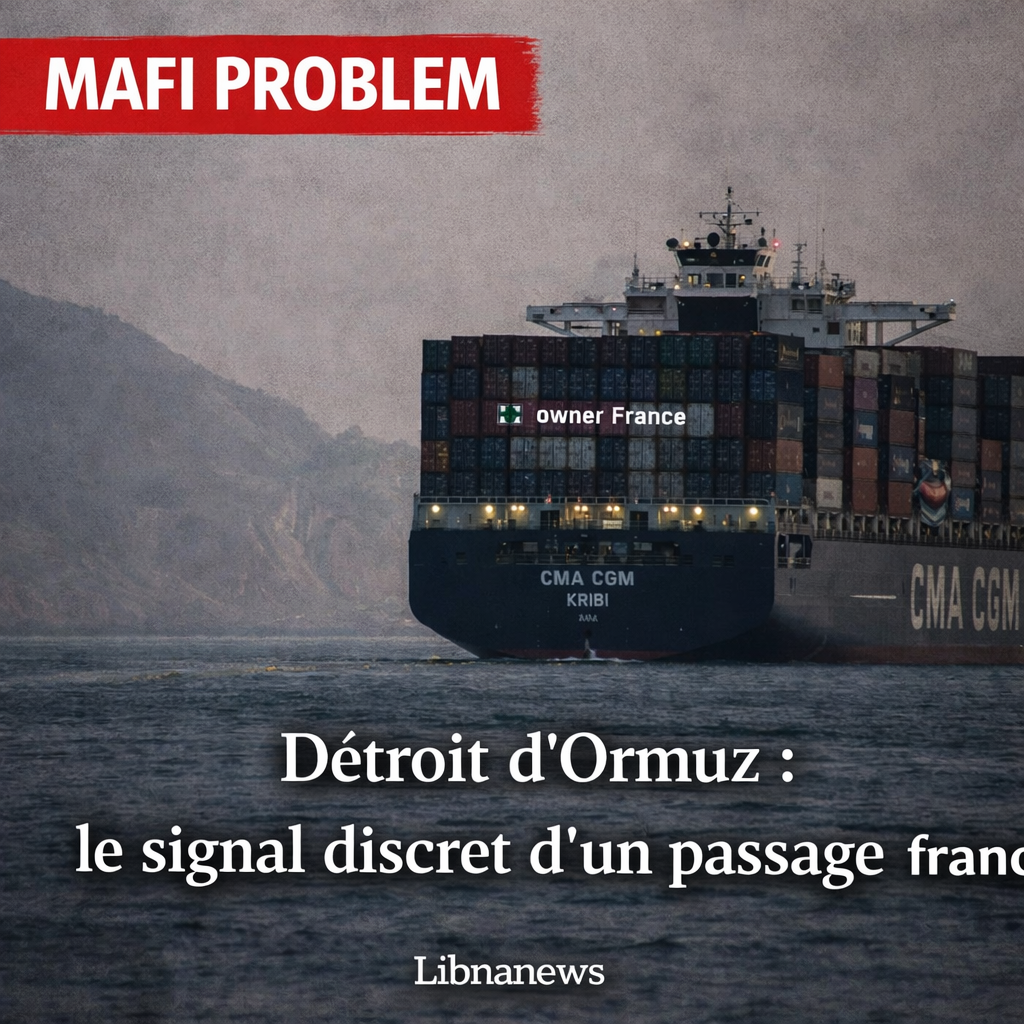
A container carrier from CMA CGM crossed the Strait of Ormuz with an unusual message on its navigation signal: « owner France ». The ship,Kribi, flying the Maltese flag, crossed the strategic crossing to exit the Gulf on Thursday before being spotted Friday off Muscat, according to the maritime monitoring data consulted by Reuters and other naval tracking services. The gesture immediately attracted attention, as the Strait of Ormuz remained under very high pressure since the open war between Iran, the United States and Israel, and traffic was reduced to a fraction of its usual level. In this context, the crossing of a cargo ship linked to a French shipowner appears less like a mere commercial movement than as a discreet political signal.
The fact is all the more noteworthy that France has carefully kept itself away from any military operation aimed at reopening the strait by force. Emmanuel Macron stated on 17 March that Paris would never participate, in the current context, in operations to « open » or « liberate » Ormuz. At the same time, French diplomacy is working on a separate initiative, conceived for post-tagonism, with the idea of a strictly defensive international security mission, conducted only after a de-escalation and with prior discussions with Iran. Seen from this sequence, the passage ofKribiFrance does not fight Iran, but clearly seeks to preserve a channel of circulation, discussion and perhaps tacit tolerance.
A transit that does not resemble others
According to the maritime monitoring data, theCMA CGM Kribisailed near the Iranian coast, using a channel between the islands of Qeshm and Larak, while openly spreading the mention « owner France ». Friday morning, he reported his position off Muscat. Two people familiar with the record confirmed to Reuters that the vessel had crossed well. This emphasis on the nationality of the shareholder or the control of the ship, instead of a conventional commercial destination, has nothing to say about. In normal times, this type of information is not the core of the AIS message that a container carrier chooses to display. In the present circumstances, the message looks like a way to make it clear to the Iranian authorities that the ship is attached to a State that is not involved in the strikes against Iran and is seeking a diplomatic outcome.
There is nothing at this stage to speak of Tehran’s official public authorization to French cargo ships. Neither CMA CGM nor the French Ministry of Foreign Affairs commented on the episode in the elements reported. But the facts available allow for a more cautious and robust reading: the passage ofKribisuggests that a ship linked to a French group has, at a minimum, benefited from a form of operational tolerance in a strait where Iran now very severely filters movements. Reuters already recalled at the end of March that Tehran had allowed certain vessels from countries deemed friendly to transit through pre-approved roads, while maintaining the threat to buildings perceived to be linked to the United States, Israel or their direct allies. The caseKribiseems to fit in with this logic.
This shade is important. To write that French cargo ships are « authorized » to pass would be to lend Iran a formalised policy that is not publicly documented in the sources consulted. On the other hand, to say that a CMA CGM container ship has crossed by highlighting its French link, in an environment where Iran seems to select the ships that it is allowing to cross the strait, is more in line with the state of affairs. In both diplomatic and maritime language, the difference between a proclaimed official authorization and a permissive de facto is decisive. Here, everything indicates a discrete permissiveness, possibly negotiated or at least understood by the parties, but not displayed as such.
France, a separate naval power
The French position partly explains this particular treatment. Since the outbreak of the war, Paris has sought to distinguish itself from Washington and Jerusalem. Emmanuel Macron reiterated that France was not a party to the conflict and that it would not intervene to reopen the strait by force. A French military official quoted by Reuters even insisted that Paris dissociated its action from that of the United States and Israel. At the same time, France consults with European, Asian and Arab partners in order to prepare, once hostilities have been calmed, a possible system of escort or securing maritime flows. The French line thus holds in two words: military distance, diplomatic activism.
This posture has several effects. First, it allows Paris to speak with states that refuse to stand behind a logic of direct confrontation with Iran. Secondly, it creates France as an actor in practical mediation on maritime routes. Finally, it may offer French economic interests, of which CMA CGM is a part, greater room for manoeuvre than shipowners perceived as more directly aligned with the United States. This is not a publicly claimed privilege. Rather, it is a possible consequence of a more autonomous geopolitical positioning. The passage ofKribidoes not alone prove the existence of a specific agreement between Paris and Tehran. But it gives weight to the idea that a French political flag, even implicit, now retains a relative protective value in the Gulf. The latter sentence is an inference based on the facts reported.
The CMA CGM group occupies a special place in this sequence. It is the third largest container shipowner in the world, mostly owned by the Saade family. Reuters recalls that its founder, Jacques Saadé, left Lebanon for France before setting up the company in Marseilles in 1978. The French identity of the group is therefore real, even if the vessel concerned is sailing under Maltese flag. In the world of shipping, where pavilions, management companies, beneficial owners and charterers often form complex chains, the choice to display « owner France » is almost like a simplified reading request: beyond the pavilion, see who we are.
Iran sorts passages
Since the de facto closure of Ormuz, Iran has not treated all ships in the same way. Reuters reported that some Chinese vessels had finally managed to exit the Gulf after coordination with the « stakeholders concerned ». At the same time, other attempts had failed, despite initial assurances, showing a system that was both selective and unstable. This case-by-case management transforms the strait into a space of demonstrative sovereignty. Tehran does not just say that he controls the road. He shows that he chooses who can still borrow.
The Chinese case had already revealed this mechanics. Beijing maintains sustained relations with Iran and does not participate in military operations against it. The fact that Chinese-related ships were able to pass before a ship associated with a French group reinforced the idea of an implicit hierarchy of tolerated nationalities. In this grid, France could benefit from an intermediate status: a Western ally, certainly, but not engaged in war, critical of a military solution in Ormuz, and active in the diplomatic field. TheKribiwould then be included in a category of ships, neither strategic friends in the Iranian sense, nor priority enemies. This reading remains an interpretation, but it is consistent with the already observed passages and with the French posture.
This selectivity also has an economic function. The Strait of Ormuz remains a vital artery for the global economy. Reuters recalls that about a fifth of the world’s oil flows usually flow there. The almost total closure of the passage has already caused major disruptions. Allowing a few selected ships to circulate allows Iran to maintain maximum pressure while avoiding an absolutely hermetic stop that could turn against it more quickly diplomatically. In other words, partial permission serves both as a political lever and a strategic valve.
A message to both insurers and states
The transitKribihas another scope: he speaks to the market. In shipping, the physical ability to cross a strait is not sufficient. Shipowners, charterers, insurers and captains must also consider risk to be bearable. By displaying « owner France », the ship is not only addressed to the Iranian authorities. He also sends a message to the commercial actors: this passage is not a clandestine or improvised gesture, but an assumed, reported, visible navigation. This can include the evaluation of premiums, detours, deadlines and future routes. This analysis is an inference based on the logic of the maritime market and the French declarations on the need to involve insurers in any future mission.
France itself insists on this point. In his positions on Ormuz, Emmanuel Macron explained that any durable solution must involve shipping companies, insurers and operators in the sector. Paris knows that a maritime route is not only reopened with military ships. It reopens when private actors agree to come back. In this perspective, each successful passage counts as a life-size test. TheKribiis therefore worth more than just a commercial trip. It works as an indicator: despite the de facto closure of the Strait, some routes remain practicable for ships considered acceptable by Iran.
For CMA CGM, the issue is also operational. At the end of March, Reuters reported that the group was looking for solutions to overcome the difficulties associated with Ormuz. Crossing theKribisuggests that pure and simple circumvention is not always the only option. When political conditions lend themselves to it, the company can also test the maintenance of certain flows. This does not mean a return to normal. This means that a large French shipowner is trying to preserve continuity margins in an environment where most actors are still hesitant.
A very limited opening, not a return to normal
However, it would be excessive to see in this episode the beginning of normalisation for French ships. Firstly, because available sources at this stage only document a clearly identified case. Secondly, because the strait remains exposed to signal interference, risk of attack and high unpredictability. Reuters pointed out that tracking ships in the area is made more difficult by intense interference and spoofing, which makes it difficult to identify real trajectories. Finally, because Iranian politics itself can evolve from day to day, depending on the relationship of military and diplomatic force.
This precariousness also explains the official silence. Neither CMA CGM nor the French authorities have an interest at this stage in transforming a successful passage into a political announcement that is too visible. On the French side, excessive discretion would preserve the line of active neutrality. On the Iranian side, too open an advertisement about a favourable treatment given to French interests could blur the message of firmness that Tehran wants to continue to send. Under these conditions, the most just formula remains that of a discreetly tolerated passage, not that of a corridor officially proclaimed for French ships. This conclusion is a prudent inference based on the silence of the parties and the facts observed.
But this precedent creates a new fact. After the Chinese ships, a ship associated with a large French group crossed Ormuz explicitly claiming its link with France. This means that in the middle of general hardening there are exceptions. And this confirms that the geopolitics of the straits do not only oppose commercial ships to an abstract military risk. It already organizes a differentiated movement according to the nationalities, diplomatic alignments and signals sent to the Iranian authorities. In this moving mapping, France now seems to occupy a singular place: Western enough to count, rather distant from the war to pass.






