

« Two to four weeks »: Rubio sets a horizon, but Europe remains cautious as the war spreads to Arak, Ardakan, Ormuz and Beirut
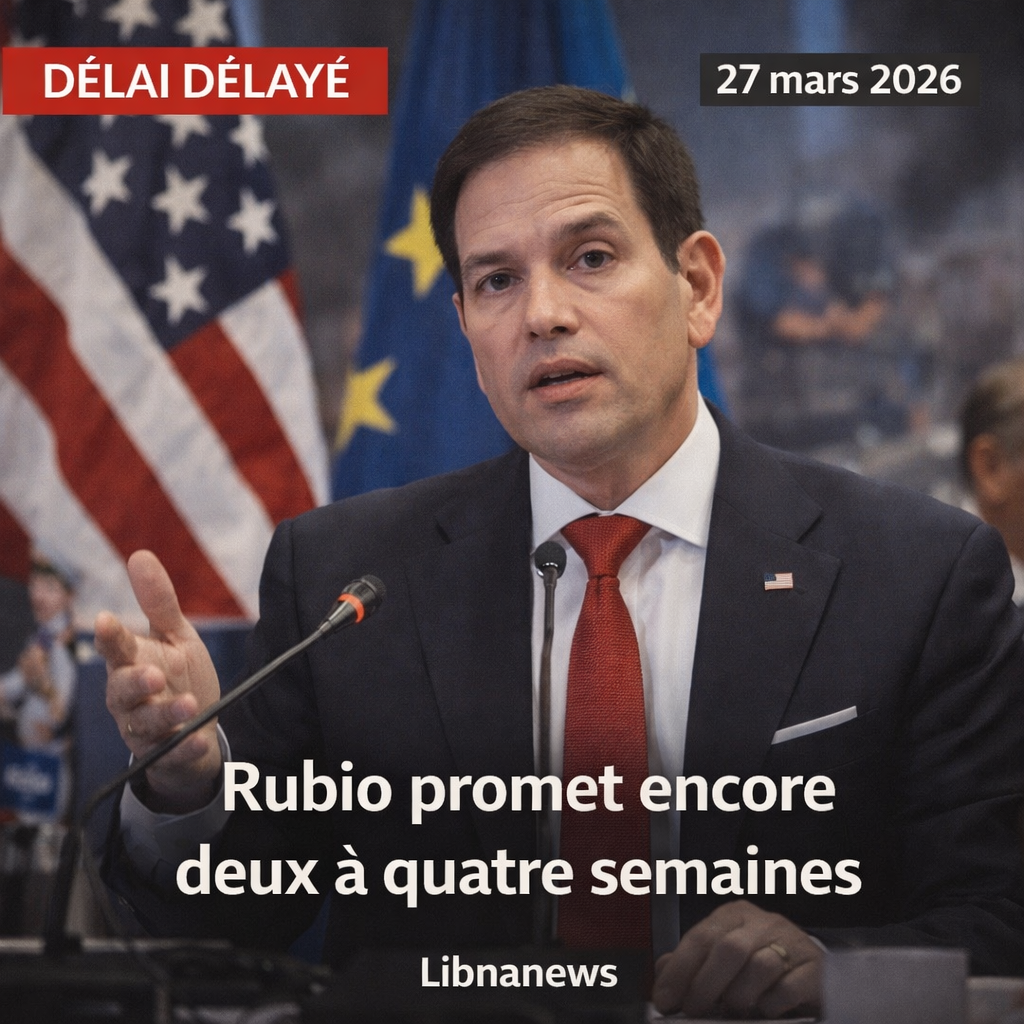
The day of 27 March 2026 was dominated by an American formula supposed to set a course: according to Axios, Marco Rubio explained to his G7 counterparts that the war against Iran had yet to continue2 to 4 weeks, with the idea that a real trading sequence could then open. At the same time, the terrain has said something else: new strikes have hit Iranian nuclear installations, pressure has remained maximum on the Strait of Ormuz, and Beirut has again been targeted. The contrast is there: Washington speaks of an exit horizon, but the war continues to rise in intensity.
Arak and Ardakan struck, new stage in the war against Iran’s nuclear program
The most important military event of the day was played in Iran. The Israeli army confirmed that it had struckArak heavy water reactor, while the Iranian Atomic Energy Organization announced thaturanium processing plant in Ardakan, in Yazd province, had also been affected. According to the Iranian authorities relayed by AP, no radioactive leaks or casualties were reported at this stage.
These strikes have a greater political and strategic impact than many other raids observed since the beginning of the war. They are no longer limited to bases, launchers or energy infrastructure, but to elements directly linked to the Iranian nuclear cycle. In short, the US-Israeli campaign is now attacking sensitive links in Iran’s strategic capabilities, which mechanically increases the risk of a symbolic and calibrated response against high-value Israeli targets.
Rubio sells a calendar, but not yet a real exit from crisis
The2 to 4 weeksserved as the diplomatic spine in Washington. According to Axios, Rubio explained to the G7 that the US administration thought it would be able to complete the military phase inweeks and not monthswhile continuing to explore indirect channels with Tehran via mediators. But this presentation does not dispel the central ambiguities: how far do the United States want to go, what military objectives do they consider sufficient, and when will negotiations become a real priority?
It is precisely on this point that the Western allies remained reserved. AP reports that in Vaux-de-Cernay, Rubio had to defend the American strategy against partnerssceptics, irritated both by the lack of initial consultation before the strikes and by the Trump method more generally. While the G7 has succeeded in publishing a joint text calling for an immediate halt to attacks on civilians and civilian infrastructure, this minimal compromise does not mask differences in the conduct of war.
Germany supports the diplomatic path, without aligning with war
The German position gained sharpness throughout the day. Reuters reports that German Foreign MinisterJohann Wadephulcalled on Iran to commitserious negotiations with the United Statesby pointing out that there were preliminary signs that a discussion channel could open. Two days earlier, he had already welcomed Donald Trump’s postponement of an earlier delay as an opportunity for diplomacy.
But this German openness to negotiation does not mean military alignment. Reuters had already reported on 16 March that the ChancellorFriedrich Merzhad clearly stated thatGermany would not participate in the war against Iran. And on 25 March, Merz again explained to the Bundestag that the best response to the energy shock caused by the war was not a military flight, but the end of the conflict itself, Berlin saying it was ready to support stabilization efforts only within an international framework, ideally with a UN mandate.
In other words, the German line is based on three pillars: political pressure on Tehran to negotiate, refusal to participate in the American-Israeli offensive, and the desire to avoid a prolonged war further destabilizing the European economy. This explains why Berlin supported the reopening of Ormuz and the protection of energy flows, while remaining cautious on the very logic of American escalation.
France hardens its tone on the American method, but prepares the post-Ormuz
On the French side, the day was marked by a more direct expression of political agitation. AP reports that the French Minister of ArmyCatherine Vautrinsaid that this war♪ Not ours ♪, stating that the French posture remainedstrictly defensive. This sentence summarizes the Paris doctrine: not to enter into the war unleashed by Washington and Tel Aviv, while protecting its interests, its citizens and its regional capabilities.
In an interview relayed by CNEWS, Catherine Vautrin added thatthe United States had not bothered to call France to inform it of their plans at the beginning of the conflictbefore seeking support from certain allies. Even if this formulation comes from a French media interview, it is part of the climate described by AP: Europeans did not appreciate being placed before the fait accompli and then called upon to contribute to regional security.
In parallel, Reuters reports that France is already working on the post-crisis dossier.Ormuz. Paris has approachedabout 35 countriesto discuss a future mission to reopen and secure the strait after the fighting has returned. The French project wouldstrictly defensivepossible demining, protection of commercial traffic, coordination with maritime actors and, if possible, involvement of the United Nations. This clearly shows the singularity of the French position: refusal to enter the war itself, but active preparation of a stabilization device if a window opens.
A wary Europe against Washington, but not indifferent to the Iranian danger
The European reserve must not be confused with passivity. AP points out thatFrance, Germany and United Kingdomstressed the need for a diplomatic solution and the restoration of maritime security in the Strait of Ormuz. Reuters adds that Europeans have also asked Rubio for more clarity on US war goals and information about possible Russian support for Iran.
The heart of transatlantic malaise is there. Europeans share concern about Iran’s nuclear power, Iranian fire and the risk of blockade of Ormuz. But they contest the American way: a war initiated without genuine prior consultation, then a diplomatic effort requested a posteriori from allies already exposed to the economic and security effects of escalation. The G7 final communiqué, focusing on the protection of civilians and freedom of navigation, reflects this defensive position more than a rallying to the White House strategy.
Ormuz remains the global tipping point
While Iran’s nuclear power has dominated the headlines, the real strategic node of the day remains theStrait of Ormuz. The G7 reaffirmed the urgency of restoring navigationsafe and toll freein this crucial marine passage, while Rubio called on the allies to prevent Iran from imposing a form of coercive control. Reuters points out that disruption of flows already threatens commercial, energy and even agricultural supply chains.
This is why France, Germany and other naval powers are thinking less about joining the war than about containing its systemic effects. Europe has no interest in being trained in a military campaign that it does not control. On the other hand, it has a vital interest in preventing a lasting paralysis of energy roads. All European diplomacy of the day has been organised around this contradiction.
Beirut again hit, reminder that Lebanon remains one of the most exposed theatres
While the diplomatic debate occupied the G7, Lebanon again suffered the direct impact of the regional war. Reuters reported thatair strike targeted a building in the southern suburbs of BeirutFriday, after first explosions reported earlier. AP recalls that Lebanon is already paying a huge human cost, with more1,100 deathsand massive displacements since the resumption of the conflict.
This also sheds light on European reluctance. For Paris, Berlin and others, the war against Iran is not a strategic abstraction: it immediately fuels the burning of Lebanon, further weakens regional balances and increases humanitarian pressure. Any American promise of short war is therefore judged by its concrete effects on the already open fronts.
A day of partial clarification, no real convergence
At the end of this day, Washington managed to impose a simple message: war must not last indefinitely, and Rubio is now talking about a horizon oftwo to four weeks. But this framing did not produce the desired accession. Germany continues to push negotiations without entering into war. France claims that this conflict is not its own, while already preparing a security role for post-Ormuz. And the G7, far from forming a united front behind Washington, has focused on limiting the human, economic and maritime damage of an already widely waged war.
The real teaching of the day is therefore less the existence of an American calendar than the gap between this calendar and Western political reality. The United States wants to convince them to master the tempo. Europeans, for their part, feel that they are preparing above all to deal with the consequences of a war that they are neither determined nor genuinely validated.






