

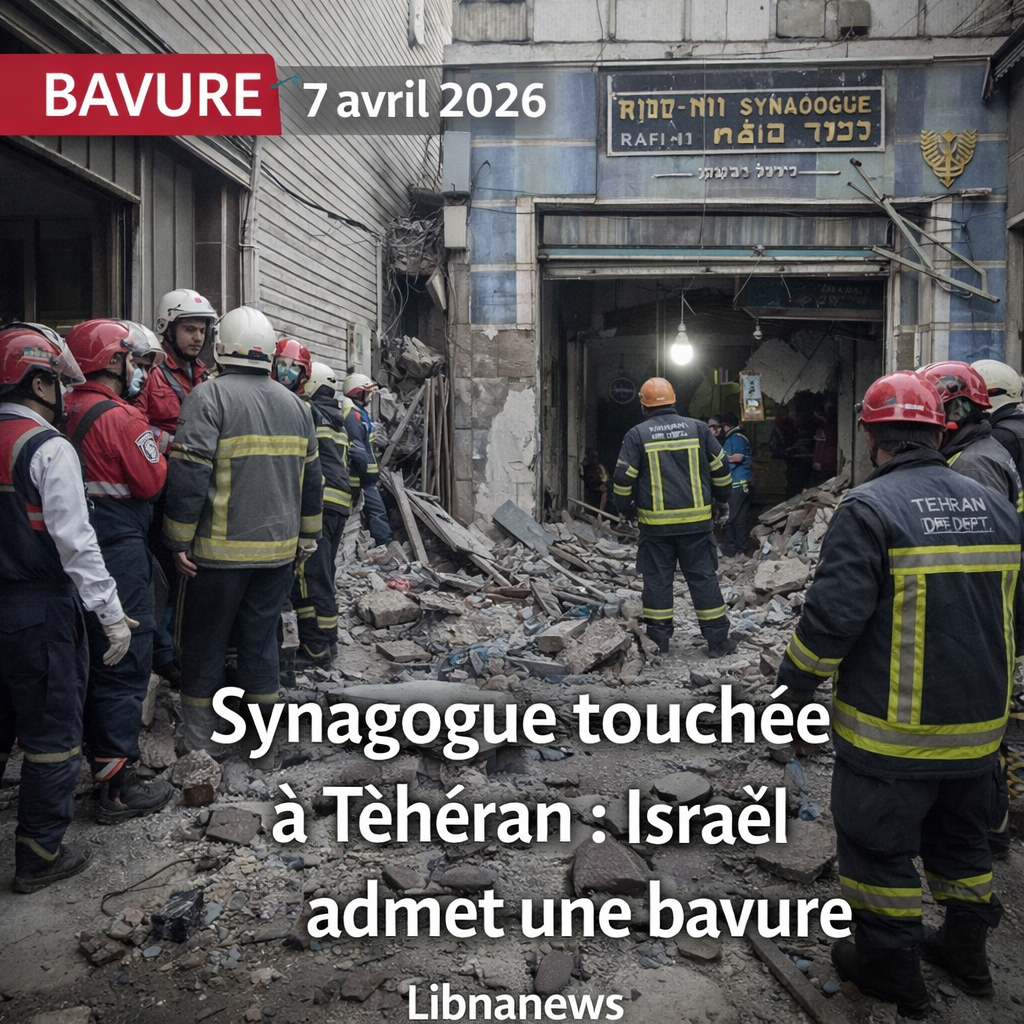
The Israeli army recognized on Tuesday that a strike in Tehran against a « high military commander » had also damaged a synagogue, and expressed its « remove » after this episode. According to an AFP dispatch relayed by several media, the staff maintained that the target was a senior military official, while admitting that a synagogue had been affected in the operation. This recognition is equivalent to the admission of a blunder, even if the Israeli army presents the damage to the place of worship as an unintended consequence of the strike.
The incident comes after reports in the morning by Iranian media that the Rafi-Nia synagogue in central Tehran had been severely damaged or « fully destroyed » during Israeli-American strikes. Videos relayed by Mehr and then taken by several international media showed rubble, scattered religious books and rescue teams on the spot. The exact extent of the damage could not be independently verified immediately, but the sequence quickly took on a major political and symbolic dimension, due to the religious nature of the site affected.
The Israeli declaration marks a turning point in the army’s communication on this strike. To date, the Israeli authorities have claimed the destruction of military infrastructure, bridges and railways in Iran, while denying targeting civilian sites as such. By acknowledging that a synagogue was damaged in an operation directed against a military commander, they admit that a place of worship was reached during a strike they say was targeted. As a matter of fact, it is a blunder recognized by the army itself, although it continues to insist on the military nature of its main objective.
The episode adds a sensitive element to a day already marked by the intensification of strikes in Iran. On Tuesday, news agencies and several media outlets reported attacks on bridges, railways and targets on Kharg Island, Iran’s main oil node. In this context, the synagogue affected in Tehran becomes an additional symbol of collateral effects, or targeting errors, that accompany the expansion of military operations. The Israeli army seeks to contain the diplomatic impact of the case by speaking of « remove », but its formulation amounts to recognizing that a strike supposed to target a high commander has reached a Jewish place of worship in the heart of the Iranian capital.
The scope of this recognition goes beyond military communication. In a regional climate already dominated by accusations of attacks on civilian infrastructure, the Israeli confession comes as the United Nations reminded on Tuesday that deliberately attacking civilians and civilian infrastructure constitutes a war crime. The Israeli army does not claim to have targeted the synagogue itself. But by admitting that such a site was damaged during a strike in a dense urban area of Tehran, it opens a new debate on the real accuracy of its operations and the risks to civilian or religious sites in the current phase of the conflict.
For Israel, the difficulty is twofold. It must both maintain the narrative of a war against Iranian military objectives and contain the political effect of a strike that hit a synagogue. For Iran, on the contrary, the incident provides a powerful argument to denounce the nature of Israeli operations in the capital and highlight the symbolic cost of bombing. Between the two accounts, one fact remains: the Israeli army acknowledged that the operation against a high military commander also struck a place of worship. And this recognition is enough to make this strike not only a military episode, but also an officially accepted blunder.






