

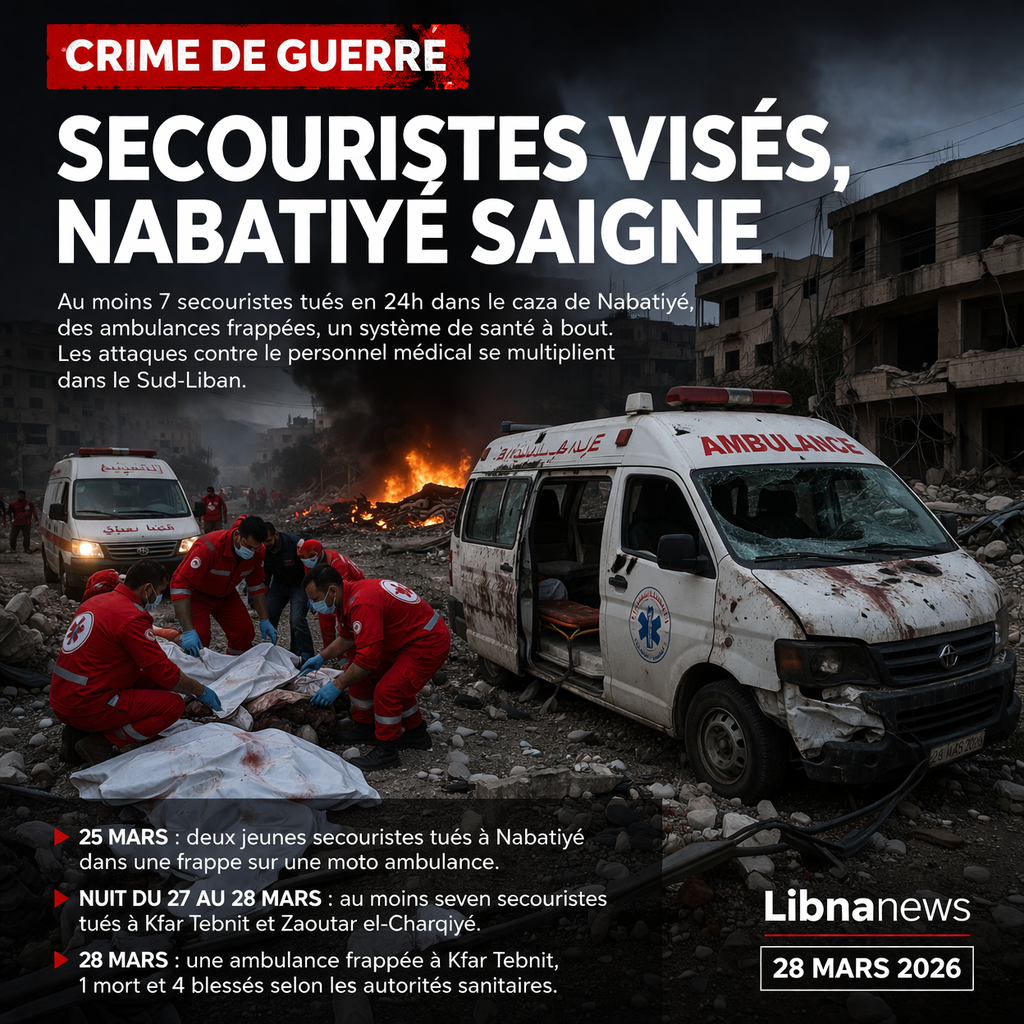
In Nabatiyah, sirens and strikes almost leave no respite. But for the past few days, another marker has imposed itself on the balance sheets: that of the rescue workers killed while acting, travelling by ambulance or going on a rescue mission. In the Nabatiyah district, several attacks recorded this week targeted medical teams and health vehicles, to the point of feeding the accusation, now repeated by the Lebanese authorities, United Nations agencies and several NGOs, of a recurring targeting of health workers. The last episode was particularly shocking: on the night of Friday to Saturday, at least seven rescuers were killed in the Nabatiyah district in separate strikes in Kfar Tebnit and Zaoutar al-Sharqiyah, before a further strike reported on Saturday on an ambulance in Kfar Tebnit left one dead and four wounded according to Lebanese health authorities.
This sequence does not happen in a vacuum. Already on 25 March, two young rescuers, Ali Jaber, 23, and Jud Sleiman, 16, were killed in Nabatiyah in a striking on a clearly identified ambulance motorcycle, according to the Lebanese Ministry of Health and several field reports. Their death caused a particular emotion because it alone summarized the collapse of the theoretical protections supposed to surround the relief missions: two volunteers in uniform, visible, in a city already largely emptied of its inhabitants, struck while they were on a mission or an activity related to relief.
A new murderous night in Nabatiyah District
The information available Saturday morning converges on at least two separate attacks during the night. The first hit vehicles belonging to the Islamic Health Committee in Kfar Tebnit; At least two first aid workers were killed there, according to consistent press reports. The second targeted an ambulance of al-Rissala scouts, affiliated with the Amal movement, in Zaoutar al-Sharqiyah, where at least five rescuers were killed. To this was added, according to Anadolu agency citing the Lebanese Ministry of Health and NNA, a drone raid on an ambulance in Kfar Tebnit on Saturday, with a rescuer killed and four others injured. Caution is still needed on the consolidated count of the last few hours, as the balance sheets are changing rapidly. But one thing is already established: in the Nabatiyah area alone, the rescue teams have still paid a very heavy human price in less than 24 hours.
The repetitive nature of the incidents reinforces the feeling of tipping. The strikes against the first aid workers no longer appear as isolated episodes. They are part of a series of attacks that have affected ambulances, health centres, clinics, paramedics and hospitals since the beginning of the 2 March escalation.The World, which spent several days in Nabatiyah, describes an almost empty city where « no one adventures outside » except the rescue teams, which became both the last safety net and one of the most exposed groups. The first responders interviewed told of the delays in intervention that were prolonged by fear of second strikes, teams forced to wait several minutes before approaching a bombed site, and colleagues buried almost every week.
Figures that document a trend, not an accident
The figures published in recent days by the United Nations agencies and the Lebanese Ministry of Health show that the issue is no longer a matter of various nature. In his statement of 17 March in Geneva, the United Nations humanitarian coordinator in Lebanon, Imran Riza, reported that the WHO surveillance system had already recorded 28 attacks against health workers since the beginning of the escalation, killing 30 people and wounding 35 people, while at least 48 primary health centres and five hospitals had closed due to hostilities. Ten days later, the situation had become even worse: according to the WHO emergency report of 27 March, 64 attacks against the health sector had been identified, with at least 53 caregivers killed and 91 injured.
This rapid increase in figures is more than the gross total. It indicates that medical structures and field teams are not only affected by the collateral effects of intense war. They are among the sectors regularly affected. The United Nations Office for Humanitarian Affairs further reported on 23 March that 64 attacks against health services had resulted in 51 deaths and 91 injuries, while UNICEF reported 67 attacks against emergency medical workers since its report of 19 March. The difference between the counts is explained by the dates of the order, the methods of verification and the perimeter chosen, but all sources point in the same direction: the first aid workers and the health infrastructure have become a full front of this war.
The Lebanese Ministry of Health was advancing, on 25 March, at least 42 paramedics killed since 2 March. This figure, repeated in several international reports, was already very high even before the new series of strikes recorded in the Nabatiyah region. It gives an idea of the national scale of the phenomenon. But Nabatiyé concentrates a particular symbolic part of this violence, because the city is both in relative depth in relation to the border, on the axis of the relief of the South, and in the heart of an area where Israeli strikes have intensified as the army announced its intention to cut South Lebanon from the rest of the country and push to the Litani.
In Nabatiyah, relief work under permanent threat
What is at stake in Nabatiyah is beyond the accounting of the dead. The city is an essential logistics hub for the evacuation of the wounded, the distribution of aid, the orientation of ambulances to hospitals still functioning and the coordination between municipal volunteers, the Red Cross, civil defence and partisan or associative structures. When rescuers are struck, the entire rescue chain in the South is dislodged.The Worlddescribes a popular hospital where caregivers live on site, because they are not safe to go back and forth, and where fear of « double strikes » — a strike followed by a second to reach the responders — is changing the most basic procedures.
The testimony gathered from paramedics by several media gives a concrete measure of this degradation. Some say that they delay their departure to the hit places, wait until a drone moves away or a second explosion does not occur, and then move forward with the feeling of becoming a target themselves. In these conditions, saving quickly sometimes becomes impossible. Medical time runs into military time. In war traumas, however, a few minutes often decide between life and death. This is the perverse nature of the phenomenon: even when an attack does not directly destroy a hospital, it weakens relief if it imposes fear, waiting and disorganization.
Protection of humanitarian law, increasingly theoretical
However, the legal framework is clear. Health institutions, ambulances and medical personnel benefit from specific protection under international humanitarian law. They can only be targeted in highly supervised cases, in particular if they are used to commit acts that are harmful to the enemy outside their humanitarian function. This is Israel’s regular argument that Hezbollah or its nearest structures would use ambulances or medical sites for military purposes. But international and human rights organisations recall that such an allegation is not in itself sufficient to lift protection and that it must be substantiated, proportionate and compatible with precautionary obligations.
The problem is that the current war is taking place in an environment where these guarantees seem increasingly theoretical. Human Rights Watch has already documented, in autumn 2024, three Israeli attacks against health personnel or structures in Lebanon that are described as « apparent war crimes », noting the lack of credible military justification in the cases studied. Amnesty International, in a statement published on 19 March 2026, states that Israel is applying the same « deadly playbook » in Lebanon as in the previous phase of the conflict, with repeated attacks on ambulances, first aid and health facilities, and calls for investigations into war crimes. These organisations obviously do not have the capacity to adjudicate judicially. But their intervention counts because it records the facts of March 2026 in documented continuity, not in a series of independent incidents.
A health system that loses its men before losing its walls
The physical destruction of hospitals remains visible, measurable and photographable. The loss of first aid workers is less, while it can be even more destabilizing. A damaged facility may sometimes be partially repaired, moved or relayed. An experienced paramedic killed in the field does not replace himself in a few days. NGOs and UN agencies have been insisting on this human fragility for weeks. Behind each attack, there are not only dead and wounded, but also an immediate decrease in capacity: fewer teams to leave, fewer ambulance drivers, fewer volunteers available, more fear among those who remain, and often more families who ask their loved ones to stop their missions.
In southern Lebanon, this human erosion affects an area already under pressure before the new war. The Lebanese health system had barely emerged from the economic collapse, shortages of fuel and medicine, and the damage caused by the hostilities of 2023 and 2024. The closures of hospitals and health-care centres documented by WHO are therefore taking place on a weakened basis. Five hospitals are already out of service according to the organization’s latest records, and dozens of health centres have closed. When first aid workers fall in turn, the crisis no longer only affects access to care; It has reached the very possibility of organising a minimum emergency response in the bombed areas.
Nabatiyah, mirror of a war that spreads
The centrality of Nabatiyah is also due to the transformation of the Israeli campaign in southern Lebanon. Several analyses of recent days describe a strategy to separate the South from the rest of the country, to destroy the link infrastructure and to create the conditions of a buffer zone to the Litani. In this diagram, roads, bridges, vehicles and logistics nodes become valuable targets. Relief is all the more vulnerable as it circulates precisely on these axes, as close as possible to the affected areas. It would be imprudent to say, without independent investigation, that every attack on an ambulance necessarily constitutes deliberate targeting. On the other hand, it is factual to note that as the war becomes territorial and the Israeli military grip deepens, first aid workers are exposed to the very centre of this strategy of control of the ground.
This exhibition is already reflected in broader humanitarian statistics. More than one million people have been displaced in Lebanon since the beginning of the escalation, according to UN agencies, and more than 370,000 children have been uprooted in three weeks. Approximately 150,000 people are said to be isolated as a result of the destruction of bridges and roads, further increasing reliance on health convoys and relief teams. In such a context, striking first aid workers, or simply creating conditions where they can no longer intervene quickly, produces an effect far beyond the direct victims. This deprives entire villages of viable access to evacuation, triage and first aid.
An international red line, but without visible deterrent effect
International condemnations are increasing, without producing any obvious deterrent effect so far. Imran Riza reminded mid-March that health facilities and personnel « are not military targets ». WHO, the Red Cross and several United Nations agencies reiterate that attacking health structures immediately increases civilian mortality, even away from directly bombed sites. The Office of the United Nations High Commissioner for Human Rights has also reported that recent attacks on residential buildings, shelters and medical personnel raise serious concerns under international humanitarian law. Yet, in the field, strikes on rescue teams continue. The gap between norm and reality is fuelling a growing sense of impunity.
This shift is not new. It is part of an already heavy liability. According to Human Rights Watch, at least 163 health and relief workers had been killed in Lebanon during the year of fighting prior to the November 2024 ceasefire, and 55 hospitals and 158 ambulances had been damaged. These figures do not concern the current sequence, but they allow us to understand why the warnings of March 2026 are received with particular concern: medical and humanitarian institutions do not leave on a blank page. They return to a war where the attacks on relief have already a documented history, and where accountability mechanisms have not prevented their repetition.
Behind the figures, a political and moral breakdown
Finally, there is a less quantifiable but politically central dimension. In a city like Nabatiyah, first aid workers are often the last civilians to travel permanently. When they in turn become recurrent victims, the war sends a very deep message of desolation: even those whose function is to save are no longer protected. This moral breakdown counts in a conflict where the issue is not only territorial or military, but also psychological. The remaining population, displaced families, the injured waiting for an ambulance, all incorporate this idea that a sanitary vehicle no longer offers the minimum safety it should guarantee.
The title of this sequence could be summed up as follows: in Lebanon, first aid workers no longer die only alongside the war, they die in its axis. In Nabatiyah, this can be seen with particular brutality. Two young volunteers killed on March 25. At least seven rescue workers killed on the night of Friday to Saturday in the same district. A new ambulance hit again Saturday. National balance sheets that grow almost daily. Closed hospitals, stopping health centres, teams that delay their departures for fear of becoming themselves the next target. As long as this dynamic continues, the question will no longer be just how many deaths the South of Lebanon counts, but how many more lives will be lost because those who were to rescue arrive too late, or can no longer arrive at all.






