

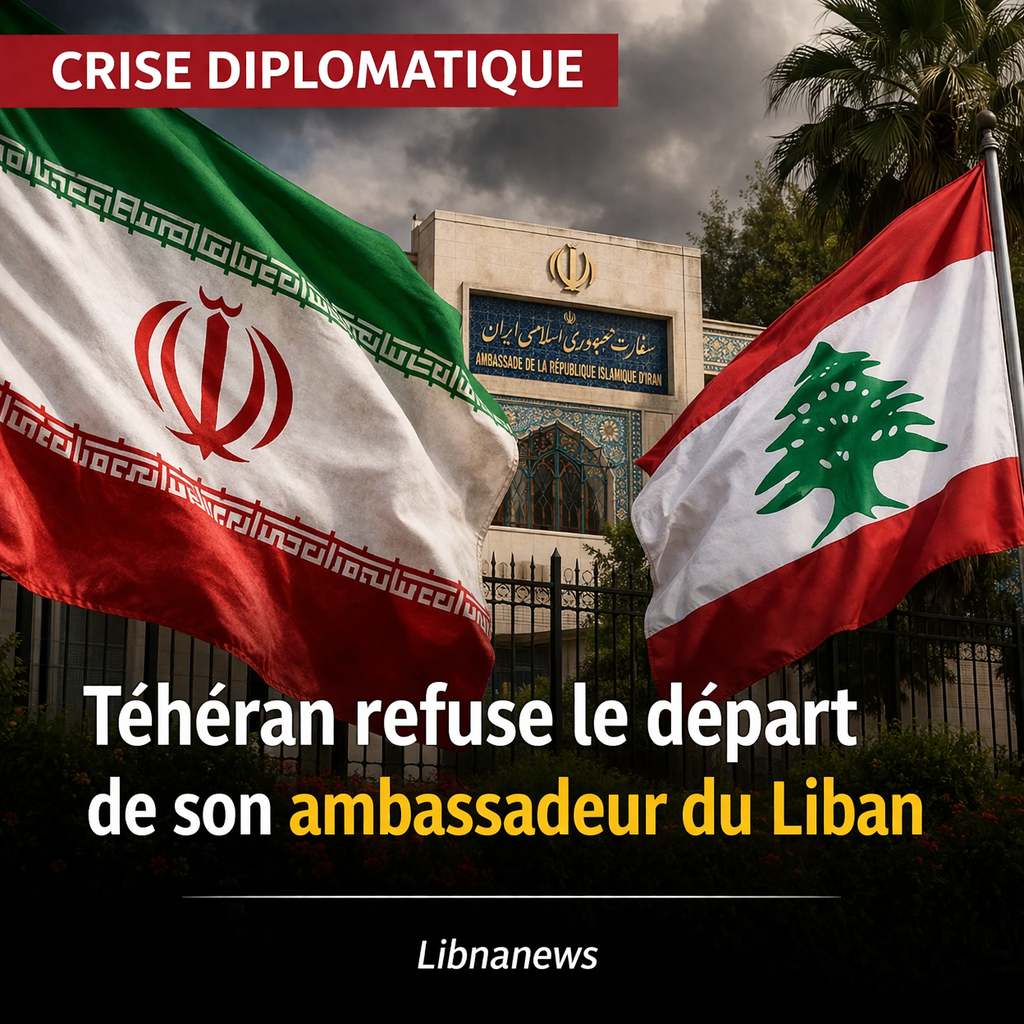
Iran refused on Monday to execute the deportation order against its ambassador in Beirut, opening a new sequence of diplomatic tension with the Lebanese authorities. While Beirut had declared Ambassador Mohammad Reza Shibanipersona non grataand set him Sunday as the deadline for departure, Tehran claimed that he would remain in office. The spokesman for the Iranian Foreign Ministry, Esmail Baghaei, assured that the Iranian embassy in Lebanon remained fully active and that its ambassador was continuing his mission in Beirut.
This Iranian response turns a Lebanese decision into an open arm. So far, expulsion had already been a rare political gesture on the part of Beirut, in a context of increasing pressure against Iranian influence in Lebanon and against the military role of Hezbollah. Tehran’s public refusal to recall its representative now gives the case a stronger institutional dimension: Lebanon has meant a diplomatic sanction, Iran replies that it will not comply with it.
An expulsion order now openly challenged
According to the Associated Press, Lebanon had asked the Iranian ambassador to leave the country in order to reduce the diplomatic presence of Tehran and to bring the Iranian representation back to the level of a Chargé d’affaires. The deadline was Sunday. On Monday, Iran made it clear that this deadline would not be respected. Baghaei told journalists that « according to the comments of the Lebanese authorities concerned and the conclusions reached », the ambassador would continue his mission in Beirut.
At this time, no detailed public response from the Lebanese authorities was reported to clarify the concrete follow-up to this Iranian refusal. This silence leaves open the essential question: how does Beirut intend to enforce a decision of persona non grata when an ambassador remains cut off in his embassy and enjoys, in principle, diplomatic protections attached to his status. The PA notes precisely that the ambassador would still be in the Iranian diplomatic compound in Beirut.
A new stage in the confrontation between Beirut and Tehran
The case does not arise in a vacuum. Five days earlier, the Associated Press reported that Lebanon had crossed a threshold by declaring the Iranian ambassador persona non grata, in a broader movement aimed at reducing the Iranian footprint in the country. This decision came after the Lebanese government banned Hezbollah’s military activities and those of the Iranian Revolutionary Guards on Lebanese soil.
This line is part of a broader political inflection of the Lebanese State. Since the resumption of the war caused by the entry of Hezbollah into the conflict in the name of solidarity with Iran, President Joseph Aoun and Prime Minister Nawaf Salam have sought to convince them that they want to reaffirm the authority of the State and disarm armed non-State actors. The expulsion of the Iranian ambassador was one of the most visible actions of this attempt to regain control.
Hezbollah denounced Lebanese decision
Hezbollah immediately rejected the measure. According to the PA, the movement described it as « unwise and condemnable » and « clear capitulation in the face of external pressures and dictates ». He held a rally near the Iranian embassy to support the ambassador. This reaction shows that the case goes far beyond a simple protocol dispute between chanceries: it is at the crossroads of Lebanese sovereignty, the Iranian presence and the internal power relationship around Hezbollah.
The PA adds that a Lebanese diplomatic official accused Iran of exerting intense pressure over the past week on the government and the Speaker of the Parliament, Nabih Berri, a key ally of Hezbollah, in order to get back on that decision. In other words, expulsion has not only provoked a public protest. It also triggered a political battle behind the scenes to try to prevent its application.
A crisis as Lebanon seeks to disarm Hezbollah
The Iranian ambassador’s file comes as Lebanon tries, in a war context, to move forward with an extremely sensitive agenda: the disarmament of Hezbollah. According to the PA, Beirut fears that Iran’s insistence on including Lebanon in the context of a dialogue with Washington may further complicate the efforts of the Lebanese authorities to reduce the military autonomy of the Shiite movement.
This is central to understanding the scope of the current crisis. In the eyes of a part of the Lebanese state apparatus, the question is no longer merely that of abstract Iranian influence. It is also that of Lebanon’s ability to regain control of a war triggered by Hezbollah and a political scene where Tehran continues to weigh directly. The expulsion of the ambassador was one of the means chosen to signify this will to break. Iran’s refusal to bend is tantamount to a direct challenge to this line.
A camouflet for Lebanese authority
The episode also challenges Lebanese institutions on the symbolic ground. On Monday, Israeli Foreign Minister Gideon Saar commented on the X case, ironing that the Iranian ambassador was taking his coffee in Beirut despite the deportation order, accusing Lebanon of being a « virtual » country under Iranian occupation. Even if this position comes from an actor directly involved in the war and must be read as such, it illustrates the immediate political effect of the arm: Lebanon’s weakness in enforcing its own decision becomes an argument exploited outside.
Within the country too, the crisis worsens the fractures. The PA recalls that Foreign Minister Youssef Rajji, a determined opponent of Hezbollah, is at the heart of this expulsion decision, while Shiite leaders have multiplied verbal threats against him. In this context, the Shibani case becomes a test for the balance of powers in Beirut: either the state maintains its decision, or it gives the image of a power incapable of imposing its choices against the Hezbollah-Iran tandem.
A diplomatic relationship entered into a grey zone
For the moment, there is no indication of a complete breakdown of diplomatic relations between Beirut and Tehran. But the situation has now entered a grey zone. Lebanon has declared its official rejection of an ambassador. Iran replied that the Ambassador remained in office. Between the two, no exit from crisis appears publicly. The absence of a detailed response from the Lebanese authorities, after the expiry of the time limit they had themselves set, leaves open the question of the real means at their disposal to enforce their decision.
This sequence may also complicate broader diplomatic efforts around the war. The PA points out that the divide with Iran already weakens Lebanese attempts to find a solution to the conflict. The more the dispute over the ambassador gets, the more difficult it becomes for Beirut to hold several lines simultaneously: denounce the Israeli invasion, contain Hezbollah, reassure its Arab and Western partners, and avoid a frontal confrontation with Tehran.
A file that goes beyond the protocol question
Basically, the issue goes beyond the personal case of Mohammad Reza Shibani. The case summarizes the question that is now going through Lebanon: who really decides the country’s red lines in the ongoing war. By expelling the ambassador, Beirut attempted to assert a framework. By refusing to leave, Tehran means that it does not recognize this framework as sufficient to challenge its political presence. Between the two, Lebanon is again exposed to a confrontation in which the sovereignty displayed and the real balance of power do not always coincide.






