

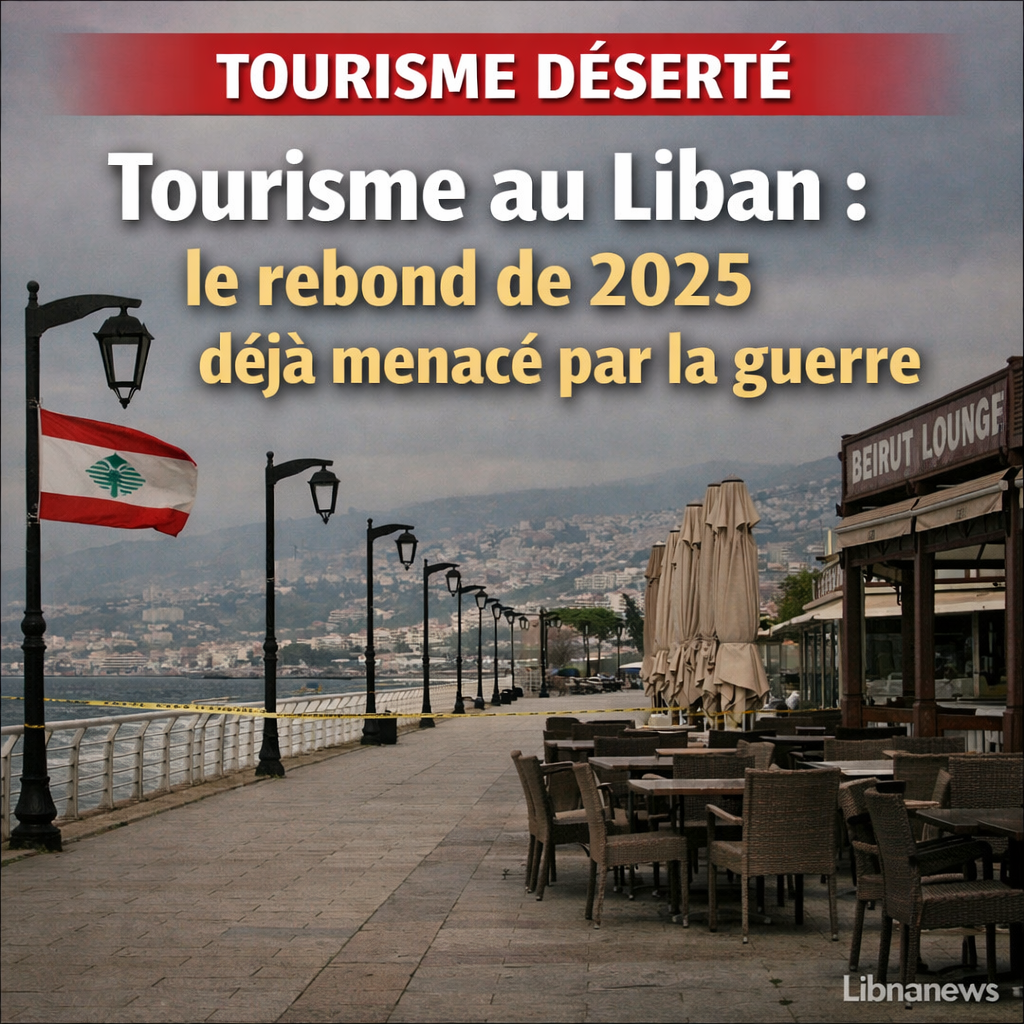
Tourism in Lebanon had offered, in 2025, one of the few tangible signs of recovery in an economy exhausted by six years of crisis. Arrivals of visitors reached1 635 490over the year as a whole, up44.6%compared to 2024. This recovery remained 2 per cent lower than in 2023, but confirmed the gradual return of a vital sector to foreign exchange earnings, seasonal employment and service activity. A few months later, this shimmering is again threatened. The war has put tourism activity back in line with expectations, cancellations and postponements, at a time when the country was hoping to turn a cyclical rebound into a stronger recovery.
The shock exceeds the only decrease in the number of passengers. In Lebanon, tourism acts as an economic transmission channel. When visitors flock, hotels fill up, restaurants turn, car rental, taxis, shops, private beaches, guest houses and cultural events find recipes. When flights become scarce and security uncertainty dominates, the entire ecosystem slows down almost immediately. The note from Byblos Bank also points out that the collapse of tourism activity is the main driving force behind the expected contraction of GDP in 2026, with a projected decline in GDP in 2026.12% to 16%depending on the duration of the conflict.
A real recovery in 2025, but still fragile
The tourism rebound of 2025 was nothing unusual. After a year of severe degradation in 2024, the country had recovered a close association with its usual seasonal capacities. The data contained in the two documents submitted indicate that the total number of visitors went from1 131 100in 2024 to1 635 490in 2025. The increase in44.6%So it was clear. It reflected both a catch-up effect, a renewed displacement of the diaspora, and a relative improvement in the regional environment over part of the year.
The quarterly breakdown also shows that this recovery was consolidated over the months. The first quarter of 2025 showed238 009arrivals, second397 513the third612 101and fourth387 867. The third quarter logically concentrated the seasonal peak, but the fourth quarter also showed a dramatic improvement over the same period of 2024. Arrivals in the last quarter had jumped257 %This is a sign that the basis of comparison was very degraded, but also that the demand had not disappeared. In other words, tourism in Lebanon remained able to leave quickly as soon as security conditions seemed to stabilize.
The summer months illustrated this return. July 2025 had recorded252 079visitors, August209 525June159 469September150 497and December152 391. Annual increases were particularly strong in August, September and December. This sequence confirmed the central weight of the holiday, family visits and diaspora stays in the Lebanese tourism model. The sector is not only dependent on traditional leisure tourism. It also experiences family back and forth trips, festivals, private events and local consumption that irrigates a large part of urban services.
The decisive weight of European and Arab visitors
The structure of demand in 2025 also sheds light on the nature of the current risk. Visitors from Europe represented749 063persons, either45.8 per centTotal. The Arab countries came second with360 771visitors, either22.1%, ahead of the Americas with310 401visitors, either19%. Africa, Oceania and Asia completed the table with smaller shares, respectively4.6 per cent,4.3 per centand4.2 per cent. This distribution shows that Lebanese tourism is based on diversified markets, but very sensitive to risk perception and air accessibility.
This diversity is normally a force. It reduces dependence on a single customer pool. But in times of war, it becomes a shared vulnerability. European travellers react quickly to security alerts, Gulf customers can be restrained by official orders or flight suspensions, while the diaspora adjusts its stays according to the situation on the ground. Lebanon therefore does not lose a single segment. It may see several markets contract at the same time, with a cumulative effect on bookings, expenses and duration of stays. This simultaneousity explains why a security shock can quickly neutralize the gains accumulated in a few months.
The details of increases by geographical area also confirm that the sector had regained some momentum before the new shock. Europe’s arrivals had increased by61.1%in 2025, those of Oceania53.6%Arab countries34.5%the Americas of34.2 %Africa33%Asia and8.5 %. In other words, the recovery was not based solely on a captive segment. It extended to several markets. This is precisely what makes the potential relapse more expensive. When a sector starts to diversify again, it recreates activity flows throughout the territory. When this dynamic breaks, the contraction again affects the entire tourist chain.
War reopened air risk
The most visible signal of the reversal came from air transport. The weekly note from Bank Audi indicates that, almost four weeks after the beginning of the regional war, onlyMiddle East AirlinesandRoyal Jordanianwere maintaining daily flights to Beirut. The first adapted its programme to continue to operate, while the second carefully resumed its Beirut-Amman link on21 March. Most other airlines extended the suspension of their flights to Beirut at least until April.
In a country where the aircraft remains the dominant gateway for visitors, this situation acts as an immediate brake. The problem is not just the mechanical decrease in the number of seats available. It is also due to the loss of visibility. When companies suspend, travellers hesitate. When they postpone week after week, agencies, hotels and event organizers can no longer build a reliable calendar. Even ready-to-travel customers may prefer to wait, due to the lack of guarantees on returns, insurance or the stability of air routes. Tourism in Lebanon then suffers less from a lack of interest than from an inability to project.
The document also points out that Iraqi airspace remained closed and that Syria operated only via Aleppo. This logistical data weighs beyond Lebanon alone. It reduces margins of circumvention, increases regional uncertainties and fosters company prudence. Gulf carriers had already suspended their flights even before the recent escalation, due to political tensions. Those who can redeploy their aircraft to other roads have little incentive to return quickly as long as the security, operational and commercial risk remains high.
A sector that drives much more than hotels
Reducing the impact of the tourism crisis on hotels would be a misreading. In Lebanon, tourism disseminates its revenues in highly fragmented activities. It supports restaurants, cafes, transportation services, seasonal rental, downtown shops, caterers, reception venues, festivals, artisans and an entire economy of services often not visible in global accounts. It is for this reason that the IIF describes tourism as the country’s main source of foreign exchange. When this channel closes, the contraction does not only affect travel professionals. It reaches a portion of local consumption, dollar payments and informal jobs.
Bank Audi’s note on business activity gives an overview of this dissemination effect. It states that, despite the continuation of an activity in certain areas around Beirut, commercial turnover excluding essential goods would have declined by around60 %compared to March 2025. The massive shift from households to essential purchases and the carry-over of non-essential expenditures show how the conflict immediately recomposes demand. However, tourism spending feeds these non-essential consumptions, whether it be leisure, outing, shopping or events. When visitors become scarce, the decline in demand adds to that of residents.
Tourism in Lebanon also has a territorial dimension. Summer gains are not only concentrated in Beirut. They irrigate seaside resorts, mountain restaurants, diaspora villages, wine regions, small guest houses and local cultural activities. A suitable season often allows small structures to finance several months of activity. Conversely, an amputated season or cancelled reservations weaken a whole fabric of micro-enterprises with little cash and very limited access to bank credit.
The first channels of transmission of the shock
- flight suspensions and reduced air capacity;
- cancellations or postponements of hotel reservations;
- decrease in food and recreation expenditure;
- decrease in foreign exchange revenues for services;
- immediate pressure on seasonal and informal employment.
These mechanisms explain why war threatens one of the few sectors that can quickly generate revenue without heavy investment. Tourism alone does not solve Lebanon’s structural imbalances. But it offers cash inflows, maintains active businesses and supports part of domestic consumption. Its paralysis therefore removes one of its most reactive shock absorbers from the economy.
The rebound of 2025 had not erased the frailties
The return of visitors in 2025 did not mean that the area had become strong again. The increase was based on a degraded basis and a still precarious stability. Tourism companies were already operating in an environment of high costs, intermittent electricity, weakened utilities and persistent financial uncertainty. The documents provided on logistics recall that Lebanon suffers from a limited transport system, insufficient infrastructure and high costs for essential services. Even before the current worsening, this reality reduced the country’s competitiveness as a destination.
The conflict adds new costs to these vulnerabilities. The note of Bank Audi evokes an increase of approximately20 %prices, including transport, insurance and transport. It also mentions a risk of an increase in the energy bill, which could fall by around4.8near$6 billionper year if oil tensions persist. For tourism, these factors have a direct effect. They increase the cost of travel, operation of establishments, air conditioning, catering and all services that depend on private generators or imported inputs.
In these circumstances, the sector can be hit at the same time by falling demand and rising costs. This is the most difficult combination to absorb. A tourist company can sometimes survive a hole in the air over a few weeks if its loads remain stable. It resists much less when reservations decline while fuel, insurance, logistics and operating expenses rise. This tension reduces margins, delays recruitment and pushes the most fragile players to close temporarily or permanently.
Tourism in Lebanon remains vital for foreign exchange
A central issue is the role of tourism in the supply of foreign currency. It is described as the main source of foreign currency for the economy. This is crucial in a country where exchange rate stability, import capacity and consumption of many households still depend on dollar flows. Visitors make direct payments to hotels, restaurants and services. They also reinforce the use of cash or cards in an economy where the banking system remains deeply weakened.
When tourism slows down, the external balance thus deteriorates through several channels. Services exports are declining, private foreign exchange revenues are contracting and the economy is more dependent on diaspora transfers and external aid. The same Byblos Bank report also foresees an enlargement of the current account deficit to17% of GDPin 2026, against14 %in 2025, as a result of the war, rising energy bills and falling exports of goods and services. Tourism is therefore not just an image sector. It weighs in the country’s macroeconomic balances.
This dependency also explains how quickly the sector influences general expectations. When visitors return, merchants restock, establishments hire, owners rent, events reprogram. When they disappear, the psychological effect is the opposite. The economic actors cut down their schedules, postpone their purchases and fall back on the essentials. Tourism in Lebanon thus acts as a sign of the general climate. It not only creates activity. He gives or withdraws trust in all services.
Between resistance from the private sector and the economy under stress
Despite this picture, the documents submitted also show the ability of the private sector to adapt. Companies continue to operate in certain areas, move part of their activities, set up flexible work and strengthen their safety measures. This resilience is real. It reflects years of crisis learning. But it is not enough to recreate a normal tourist market. An open hotel, an active restaurant or a standby agency can be maintained. A season cannot be reconstructed without air accessibility, safe visibility and solvent demand.
The risk for 2026 is therefore double. On the one hand, the 2025 recovery could be eliminated within a few weeks if flight suspensions persist and if travellers postpone their summer stays. On the other hand, the deterioration of tourism can amplify the wider contraction of the economy by removing a rapid source of foreign exchange, employment and consumption from the country. It is this interaction that gives the subject its central scope. Tourism is not a peripheral sector. In today’s Lebanon, it is one of the most sensitive barometers of the war and one of the first to translate its effects into daily economic life.
Exact number of body words: 2351
Keyword:tourism Lebanon
Keywords Secondary SEO:
Description:
Extract:
Tourism in Lebanon had recovered in 2025 with more than 1.63 million visitors, up 44.6 per cent year-on-year. But this recovery remains fragile. War, flight suspensions to Beirut, rising costs and falling security visibility are already threatening a central sector for currency, employment and services. Behind tourist arrivals, it’s a whole economic chain that risks going back down.
Alternative securities suggestions:
- Lebanon: War already threatens tourism recovery
- In Lebanon, suspended flights weaken tourism
- Lebanese tourism plunges into uncertainty
- Beirut: The War Stopped Tourism Recovery · Global Voices
- Tourism Lebanon: a 2025 rebound under threat
Coverage:
To comply with your instructions to use areal photoI need an image transmitted by you or a free photo that you want to impose. As soon as you send me, I’ll give you the horizontal cover withred label,visible titleand discreet mentionlibnanews.
Send itnext issueAnytime.






