

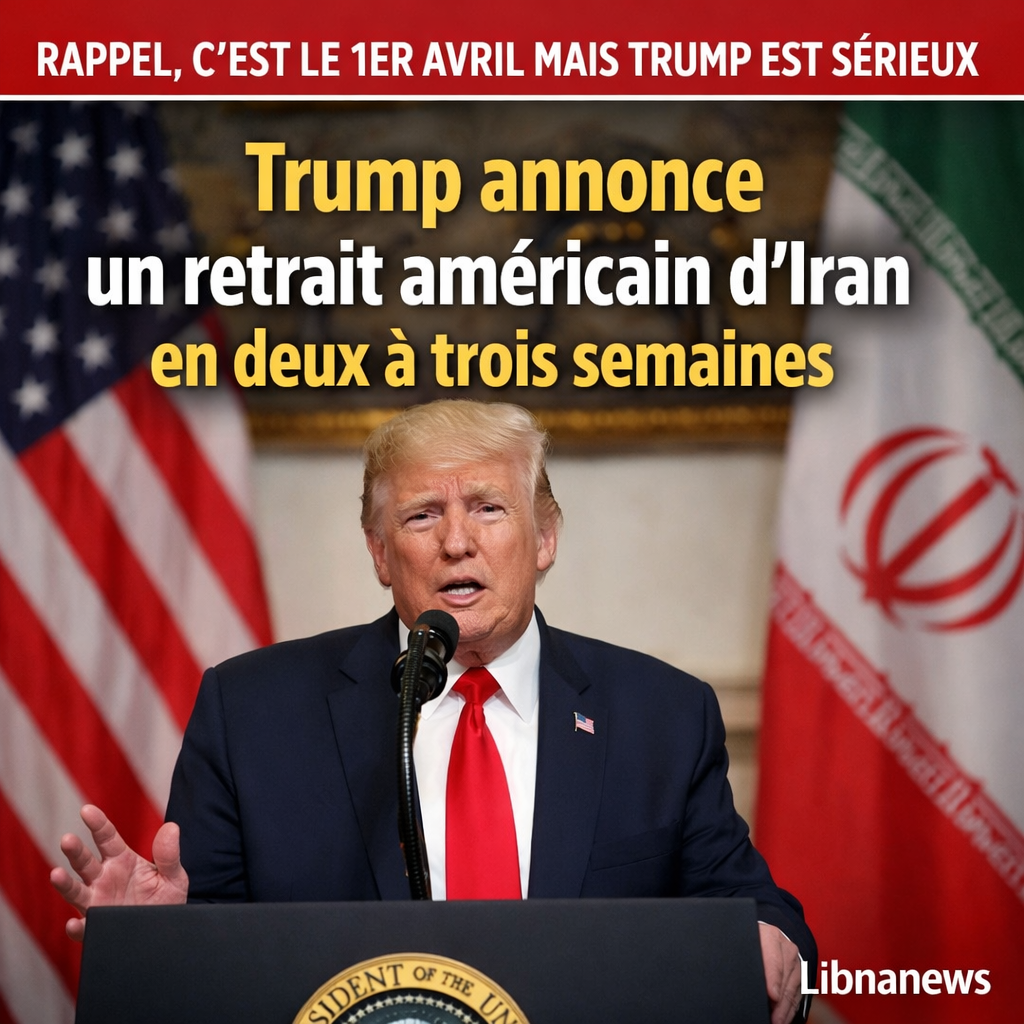
Donald Trump said, Tuesday, March 31 in Washington, that the United States could end its military operations in Iran « in two to three weeks », without making an agreement with Tehran a precondition. This statement, delivered as the war enters its fifth week, is at this stage the most precise indication given by the US President on a release schedule. It does not mean an immediate withdrawal or a ceasefire already concluded, but it publicly sets a political horizon: that of a campaign that the White House presents as close to its end.
The U.S. President has linked this deadline to the objective of the war. According to him, the United States does not need an agreement to stop their strikes: Washington first wants to destroy Iranian offensive capabilities and permanently prevent Iran from gaining access to nuclear weapons. Once that goal was achieved, he suggested, American forces would leave Iranian theatre. This is important because it shows that Trump’s timetable depends less on a diplomatic compromise than on a unilateral assessment of the mission by Washington.
A political promise more than a detailed plan
At this stage, the US administration has not published a detailed roadmap on the practical modalities of a withdrawal. No clear operational timetable has been made public on the pace of disengagement, the volume of forces involved and how the United States intends to manage the post-retirement period. The message broadcast at the moment is first of all political: Trump wants to show that the war is not open without limits, that it can be closed quickly and that the final decision depends on the achievement of American objectives, not on a negotiation agreed by Tehran.
This statement also takes place in a sensitive internal context. In the United States, the idea of military sluggishness worries some of the opinion, while rising energy prices fuel economic pressure. By announcing a window of « two to three weeks », Trump is also seeking to reassure the duration of the conflict. He tries to present the intervention as a short, calibrated campaign close to its conclusion, rather than as the opening of a new long war in the Middle East.
White House prepares new sequence
The declaration of 31 March did not remain isolated. The White House announced that Donald Trump should address the nation Wednesday, April 1 at 9 p.m., Washington time, for an important update on Iran. In Paris time, this address corresponds to the night of Thursday 2 April at 3 a.m. This statement is expected as the time when the US executive may specify what exactly this withdrawal formula means « in two to three weeks ».
For now, the administration maintains a firm line. Secretary of State Marco Rubio also said that the United States was now seeing the « arrival line » of the conflict, while noting that it was not immediate. This consistency of language between Trump and Rubio suggests that the White House seeks to set up the same idea in public space: the war continues, but according to them it enters its final phase.
No formal peace in sight at this stage
One of the most significant elements of the presidential statement is probably the fact that Trump does not, at least publicly, require a formal agreement to stop operations. He explained that Iran was not obliged to conclude a deal for the United States to end its campaign. This means that Washington reserves the right to decide alone when to consider his mission accomplished. This posture contrasts with a classical logic of negotiated de-escalation. It also opens up an area of uncertainty: if the United States withdraws without agreement, there is no guarantee in itself that a new escalation will occur afterwards.
On the Iranian side, the tone is different. Foreign Minister Abbas Araghchi said that there were no formal negotiations underway with Washington, only indirect messages exchanged by intermediaries. He also reiterated that Iran would not accept a simple ceasefire, but would require a complete end to the war throughout the region, as well as guarantees against repeated attacks and compensation for the damage suffered. The gap between the two discourses therefore remains clear: Washington speaks of a possible end without agreement, while Tehran continues to display regional demands and wider conditions.
An announced withdrawal, but a still explosive context
Trump’s announcement comes as the clashes continue to have effects far beyond Iranian territory. Attacks and counter-attacks have affected several Gulf countries, Lebanon and regional energy routes. At the same time, the Strait of Ormuz remains at the heart of the tensions. Trump also stated that the safety of this passage was no longer the responsibility of the United States, inviting the countries dependent on this route to take their own responsibility. This position accompanies his withdrawal speech: it suggests that Washington wants to reduce its direct involvement, including on one of the major strategic points of the crisis.
However, this line does not end the risks. As long as the strikes continue and no stable diplomatic framework exists, the prospect of an American withdrawal remains a political promise, not yet a military reality. The formula « two to three weeks » has a real but limited scope: it indicates the will of the US President, not the existence of a disengagement already on the ground.
What we can say at this stage
The verified facts are therefore as follows. Donald Trump stated on March 31 that the United States could be « finished » in Iran within two to three weeks. He linked this deadline to the idea that Washington wants to neutralize Iranian offensive and nuclear capabilities, without making an agreement with Tehran a mandatory condition. The White House announced a presidential address for April 1st to the evening in Washington to give an important update on the war. However, no detailed withdrawal plan has yet been made public, and no formal end to the conflict has been announced.
In other words, Trump’s sentence marks a political turning point in the White House communication. She’s creditizing the idea of a future exit. But as long as it is not followed by precise operational announcements or a verifiable drop in strikes, it remains above all a presidential statement on American intent, not yet proof that an effective withdrawal has begun.






