

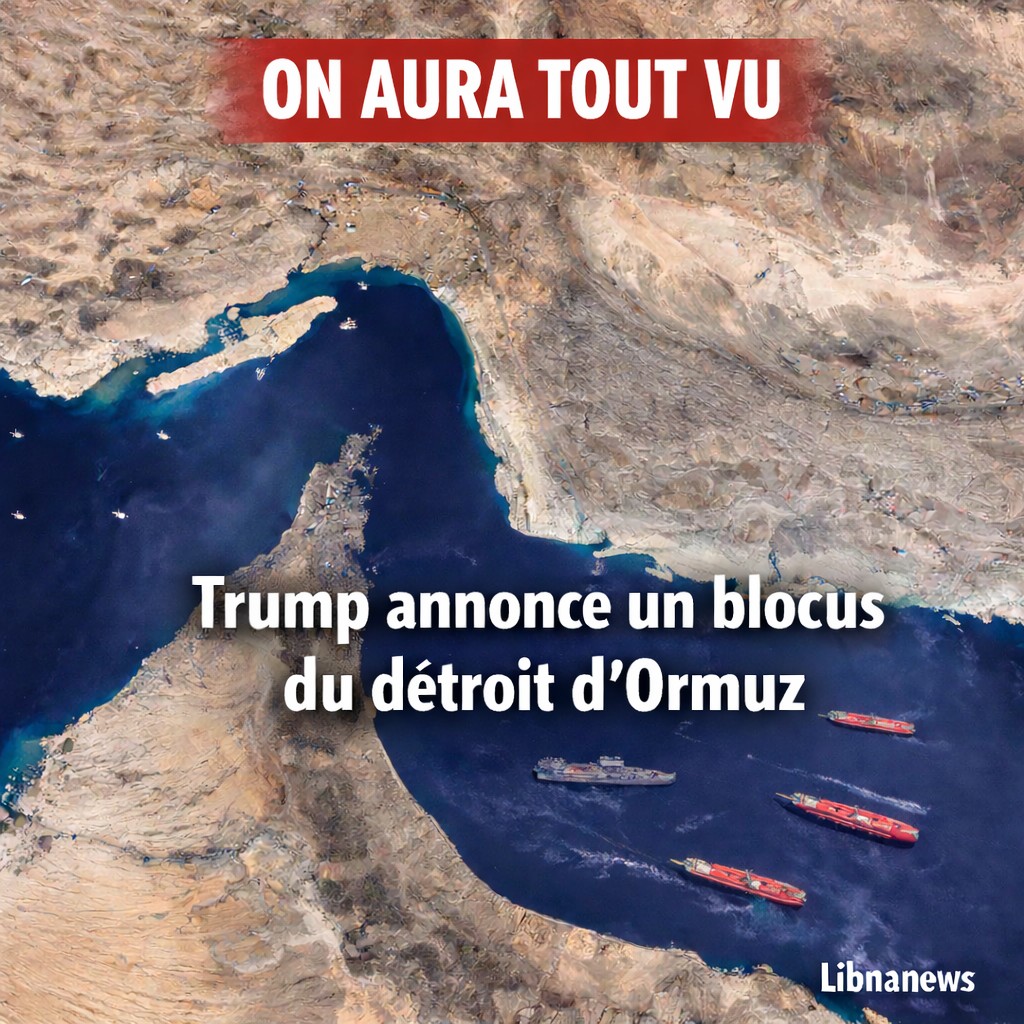
Donald Trump chose climbing rather than patience. A few hours after the failure of U.S.-Iranian discussions as promising, the U.S. President announced a naval blockade of the Strait of Ormuz and the search for any ship that paid a toll to Iran. In the same movement, he revived the commercial weapon by brandishing 50 per cent tariffs against countries that would militarily assist Tehran. Behind the sequence of communication, a reality is already emerging: the crisis in the Strait of Ormuz is again becoming the centre of gravity of a confrontation where maritime security, energy prices, international law and rivalry with China intertwine.
An announcement to change the crisis
The ad first took the form of a martial message. Donald Trump said the U.S. Navy was going to begin immediately to block the Strait of Ormuz, following talks in Islamabad between American and Iranian officials. These discussions, the first at this level in years, had led to convergence on several points, but they have focused on the essentials: Iran’s nuclear programme, the control of the sea crossing and the political conditions for a lasting ceasefire. In the same text, the U.S. President also ordered the interception of ships that allegedly paid a toll to Tehran to cross the Strait, calling this illegal payment. The formula aims to delegitimize Iran’s attempt to mingle a passage that the law of the sea considers an international road, and to place Washington at the centre of the regional security game.
A few hours later, however, the White House revealed the gap between political promise and military reality. When questioned about Fox News, Donald Trump admitted that such a blockade would take a little time. That confession counts. A blockade is not simply published on Truth Social. Naval means, rules of engagement, intelligence, ship identification procedures and, above all, acceptance of the risk of armed clashes with Iranian forces or with civilian intermediaries are needed. The US President also mentioned the possible involvement of other countries, without naming them. This reservation suggests that Washington is still seeking to transform a political threat into a credible operational arrangement, even as the ceasefire reached a few days earlier remains precarious and its expiry date is approaching.
However, the Islamabad discussions suggested a partial outcome. According to consistent reports, several technical points had advanced, but the US nuclear red line remained intact. JD Vance reiterated that Washington demanded an Iranian commitment not to develop the atomic weapon. Tehran, for its part, denounced excessive demands, called for the release of frozen assets, war reparations and a form of control over Ormuz, while linking the file to a broader ceasefire, particularly in Lebanon. This accumulation of targets has transformed the negotiation into a package that is almost impossible to complete in a weekend. The result is this: in the absence of a framework agreement, each camp is now trying to move the balance of power on the terrain that it best controls, the United States by sea, Iran by geography.
Why the Strait of Ormuz matters so much
The Ormuz Strait focuses so much attention, because no other sea gully weighs so much on the world economy. In 2024, the oil flow in the region reached an average of 20 million barrels per day, or about 20 per cent of global consumption of petroleum liquids. According to the latest data from the International Energy Agency, the passage still absorbed around 20 million barrels per day in 2025, or nearly a quarter of the world’s maritime oil trade. Added to this is liquefied natural gas: about 20% of global LNG flows crossed Ormuz in 2024, especially from Qatar and the United Arab Emirates. Clearly, an incident in this corridor does not only affect the Gulf. It immediately recomposes expectations for inflation, transport, industrial costs and fiscal balances in many importing States.
The vital nature of the Strait also explains the extreme nervousness of markets since the beginning of the crisis. Flows have already slowed sharply in the spring, to the point of forcing the International Energy Agency to coordinate in March an emergency destocking of 400 million barrels, the most important in its history. Prices have responded in a sudden fashion. The Brent peaked at almost $128 in early April, before falling back under $95 after the announcement of a temporary ceasefire. But this respite remained fragile. In the physical market, some crude qualities have still close to or exceeded 150 dollars per barrel during the peak of disturbances. This volatility reflects simple evidence: even when a ship can theoretically pass, insurance, war risk, delays, inspections and fear of a strike are enough to disrupt trade.
| Indicator | Recent level | Issue |
|---|---|---|
| Oil flows via Ormuz | 20 Mb/d in 2024 | About 20% of global consumption of petroleum liquids |
| World maritime oil trade | Nearly 25% in 2025 | Immediate impact on global supply |
| Global LNG trade | About 20% in 2024 | Strong exhibition of Qatar and Asian buyers |
| Brent | Pic close to $128 early April 2026 | Rapid transmission to prices and inflation |
Energy benchmarks based on recent EIA and EIA data.
The Strait of Ormuz at the heart of a legal arm
Legally, the sequence opened by Donald Trump does not only oppose Washington to Tehran. It tests the freedom of navigation itself. The United Nations Convention on the Law of the Sea enshrines straits used for international navigation and specifies that riparian States should not impede transit passage. The International Maritime Organization recalled from 1 March that this freedom of navigation is a fundamental principle of international maritime law. A few days later, the UN agency decided that a toll imposed on Ormuz would create a dangerous precedent. In other words, the Iranian logic of the fee-for-passing right of way undermines the legal architecture of maritime routes. But the American response also raises some serious questions: an American blockade, accompanied by interceptions on the high seas, would move the dispute from the ground of law to that of naval coercion.
This legal tension is coupled with a broader strategic calculation. Donald Trump is not only trying to prevent Iran from drawing an immediate rent from the crisis. He wants to demonstrate that the United States remains able to impose the rules of movement in the Gulf, even after weeks of floating. The message is addressed to shipowners, insurers, Gulf monarchies and Western allies. He also addresses American opinions, to whom the president sells an image of total firmness against Tehran. The problem is that this demonstration of force encounters a paradox. The more Washington threatens to militarize the passage, the more the cost of using the strait increases, including for the actors the United States claims to protect. Maritime safety then depends less on a power proclamation than on an ability to restore a predictable routine, which none of the protagonists currently offer.
China in Trump’s sights
China appears watermarked behind this surge in pressure. On April 8, Donald Trump announced that any country supplying weapons to Iran would be subject to immediate tariffs of 50%, without exemption. The U.S. president did not mention any state, but the message was clearly aimed at Beijing and, to a lesser extent, Moscow. Both capitals denied any recent delivery of weapons. However, for months Washington has been suspecting transfers of equipment, components and technologies that could strengthen Iran’s military apparatus. The commercial lever completes here the naval tool: on one side, the United States promises to control the sea; on the other, they threaten to punish the logistic depth of one opponent. The crisis in the Strait of Ormuz is therefore also a theatre of Chinese-American rivalry, well beyond the Iranian question alone.
However, this tariff threat is not without fragility. In February, the US Supreme Court reduced Donald Trump’s use of its largest tariff lever, that derived from the International Emergency Economic Powers Act. To quickly strike China or other alleged suppliers of Iran, the executive should therefore rely on narrower instruments, such as Section 301 or Section 232, with less comfortable legal and sectoral bases. The president can still threaten quickly. He can no longer act as freely as he did a few months earlier. Again, the gap between the verb and the tool counts. It does not mean that the threat is empty. It means that it is more negotiating than automatic, more intended to weigh on Beijing calculations than to produce a uniform tariff wall on all Chinese imports tomorrow.
What Washington is looking for
- delegitimize the Iranian toll on the Strait of Ormuz;
- deter shipowners and suppliers of weapons from dealing with Tehran;
- make it clear in Beijing that military support to Iran would have a commercial and strategic cost.
The choice of targeting China is not annoyed from the energy point of view. Beijing remains a central outlet for Iranian crude oil, and EIA data show that the largest increase in Iranian exports in 2024 was precisely absorbed by China. At the same time, US imports from China declined from $538.5 billion in 2018 to $308.4 billion in 2025. This decrease partially reduces the US quantitative exposure to a new tariff salve, but does not remove dependence on sensitive segments. By threatening China in the context of the Ormuz Strait, Donald Trump thus plays on two fronts: he tries to deter military support in Tehran while recalling that trade in Washington remains an ordinary geopolitical weapon and not a mere economic issue.
A shock beyond oil
The shock wave already exceeds energy. UNCTAD warns that disruptions in Ormuz increase freight rates, war insurance premiums and marine fuel costs. The Agency also points out that approximately one third of the world’s maritime trade in fertilizers, i.e. nearly 16 million tonnes, is passing through this road. A long-term closure or a disputed blockade would therefore result in not only oil and gas but also agricultural inputs, with delayed effects on food prices. For already fragile emerging economies, the shock would be twofold: a heavier energy bill and lower budget margins. The IMF and the World Bank are approaching their spring meetings with this conflict as the third major global shock after the pandemic and Russian invasion of Ukraine, at the risk of a further slowdown if the crisis continues.
The navigation data confirms this battle of wear and tear. Despite the temporary ceasefire, only a few supertankers have resumed crossing the Strait, while hundreds of other buildings remain blocked in the Gulf or awaiting clearer instructions. Traffic does not go back simply because a truce is announced. Charterers want guarantees, captains want safe corridors, insurers want stable rules, and ports want to know which authority actually controls the passage. This is what the American announcement claims to decide. But until a clear mechanism of security is accepted on the ground, the reopening of the Strait of Ormuz will remain more a diplomatic slogan than a return to normal for world trade.
In the Gulf, reactions reveal a mixture of principle support and operational concern. The United Arab Emirates stressed that the Strait does not belong to Iran and cannot be closed at its convenience. Pakistan’s mediators, the European Union, Oman and Russia are, however, pushing in the same direction: maintaining the ceasefire and reopening a negotiating area. This caution is easily explained. An American blockade could contain Iranian ambitions in the short term, but it would also create a new zone of permanent friction at the entrance to the Gulf. Exporting countries need a free, secure and banal passage. They have no interest in replacing unstable Iranian control with an open naval confrontation between Iran and the United States. In this region, power reassures less by its intensity than by its predictability.
Trump method, between sideration and blur
Basically, the last trumpian sequence follows a familiar logic. The president advances by successive shocks, mixing maximum announcement, trade threat, destruction vocabulary and tactical margin of retreat. In one day, he promised an immediate blockade, admitted that it would take time to put it in place, revived pressure on China and reaffirmed his willingness to hit Iranian infrastructure further in the event of diplomatic failure. This method produces a real political effect: it forces all actors to react to its tempo. But it also feeds structural instability, because shipowners, markets and chanceries never know whether the phrase of the day is a lasting line or a level of negotiation. In the case of Ormuz Strait, this uncertainty is already almost as much as a military act.






