

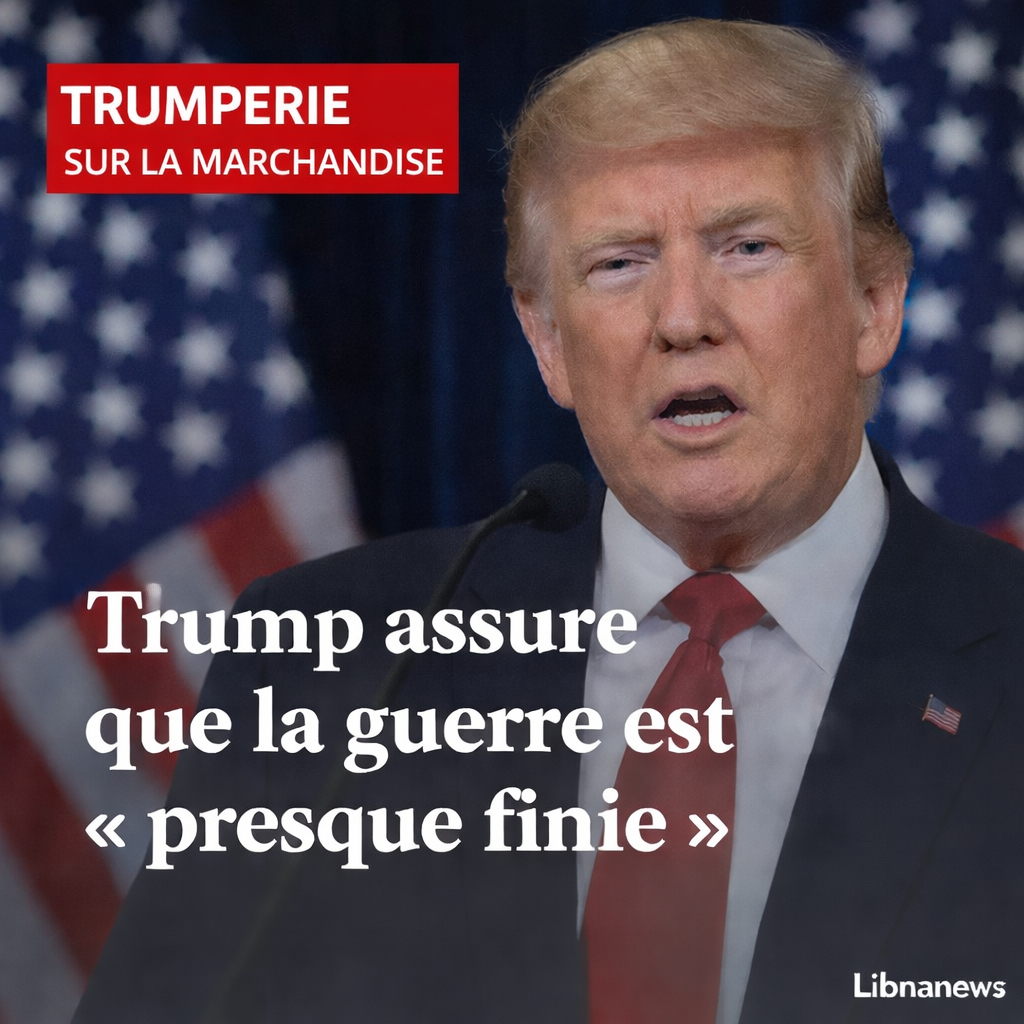
Donald Trump says the war against Iran is « almost over. » The formula strikes, as it suggests a rapid shift after several weeks of military escalation, oil disturbances and opaque deals. Yet, behind this post-crisis narrative, the facts describe a more unstable situation. The ceasefire entered into force on 8 April, but remains fragile. Last weekend’s discussions in Pakistan failed. At the same time, Washington imposed a maritime blockade on Iran, presented by the US General Staff as sufficiently effective to stop Iran’s entire trade by sea. Between victory speech, maximum economic pressure and possible resumption of talks, Donald Trump is trying to take over the political narrative of a war whose outcome remains suspended from several major locks.
Trump already claims an exit from war
On Tuesday evening, April 14, Donald Trump assured Fox News that the war was « almost over ». A few hours earlier, he had also indicated in an interview with the American press that a new round of discussions with Iran could be held « in the next two days » in Pakistan. This joint was not improvised. The US President now links his communication to two simple ideas: Iran would be weakened to the point of wanting an agreement, and the US would be in a position of strength to impose the terms of de-escalation. The message is aimed at both American opinion, regional allies and markets, which now respond to each negotiating signal as well as military developments.
This scoping also allows Donald Trump to turn a confused sequence into a quasi-victory story. However, the first round of discussions in Islamabad with Vice-President JD Vance resulted in no agreement. The negotiators left without breakthrough, in the background of deep disagreement over Iran’s nuclear programme, the fate of enriched uranium stocks and the pace of possible lifting of sanctions. The US President therefore seeks to present the initial failure not as an impasse, but as a step towards a compromise which he now says is close. It is a classic way of moving the look: less towards the real content of the negotiations than towards the idea of an imminent outcome.
Pakistan’s choice as a venue for mediation reinforces this staging. Trump praised the « super job » of Pakistan’s army leader, Asim Munir, as a central facilitator of a resumption of dialogue. UN Secretary-General António Guterres himself considered a « high probability » of a forthcoming resumption of discussions after an exchange with Pakistan’s Deputy Prime Minister. This convergence does not mean that an agreement is ready. Rather, it indicates that several capitals want to avoid an immediate resumption of open hostilities, even as American coercive instruments continue to rise.
A war that the facts do not say is over
The presidential affirmation comes up against a simple observation: the war is not formally closed. A two-week ceasefire had been in effect since 8 April, but it was not a political settlement. JD Vance himself acknowledged that there was still a deep mistrust between Washington and Tehran, impossible to erase overnight. The Vice-President said he felt « very good » on the track of the talks, while admitting that mutual distrust remained massive. In other words, the White House wants to make people believe in a dynamic of peace, but its own leaders still describe a relationship on the brink of relapse.
The regional theatre is also far from real stabilisation. The expanded conflict began on 28 February with American and Israeli strikes against Iran, followed by Iranian responses against Israel and Gulf States with American bases. Subsequently, Hizbullah opened a support front in Tehran on 2 March, triggering an Israeli offensive in Lebanon. This sequence caused thousands of deaths and massive displacements. The available records indicate that approximately 5,000 people have died in hostilities, including nearly 3,000 in Iran and 2,000 in Lebanon, while the Lebanese authorities report more than 1.2 million internally displaced persons. A war that still produces such human and regional effects is not seriously summarized in a formula for a near end.
The Strait of Ormuz is another denial of the rapid proclamations. Despite the ceasefire, the passage remains largely paralyzed. On Wednesday, 15 April, traffic there represented more than a fraction of the more than 130 daily crossings observed before the war. Gulf exports remain constrained, forcing refiners and importers to urgently seek replacement shipments. Until this central energy corridor is truly reopened and secured, the economic core of the conflict remains active. To say that the war is almost over while its main geostrategic shock continues to block world flows is at least political anticipation.
The US blockade, maximum pressure under the vocabulary of peace
The clearest contradiction lies in the American choice to tighten the pressure at the very moment when Trump talks calmly. On Monday, 13 April, Washington implemented a blockade of Iranian ports. On Wednesday, Admiral Brad Cooper, head of the U.S. Central Command, claimed that U.S. forces had completely stopped the maritime economic trade entering and leaving Iran in less than 36 hours. According to him, this traffic accounts for 90% of the Iranian economy. Several ships were forced to turn around, including one tanker held by Chinese interests under US sanctions. Eight oil tankers linked to Iran had already been intercepted since the start of the operation, according to several consistent reports.
This strategy was nothing but a gesture of negotiation. It is a major coercive escalation. The Trump administration wants to strangle Iran’s ability to export, trade and finance its economic resilience. At the political level, the White House presents this blockade as a tool for peace, designed to force Tehran to return to the discussion table. In practical terms, this is an assumed military and economic power ratio. This gap between the vocabulary used and the reality of action nourishes the central angle of the sequence: Trump speaks as if the conflict were closing, while Washington still acts as if an opponent had to bend in the midst of war.
The oil market perfectly reflects this ambivalence. On Wednesday morning, the Brent operated around $95.22 per barrel and the WTI around $91.11, after a sharp decline the day before. Investors do not read these declines as proof of a return to normal, but as the translation of a bet: that of a possible resumption of discussions and a future relaxation of constraints. Recent movements show above all that prices are now more responsive to diplomatic signals than to developments in the battlefield. This means that the market believes in the possibility of relaxation. This does not mean that he considers war to be settled.
The real node remains nuclear
Still a complete disagreement
The main obstacle did not disappear. During last weekend’s talks in Islamabad, the nuclear issue blocked any breakthrough. Washington proposed a 20-year suspension of all Iranian nuclear activity. Tehran advanced a much shorter duration, three to five years depending on the available evidence. The United States also demands that enriched nuclear material be released from Iran. On the other hand, the Iranian authorities are calling for the lifting of international sanctions. Behind these positions is the real heart of the conflict: not only a military ceasefire, but the definition of what would be an acceptable capitulation for one of the parties and an acceptable compromise for the other.
Trump himself complicates the picture. In the American press, he marked his distance with the idea of a mere 20-year suspension, for fear that it would be interpreted as a concession too favourable to Tehran. This hesitation underlines a structural problem of the American posture: the White House wants to announce a near peace while maintaining a maximalist objective on Iranian nuclear power. The higher the American demand, the more difficult it becomes to convert a tactical ceasefire into a lasting agreement. Presidential communication therefore advances faster than the real diplomatic architecture.
IAEA recalls technical reality
The Director General of the International Atomic Energy Agency, Rafael Grossi, stressed on Wednesday a decisive point: no agreement can be credible without « very detailed » verification mechanisms. The Agency estimates that Iran has 440.9 kilograms of enriched uranium at 60%, a level close to the military threshold. Grossi said that the duration of a possible moratorium was a political decision, but that any formula would require rigorous inspections. This intervention puts at the centre what the political narrative tends to simplify: a war can interrupt militarily before being settled on its main object. As long as the nuclear issue remains as sensitive, talking about an almost finished war is more of a slogan than a statement.
| Block point | American position | Iranian position |
|---|---|---|
| Duration of a nuclear moratorium | 20 years proposed | 3 to 5 years |
| Stocks of enriched uranium | Departure from Iran required | Negotiated storage or dilution |
| Penalties | Pressure maintenance | Amount requested |
| Controls | Enhanced verification | Still blurred acceptance |
These lines summarize the still visible gap between the two parts. Negotiations may resume, but their red lines remain distant. Trump would like to capitalize politically on a rapid peace. Iran wants to avoid signing under duress a text that looks like a nuclear surrender. Between the two, the Pakistani mediators mainly try to prevent an immediate return to escalation.
Pakistan, diplomatic scene of forced de-escalation
Islamabad is no longer a simple secondary decor. Pakistan has established itself as a useful channel of contact because it maintains relations with Washington, several Gulf monarchies and Tehran, while also having an interest in preventing regional expansion of the conflict. In publicly greeting Asim Munir, Donald Trump recognizes this utility. António Guterres also stressed Pakistan’s role, which gives mediation additional international legitimacy. For the US administration, Pakistan offers neutral terrain, far from European capitals and less politically charged than a return to Oman or Vienna.
This mediation, however, does not mask the weakness of the moment. If Washington and Tehran already had a solid foundation, they would not need such a crisis activism to find themselves in an emergency after the weekend failure. Pakistan therefore serves less to endorse a peace than to maintain a thread of discussion as military and economic pressure continues. It’s an in-between diplomacy. It saves time, calms the markets and offers the protagonists a scene where to step back without completely losing face.
The U.S. President uses this configuration with skill. By announcing that « something could happen » within two days, he sets up a wait and regains control of the media calendar. But this way of occupying the public space also serves to compensate for political fragility. If nothing concrete emerges from Islamabad, the formula on an almost finished war may turn against him. The closer Trump presents peace, the higher the political cost of a new failure or a resumption of strikes.
The story of the victory before the deal
One of the constants of trumpism is the primacy of the narrative over the effective stabilization of the files. On Iran, this logic appears naked. Trump is not just saying that discussions could resume. He already suggests that the conflict is nearing completion. This narrative advance has several functions. It reassures a part of the American electorate hostile to a slurry. It responds to criticism of the economic cost of the crisis. Finally, it presents the blockade and the maximum pressure not as a dangerous gear, but as a strategy that would have already borne fruit. This reading is an analysis, but it is based on the very tight chronology between the failure of the first talks, the American maritime hardening and the abrupt optimistic inflection of the presidential communication.
However, this narrative remains vulnerable to regional reality. In Lebanon, the fighting and destruction attributed to the expanded war left a highly degraded human and political landscape. In Washington, the first direct discussions between Lebanese and Israeli representatives in decades have been described as « constructive », without a clear peace framework. Hezbollah remains open. Lebanese internally displaced persons have not returned. Humanitarian demands remain. As long as this secondary front remains active, it recalls that the war with Iran is not limited to the American-Iranian face-to-face.
The global economic record is similar. The IMF lowered its global growth forecast by 2026 and warned that a harder scenario, with oil around $100, was becoming increasingly plausible. Under the severe assumption, the world economy would fall to 2 per cent growth, at the brink of recession, with inflation exceeding 6 per cent. These figures say one essential thing: even if Trump wants to tell the end of the war, the world continues to pay the price as if it were a still active and potentially lasting conflict.
Why Trump Speaks Now
This communication must be read in its domestic and international context. On the domestic front, the White House needs to show that the offensive against Iran does not open a new quagmire. The memory of the long American wars in the Middle East still weighs on opinion. To claim that the conflict is almost over is to protect the executive from the trial in strategic recklessness. This also helps to defend the idea that the US demonstration of force has produced results quickly. This interpretation is an analysis, but it is consistent with the chain observed since the ceasefire and the simultaneous tightening of the maritime system.
Internationally, Trump seeks to speak at several hearings at the same time. To the Gulf allies, he wants to show that he keeps the initiative. To Europeans, he wants to argue that an agreement is not impossible despite the brutality of the blockade. To China and major Asian importers, it sends the signal that a relaxation can eventually reopen energy flows. And in Iran, it means that there is still a way out, provided that it is presented as the fruit of American power. The President therefore speaks less of the military reality of the moment than of the negotiating position he wants to impose. Again, this is a journalistic reading based on the facts available.
This method is not without risk. If Tehran believes that Washington wants to humiliate it while already selling a political victory to American opinion, it may be tempted to tighten its position again. If the ships continue to be hijacked, if Ormuz remains in fact obstructed and if no credible compromise emerges on nuclear power, the calming rhetoric will quickly lose its credibility. Trump’s sentence now works as a communication bet. It does not yet have the strength of a diplomatic finding.
A possible peace, not yet achieved
Nevertheless, there are elements that prevent Trump’s words from being reduced to a simple brawl. First, the ceasefire still holds, which was not acquired a few days ago. Secondly, the Secretary-General of the United Nations and several regional intermediaries are likely to see a rapid resumption of discussions. Finally, oil markets have clearly responded to this prospect by erasing part of the war premium. These signals show that de-escalation remains plausible. They explain why Trump can try to award merit in advance.
But caution remains essential. War is not just an exchange of strikes. It is also a state of tension in which a maritime blockade, a partially closed strait, conflicting nuclear demands and still active secondary fronts are sufficient to prolong the conflict in other forms. Even if Washington and Tehran are in Pakistan this week, the resumption of discussions alone will not tell if the war is over. It will only say that the two parties prefer, for the moment, to negotiate under pressure rather than immediately resume the open climb.
This is where the true meaning of the sequence is played. Donald Trump tries to pass an armed truce and a successful blockade for the warning signs of almost achieved peace. The facts available allow a more nuanced diagnosis: the war is not over, but a window of de-escalation exists. It depends on the maintenance of the ceasefire until 22 April, Pakistan’s ability to put delegations around the table, the acceptability of a nuclear compromise and the American choice between maximum pressure and negotiated exit. For the time being, the US president is already speaking as if he had closed the case. The ground, on the other hand, continues to recall that the end of a war is not proclaimed until it is locked.






