

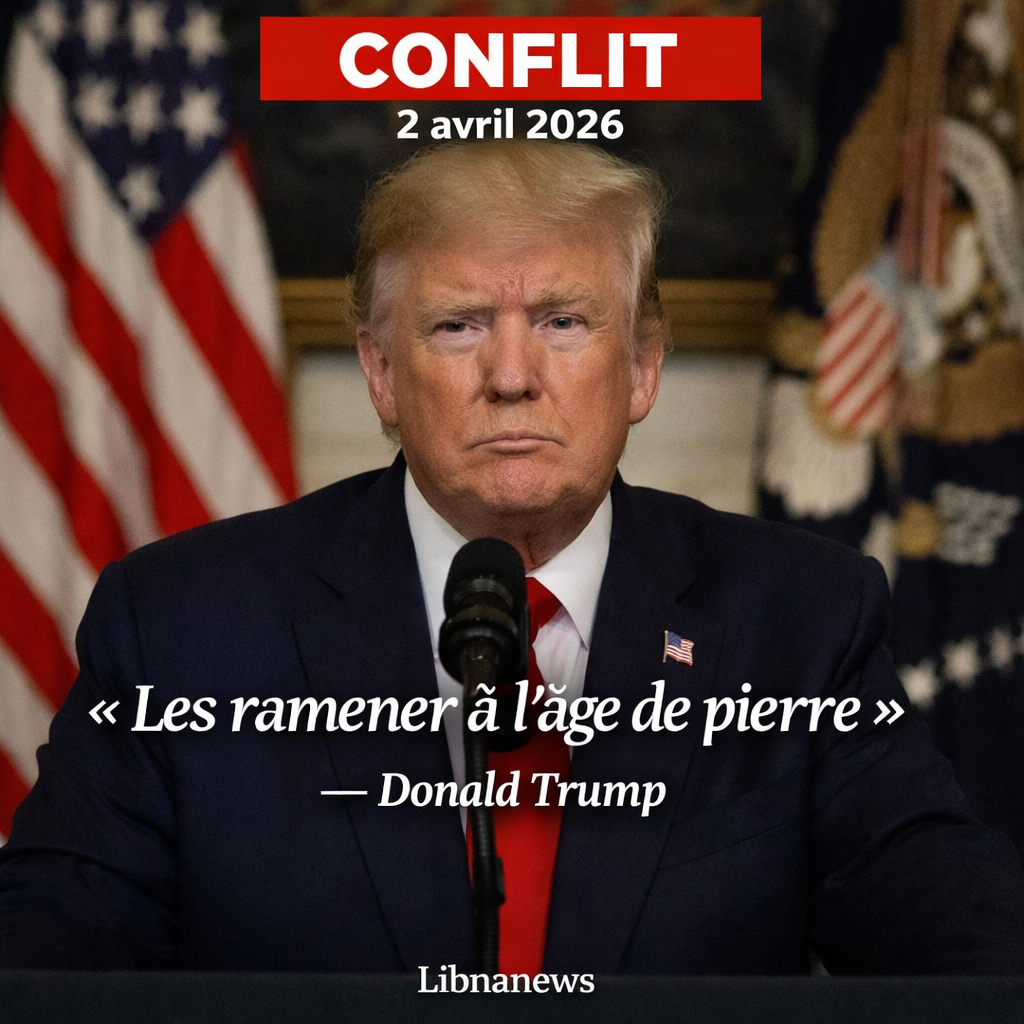
In his first live television address since the beginning of the war against Iran, Donald Trump said on Wednesday, April 1, that the United States was about to achieve its military objectives. But the core of his message was a climbing formula: if no agreement is reached, Washington will continue to strike and could target vital Iranian infrastructure. The U.S. President presented an almost complete campaign, while announcing further possible attacks in the next two to three weeks.
A speech built around a promise of strength
Donald Trump’s speech had a simple objective: to convince the American opinion that the war on 28 February was entering its final phase, without giving the impression of a retreat. The President therefore articulated his speech around a double message. On the one hand, he assured that operations with Israel had already produced « unprecedented » results. On the other hand, he warned that the campaign would not stop until Tehran accepted American conditions. This logic allows him to present the continuation of the strikes not as a sluggishness, but as the ultimate stage of a announced victory.
The most commented sentence came in the middle of this demonstration. Donald Trump said that, in the absence of agreement, the United States would « strike them extremely hard » and « bring them back to the stone age » within the next « two to three weeks. » The formula is both military threat and political communication. It is intended to mean that Washington reserves the possibility of destroying the essential capabilities of the Iranian state, beyond the only military targets already struck in the past month. It is also used to give a short deadline, to make it appear that a outcome is near.
In appearance, therefore, the President announces an imminent end to the conflict. In reality, his speech suggests above all that the White House wants to keep all options open. It did not set a net exit date. He did not submit a detailed diplomatic roadmap. Nor did he explain what would be an acceptable agreement. His speech juxtaposes three ideas: objectives are almost achieved, negotiations exist, but bombardments can still intensify rapidly. It is this ambiguity that dominates the speech.
What Trump says he already got in Iran
Donald Trump first sought to set up the idea of massive military success. According to him, the Iranian aircraft was hard hit and the country is no longer able to represent the same threat as before the offensive began. He described near-fulfiled targets, claiming that the Iranian navy and air force had been destroyed and that the country’s ballistic and nuclear capabilities had been severely damaged. To be heard, the campaign is no longer an open war with an uncertain outcome, but a finishing operation.
This presentation is central to his political narrative. The President has repeated for several days that Iran has been « annihilated », or at least neutralized as a regional military power. With this in mind, the strikes already carried out would suffice to justify the war. The additional attacks would no longer be intended to change the balance of power, but to impose the latest American terms. This allows it to respond to a concerned opinion about energy prices and the risks of escalation: the war would be almost won, so its cost would be temporary.
But the speech does not detail the real state of Tehran’s remaining capabilities or how Washington intends to verify its assertions. The President did not provide a precise assessment, military timetable or independent evaluation mechanism. His intervention is based more on domination than on a technical explanation of the results obtained. The slogan is clear: the United States dominates the sky, has the initiative and can decide the pace of the future alone. This is also why Trump insists on the supposed impotence of Iranian defences.
The central threat: hitting vital infrastructure
What Donald Trump really added on Wednesday night is not the description of new military successes. That’s the precision of the targets it could then target. He stated that, without agreement, the United States had « strategic targets » and explicitly cited Iranian power plants. This is an important shift. So far, US communications have focused on military installations, missile-related sites, nuclear infrastructure and command centres. By referring to the power grid, the president is expanding the threat to the country’s vital infrastructure.
This is a political as well as a military development. Threatening a country’s electricity means that the pressure will no longer be on the armed forces or the leaders, but on the general functioning of the economy and daily life. The message to Tehran is clear: if the Islamic Republic does not surrender, Washington can increase the civil, industrial and administrative costs of war. Trump also pointed out that Iran’s oil facilities had not yet been targeted, but that they remained, in his view, easy targets. He therefore built a hierarchy of threats: first electricity, then oil, with the idea that the United States would still retain itself.
This rhetoric has a negotiating function. The president is not just saying: we can continue. He says: we can still do much more harm. It is a way of turning military uncertainty into a diplomatic lever. But this method also has a interference effect. The more Trump insists on the « almost finished » character of the war, the more he must explain why he evokes strikes of an even greater magnitude. His speech therefore oscillates between the promise of a close conclusion and the psychological preparation for a new phase of destruction.
An agreement mentioned, but never defined
The U.S. President reiterated that discussions were « in progress ». However, he did not say anything about the content of a possible agreement. No details were given on the nature of Iran’s expected commitments, on the potential role of mediators, and on the precise sequence between ceasefire, maritime reopening and security guarantees. This absence is not secondary. It shows that the White House seeks above all to preserve a political margin of manoeuvre, without locking itself in terms that could be measured or contested.
Trump thus maintains a useful ambiguity for him. He can present himself simultaneously as a determined warlord and as a willing negotiator. If Tehran gives in, he can say that his firmness paid off. If the bombing continues, he can argue that Iran refused the opportunity offered to him. This structure of discourse, very classic at home, makes it possible to make adversary the exclusive responsible for the future escalation. The words chosen on Wednesday evening are exactly in line with this logic: the door to the talks remains open, but it is framed by the threat of a much more violent shock.
Again, the most important point is not what he detailed, but what he left behind. The President did not explain whether the discussions focused primarily on nuclear, the Strait of Ormuz, ballistic capabilities, the form of Iranian power or on several of these topics at once. His speech gives the image of a global negotiation, but without visible architecture. This reinforces the perception of a shifting balance of power, in which presidential communication counts almost as much as diplomacy itself.
Change of regime: official denial, persistent assumption
Another major point of the speech concerns the Iranian regime. Donald Trump said he had never talked about regime change. In the same movement, he said that the previous leaders had died and that, according to him, a new, less radical group had emerged. This formulation deserves attention. Officially, the White House is trying to rule out the idea of a war to overthrow power in Tehran. But, in fact, the President describes an Iranian political landscape already transformed by the strikes.
The message sent is therefore double. Outside, Washington seeks to avoid the accusation of an assumed war of overthrow, which is increasingly difficult to defend diplomatically. Inside, Trump wants to show his electorate that he got more than just a degradation of military installations: he would have changed the very structure of the opposing power. This tension between official prudence and political boasting goes through all the talk. She explains why the President can deny an objective while claiming a result that is very similar to him.
This part of the speech also sheds light on its broader relationship to war. Trump does not describe a limited, circumscribed, legally limited campaign. He speaks of a confrontation intended to reshape an opponent considered irreducibly dangerous. When he claims that Iran is no longer « the terror of the Middle East », he is not content to announce a nuclear risk reduction. It presents a regional reconfiguration already accomplished by force. This is beyond the scope of a punitive operation.
Ormuz Strait, absent from detail but present in background
Even without developing the subject at length in his address, Donald Trump has placed all of his strategy in the context of Ormuz Strait. For several days, it has been linking the halt of US military pressure to the resumption of maritime traffic in this essential passage for Gulf oil exports. He did not recall in detail, on Wednesday evening, the deadline he himself had set for 6 April for the reopening of the strait. But the subject remains the implicit lock of the entire file.
The President has also developed a very political reasoning on this point. According to him, the question of Ormuz would not first be an American problem, as the United States produces enough hydrocarbons to limit its direct exposure. On the other hand, he explained, European and Asian Gulf oil-dependent countries should take the initiative to protect this sea route. This is one way of referring the strategic cost of securing world trade to others, while saying that Washington can help without any effort alone.
This passage reveals another dimension of his speech: the war against Iran also serves as a forum for his criticism of the allies. Donald Trump blames partners for not participating in the campaign, while now asking them to take part in regional security. His message, therefore, does not only target Tehran. It is also intended for Allied capitals, invited to buy more American oil and show more firmness. On this ground, the threat against Iran is accompanied by political pressure on US partners.
An attempt to reassure Americans about the economy
The discourse did not only have a military dimension. It also addressed a very concrete concern: rising gasoline prices and nervous markets. The speech took place as public support for the conflict declined and the executive sought to calm an opinion concerned about the economic cost of the war. Donald Trump therefore chose to minimize the internal impact of the crisis, explaining that price tensions were primarily the responsibility of Iranian actions and that they would dispel once the conflict ended.
The president also stressed the strength of the US economy, saying that the stock exchange had fallen less than expected and that a quick rebound was still possible. The reasoning is consistent with his whole speech: it must be convinced that the war remains under control, that the strategic gains exceed the immediate costs and that the current disturbances are only a transitional transition. In other words, Donald Trump does not only speak by commanding in chief; He also speaks as president who knows that the price of gasoline remains a major political indicator for American households.
But this part of the speech also remains based on a promise more than a demonstration. He did not introduce any new economic measures, nor did he announce any precise mechanism to ameliorate the shock in the long term if the crisis were to continue. Here again, his method is to bet on the supposed speed of the outcome. As long as the White House can argue that the outcome is near, it can present current turbulence as temporary. This is one reason why the « two to three weeks » formula occupies such a central place in the speech.
Donald Trump’s speech is based on six messages. First, he claims that US military objectives are almost achieved. Secondly, he said that the war could still last two to three weeks. Thirdly, he warns that strikes could target vital infrastructure, including the electricity grid. Fourthly, it refers to negotiations without giving the terms. Fifthly, he denies officially seeking a change of regime while describing an Iranian leadership already replaced. Finally, he tried to convince the Americans that the economic impact would remain limited and temporary.
The formula on « stone age » alone summarizes this sequence. It’s not just an isolated verbal outrage. It condenses the central idea of the discourse: to make Iran understand that the United States considers itself to be in a position of total force, which they believe to have already destroyed the essential, but that they can still take on what allows the country to function. It is a word of coercion, intended as much to impress the adversary as to convince the American public that the White House retains control of tempo.
But the speech does not dissipate the shadow zones. It is not clear under what conditions the bombings would cease. It does not specify how a possible agreement would be guaranteed. It does not resolve the contradiction between almost finished war and promised new destruction. What Donald Trump said on Wednesday night is therefore both very simple in the tone and very vague in the final political objectives: a declared victory, an amplified threat, a negotiation mentioned, and a timetable still suspended from Washington’s choices as well as Tehran’s response.






