






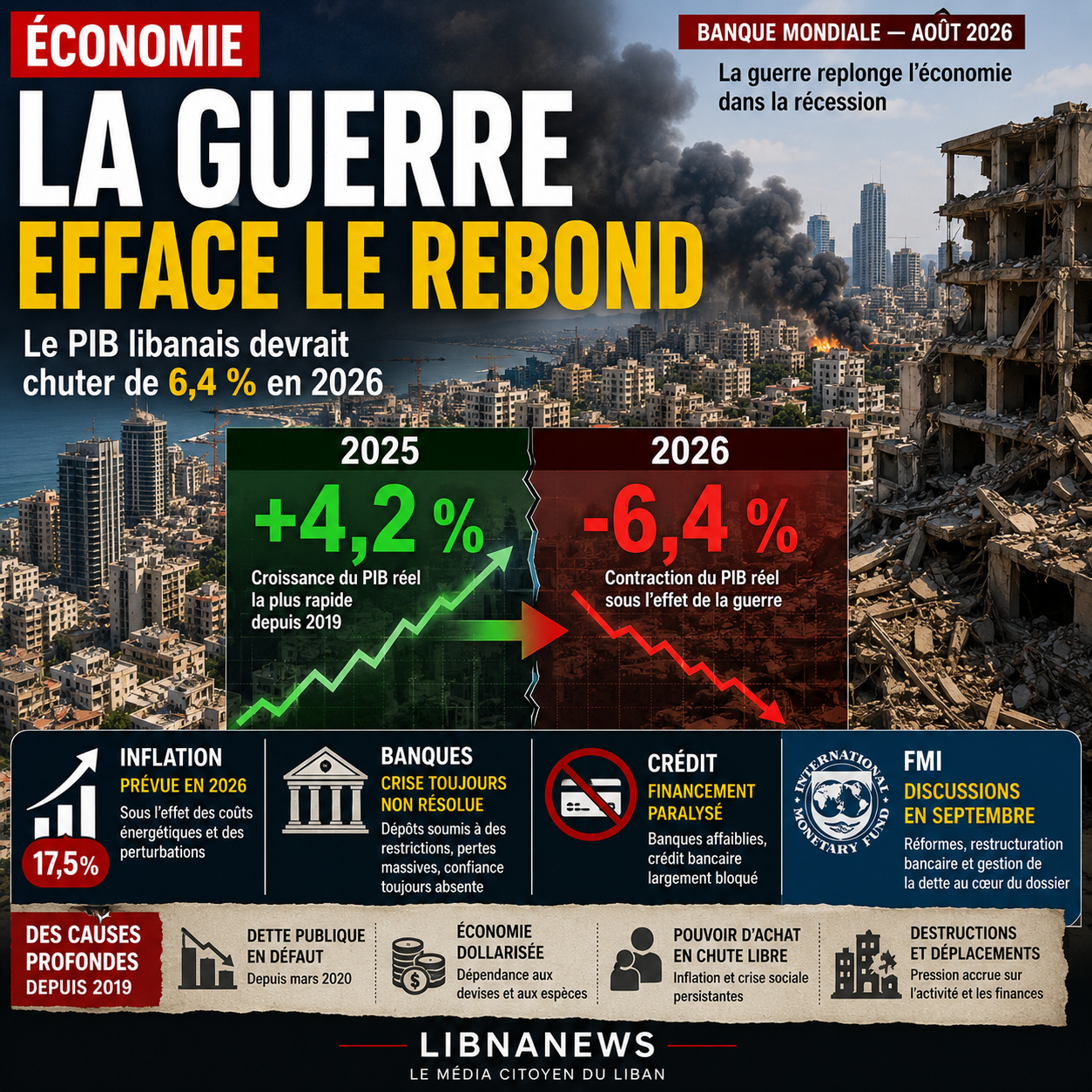
The World Bank forecasts a 6.4% contraction in the Lebanese economy in 2026 as a result of the war, with an expected inflation rate of 17.5%. The shock erases the 4.2% technical rebound recorded in 2025, which was not yet a real structural recovery after the collapse started in 2019. Banks still in crisis, restricted deposits, unrestructured sovereign debt, accumulated losses in the financial system and largely paralysed credit had left Lebanon without real shock when a new conflict hit its economy.
The World Bank now forecasts a 6.4 per cent contraction in Lebanon’s real gross domestic product in 2026. The institution directly attributes this relapse to the war, which caused a fall in tourism, weakened consumption and disrupted supply chains. Insecurity and prolonged displacement also reduce activity, while destruction and uncertainty affect household and business decisions.
The reversal seems dramatic in terms of the estimated 4.2 per cent growth rate for 2025, the highest since the financial crisis broke out in 2019. But the comparison must be interpreted with caution. This increase was largely due to a technical rebound after several years of contraction and from a very depressed economic base. It did not mean a return to pre-crisis activity or the restoration of the mechanisms necessary for sustainable growth.
The Lebanese economy had certainly regained more activity in 2025. Tourism, private consumption, diaspora transfers and some investments had supported this catch-up. But banks still did not normally finance the economy, depositors did not have all their savings freely, public debt remained in default and accumulated losses in the financial system had still not been definitively distributed. The country was therefore experiencing a cyclical improvement without having solved the structural causes of its collapse.
It is this distinction that gives full scope to the World Bank’s forecast. The war of 2026 did not interrupt an assaine economy that would have returned to a normal cycle of growth. It strikes an economy that was only beginning to recover after several years of collapse, while maintaining a large part of the vulnerabilities that have emerged since 2019.
War erases the technical rebound of 2025
The change from +4.2 per cent in 2025 to -6.4 per cent in 2026 represents a 10.6 percentage point difference. The World Bank explains this deterioration by several simultaneous effects of the conflict: collapse of tourism, weakening consumption, disruption of supplies, continued insecurity and displacement of population. They all affect sectors that had participated precisely in the technical rebound of the previous year.
Tourism occupies a special place in this equation. In a private economy with a fully functioning banking system, visitor spending and foreign exchange inflows play a greater role than they would have in an economy with normal financing channels. Hotels, restaurants, transport, shops and many services depend directly or indirectly on this activity. As a result, security degradation quickly reduces the incomes of a large part of the economy.
Consumption suffers the same shock. Population displacement changes household spending, while uncertainty encourages those who can maintain more cash. Companies delay investment when visibility of activity, supply and security deteriorates. At the same time, destruction increases the financial need to repair housing, shops, equipment and infrastructure.
These mechanisms explain why the 2025 rebound could be quickly interrupted. It was based in part on the return of activities very sensitive to stability and on an economy largely financed by the currencies available outside traditional bank credit. This form of resilience allows the private sector to function, but it does not provide the same protection against a major shock.
Expected inflation at 17.5%
The recession should be accompanied by further price acceleration. The World Bank forecasts an inflation rate of 17.5 per cent in 2026, driven by supply disruptions, rising shipping costs and rising oil prices. For Lebanese households, this trend threatens to further reduce purchasing power after several years of monetary crisis.
The increase in energy prices has a particularly wide impact. Lebanon relies heavily on imports for its energy needs, while private generators remain essential for many households and businesses. An increase in fuel therefore simultaneously affects transport, electricity generation, logistics and the final cost of many goods and services.
The situation is different from that of the early years of the crisis, when the collapse of the pound directly fuelled extremely high inflation. A significant part of the economy now operates in dollars and cash. This dollarization has brought a form of stability to transactions, but it has not removed inequalities between households with foreign exchange income and those whose resources remain primarily denominated in pounds.
Above all, it did not recreate a real financial system. The economy can operate on a daily basis thanks to cash, foreign transfers and dollar revenues. On the other hand, it faces far more difficulties when it comes to financing heavy investments, granting credit over several years or mobilizing savings to rebuild productive capacities.
The Lebanese economy remains marked by the collapse of 2019
Current fragility is rooted in the economic model that developed before 2019. For years, Lebanon has depended on large inflows of capital and deposits, particularly from its diaspora. Banks offered high remuneration to attract currencies. They then placed a considerable part of these resources with the Bank of Lebanon or with State financing.
This mechanism enabled both government deficits to be financed and the dollar to support the parity of the pound. But it required the permanent arrival of new currencies to remain viable. When capital inflows slowed and confidence deteriorated, the system gradually lost its ability to meet its commitments.
From 2019 onwards, banks have imposed restrictions on withdrawals and transfers abroad. As a result, depositors kept bank balances denominated in dollars without being able to freely dispose of their funds. For a long time, these restrictions have been applied without a general legal framework for capital control, with conditions that vary according to banks, accounts and successive mechanisms.
The banking crisis quickly contaminated the entire economy. The depreciation of the pound destroyed much of the real value of income in national currency. Bank savings have been stopped. Credit collapsed. The State ceased to repay its external debt in March 2020. The Lebanese economy has thus entered into a simultaneous banking, monetary, budgetary and social crisis.
Banks, Bank of Lebanon and State: interlocking losses
The main difficulty lies in the interlocking of balance sheets. Commercial banks had placed a considerable portion of their resources with the Bank of Lebanon and financed directly or indirectly the State. The central bank itself had accumulated significant commitments to the banking system. Finally, the State had accumulated a public debt that had become unsustainable.
When this system collapsed, the losses did not disappear. They have been divided between these different balance sheets without a rapid adoption of a comprehensive mechanism to determine who should absorb them. Banks hold claims on the State and Bank of Lebanon, while depositors hold claims on banks. Any solution applied to one of the actors therefore has consequences for others.
The World Bank had estimated losses in the financial sector at over $70 billion in the early years of the crisis. Their magnitude must be placed in the exceptional size that the banking system had reached before 2019. Bank assets accounted for about 450% of GDP at the end of 2018, a sign of a financial sector that has become disproportionate to the real economy.
This explains why the crisis could not be solved by simply recapitalizing a few institutions. The problem concerns simultaneously the losses of the Bank of Lebanon, the commitments of the State, the own funds of banks and the rights of depositors. The central issue for several years has been how to allocate these losses without making public debt permanently unsustainable or putting the bulk of the cost on savers.
Deposits remain at the heart of the banking crisis
For households, the problem has a much more concrete dimension. Some of the savings accumulated before 2019 remain subject to restrictions. Different mechanisms allowed partial or framed withdrawals, but the normal operation of a foreign currency bank account was not restored for all old deposits.
The issue of deposits is thus one of the main obstacles to final restructuring. Recognizing a debt is one thing; The availability of the assets to repay it is another. The system must determine which resources can actually be mobilized, in what order the losses must be absorbed and in what period the depositors can recover their funds.
The International Monetary Fund stresses in particular the need to respect a hierarchy of creditors compatible with international practices. Shareholders and holders of claims of lower rank must bear the losses before they are transferred to depositors. This issue is particularly sensitive in Lebanon because of the considerable difference between the nominal value of the system’s liabilities and the assets actually available.
Delays since 2019 also have an economic cost. As long as the balance sheets are not sound, banks cannot fully regain their traditional function. The deposit crisis is therefore not only a conflict between institutions and savers. It also prevents the restoration of economic financing.
Credit remains one of the major absences from recovery
The technical rebound of 2025 precisely illustrated this anomaly. The activity could progress without any real reboot of bank credit, thanks to the current dollars, diaspora transfers, business own resources and tourism spending. But this operation has obvious limits.
A company can finance its daily business in cash. It faces more difficulties when it wants to build a factory, buy expensive equipment or start a multi-year investment programme. Households face the same problem of financing housing. Without banks capable of turning savings into medium- and long-term loans, the economy’s investment capacity remains reduced.
The war makes this weakness even more costly. The destruction creates precisely long-term financing needs. Housing, shops, farms, equipment and infrastructure must be repaired or rebuilt. In a financially normal economy, part of this expenditure would be financed by credit, markets and the State. Lebanon now has much more limited possibilities.
This explains why positive growth in 2025 could not be equated with an exit from the crisis. A real structural recovery would have implied the return of a functioning banking system, credit recovery, restructuring of public debt, credible treatment of losses and a lasting improvement in productive investment. These conditions were not met when the war broke out.
Sovereign default continues to limit the state
The banking sector is not the only financial shock absorber of which Lebanon remains private. The State has been in default on its external debt since March 2020, when it announced that it would not repay a eurobond maturity. More than six years after this decision, the country has still not regained normal access to international markets.
This situation severely limits the government’s ability to respond to a new crisis. A State with sustainable debt and market confidence may borrow to temporarily finance exceptional expenditure. Lebanon does not have that margin under the same conditions. War-related needs are emerging as the country has already had to restructure its debt and rebuild the credibility of its public finances.
The origins of this problem are also old. For years, the State has accumulated deficits and high debt, largely financed by the local financial sector. Banks and the Bank of Lebanon have thus become closely linked to the financing of the Treasury. When the State ceased to be able to support this debt and capital inflows declined, the whole mechanism was put under pressure.
The recession in 2026 further complicates the fiscal equation. A contraction in GDP reduces the tax base as humanitarian, social and reconstruction needs increase. The government must therefore mobilize more resources in a smaller economy with limited access to financing.
Banking reforms move forward, but late
The Lebanese authorities have accelerated some reforms since 2025. The framework for bank secrecy has been amended and Parliament has moved forward on texts to restructure the financial sector. In August 2026, MPs adopted amendments to the Banking Resolution Act, one of the cases followed by international financial institutions.
The IMF welcomed this vote as an important step towards a framework consistent with international best practices. The text should make it possible to better organise the restructuring or liquidation of banks that are no longer viable. However, it alone does not pay the losses accumulated since 2019.
The next step is to translate the legal framework into the balance sheets. It is necessary to determine which banks still have sufficient assets, which must be recapitalised and which can no longer continue in their current form. At the same time, the Bank of Lebanon’s commitments, sovereign debt and depositor rights must be addressed.
It is on this point that the new World Bank forecast takes on an additional dimension. Reforms that were already needed to get out of the financial crisis are becoming indispensable to finance the consequences of a new war. The longer their implementation is delayed, the more Lebanon depends on external financing, international aid, private transfers and diaspora liquidity.
A recession that superimposed two crises
The 6.4% contraction announced for 2026 is therefore not a new crisis independent of that begun in 2019. It adds a clash of war to a financial crisis that has never been completely resolved. Both are now mutually reinforcing.
War destroys productive capacities, displaces people, discourages tourism and investment, increases logistical costs and feeds inflation. The banking crisis, for its part, reduces the capacity to finance the repairs and investments necessary to compensate for these destructions. The sovereign default limits the ability of the State to borrow, while the restrictions on deposits prevent a portion of private savings from normally being mobilized.
This interaction also provides a better understanding of the nature of the 2025 rebound. Growth of 4.2 per cent after several years of collapse could improve some indicators without fundamentally changing the country’s situation. The economy produced more than at the bottom of the crisis, but it remained very far from normal financial operation.
The term technical rebound describes this period better than a real structural recovery. Tourism, consumption and foreign exchange transfers had made it possible to catch up, but credit, long-term investment and banking intermediation had not regained their role. The war struck precisely the activities that had made this catch-up possible.
IMF expected in Beirut in September
The resumption of discussions with the International Monetary Fund in September is therefore taking place in a much more difficult context. Lebanon must now face up to the restructuring of the banking sector, the treatment of losses, the question of deposits, the public debt and the economic consequences of the war.
The World Bank believes that banking reforms and improved fiscal management will be essential to restoring confidence and mobilizing the financing needed for reconstruction. This requirement now exceeds the only exit of the 2019 crisis. It also conditions the country’s ability to respond to the 2026 shock.
International aid can provide resources, but it cannot replace a sustainable national financial system. Diaspora transfers can support consumption, but they are not a credit policy. Dollarization can facilitate transactions, but it does not recapitalize banks or restructure public debt.
The challenge is therefore less to quickly recover a positive growth rate than to transform a possible future recovery into sustainable growth. The 2025 precedent shows that GDP can rebound without addressing fundamental imbalances. The forecast of -6.4% for 2026 shows, conversely, how fast this catch-up can disappear when a new shock strikes an economy without financial shock.
Meetings with the IMF in September will now have to incorporate this new reality. Lebanon no longer deals with negotiations only withIMF expected in Beirut in September
The resumption of discussions with the International Monetary Fund in September is therefore taking place in a much more difficult context. Lebanon must now face up to the restructuring of the banking sector, the treatment of losses, the question of deposits, the public debt and the economic consequences of the war. These files were already closely linked before the new conflict. The contraction expected in 2026 further reduces the resources available to resolve them.
The World Bank believes that banking reforms and improved fiscal management will be essential to restoring confidence and mobilizing the financing needed for reconstruction. This requirement now exceeds the only exit from the crisis opened in 2019. It also conditions the country’s ability to respond to the 2026 shock, while destruction, displacement and the slowdown in activity create new financial needs.
International aid can provide resources, but it cannot replace a sustainable national financial system. Diaspora transfers can support consumption and provide foreign exchange, but they are not a credit policy. Dollarization facilitates part of current transactions, but it does not recapitalize banks, automatically restores old deposits and does not restructure public debt. The daily functioning of the economy should therefore not be confused with the restoration of its financial mechanisms.
The challenge is less to quickly recover a positive growth rate than to turn a future recovery into sustainable growth. The 2025 precedent shows that GDP can rebound after a collapse without addressing fundamental imbalances. The forecast of -6.4 % for 2026 shows, conversely, how fast this catch-up can disappear when a new shock strikes an economy without solid financial shock absorbers.
Meetings with the IMF in September will now have to incorporate this new reality. Lebanon no longer deals with negotiations only with the aftermath of the banking crisis that began in 2019. It must also present a credible path for a recessionary economy again, with an expected inflation of 17.5% and additional reconstruction needs. The application of the Banking Resolution, Loss Treatment and Deposit Return Act will be part of the measure of whether the adopted reforms are actually beginning to change the functioning of the financial system.
The economic trajectory will also depend on the evolution of the war. A security improvement could allow tourism and some service activities to leave relatively quickly, as observed during the 2025 technical rebound. A prolongation of the conflict would instead increase destruction, displacement and supply costs, with the risk of making current projections even more difficult to maintain. The forecast contraction of 6.4 per cent is thus a stocktaking of the Lebanese economy in 2026, but its evolution will remain directly linked to the duration of hostilities and the ability of the authorities to move forward, this time on the financial reforms that have not been completed since 2019.