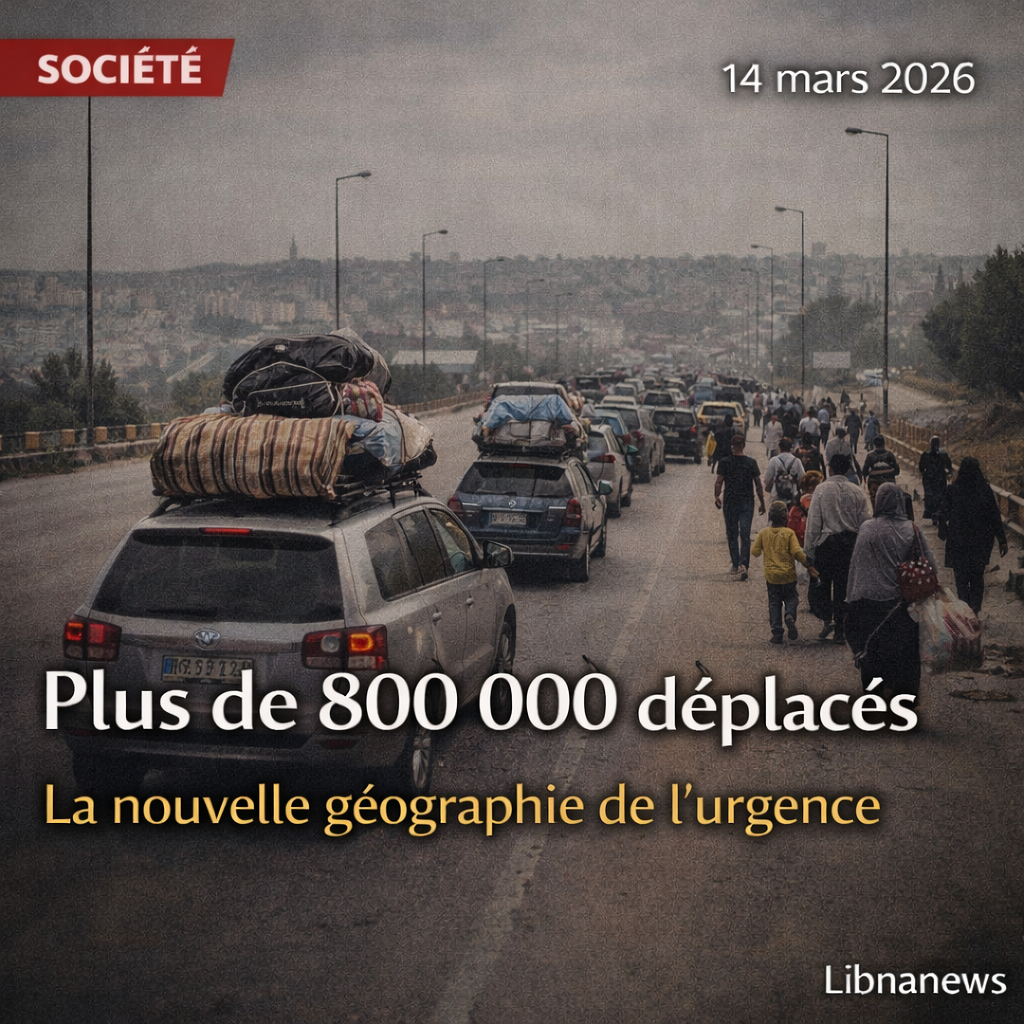
A mass displacement that changes the nature of the country
Lebanon is no longer just fighting a war. He now faces a brutal reconfiguration of his human territory. With more than 800,000 internally displaced persons in a few days, or more than one in seven, the country has entered a phase where the crisis is no longer measured solely by strikes, deaths or damage to property, but by the way in which entire regions are emptied while others become saturated. This shift is fundamental. It means that war no longer touches only specific points on the map. It re-designs places of life, routes, relations between towns and villages, schools, communal halls, stadiums, roads and housing. It transforms the country into a space of forced circulation.
The number itself is already dizzying. But he doesn’t say everything. Behind him there are families who have not simply left a house. They have left a domestic economy, a school, a neighbourhood pharmacy, a work journey, a neighbourhood, a routine, sometimes a whole network of survival. Displacement in Lebanon is not a logistical parenthesis. It becomes a total experience. It changes the relationship to space, time and state. A country that moves more than 800,000 people in a few days no longer manages only a humanitarian emergency. He’s going into a structural crisis.
What makes the situation even more serious is that this new exodus strikes an already exhausted Lebanon. The country has not recovered its breath since the financial collapse of 2019, the destruction of the port of Beirut in 2020, the aftermath of the previous conflict and the chronic fragility of its public services. The capacity of the State, municipalities, schools and the health sector was already reduced. So war did not hit a stable society. It has hit an already used society, which is suddenly required to redistribute hundreds of thousands of people in its territory to protect, feed, shelter, care and guidance.
Suivez les principaux indicateurs économiques en temps réel.
The South, the Southern Suburb and the Bekaa as starting points for a large internal exodus
The new geography of the emergency begins with areas most directly exposed to strikes and evacuation orders. South Lebanon remains the main starting point, but it is no longer the only one. The southern suburbs of Beirut and parts of Bekaa were also hit or placed under heavy pressure, pushing tens of thousands of families to take the road almost at the same time. This simultaneous character changes everything. This is not a gradual shift that could be absorbed in stages. It is a human wave that spreads on several axes at once.
The first days of March showed the speed of this shift. In 48 hours, tens of thousands of people were already registered as displaced. Within a week, the figures had crossed several successive thresholds. Humanitarian reports described residents leaving their villages in the South, families from the southern suburbs seeking to reach Mount Lebanon, the North or areas considered relatively safer, and secondary movements of people forced to leave for a second time because the first places of reception themselves became too exposed or too full. This is a crucial aspect of the crisis: many internally displaced persons do not move once. They move from one refuge to another, at the pace of alerts, rumours, saturation and military targeting.
This forced mobility produces a geography of uncertainty. The village left cannot be considered lost permanently, but it is no longer habitable. The host city is not always a sustainable refuge, but only a landing. The collective centre is not a place of life, but a point of fall. The car, roadside, stadium, school or apartment of a relative become temporary forms of installation. The country thus recomposes itself in layers of displacement: those who have fled, those who welcome, those who move relatives, those who seek an even safer place, those who return briefly for business before leaving. Lebanese territory ceases to be a residential map. It becomes a transit card.
Beirut and Mount Lebanon become the heart of pressure
As often in Lebanese crises, Beirut and Mount Lebanon absorb a major part of the wave. The capital attracts because it still concentrates hospitals, family networks, temporary housing opportunities, schools, places of worship, associations, hotels, better-equipped municipalities and a relative sense of centrality. The Mount Lebanon, on the other hand, serves as an extension space for this refuge function. But this concentration quickly produces saturation. What was perceived as safer or more practical turns into overloaded space.
Pressure begins in reassigned public places. Schools become shelters. Communal rooms, stadiums or religious structures serve as shelters. Families live with relatives. Others fall back on fortune-making solutions, often costly and unevenly accessible. Many do not even have this possibility and find themselves in cars, sidewalks or improvised installations. The image of a country where displaced people sleep wherever they can is not a cliché. It has become a documented reality.
This concentration also changes the lives of the receiving areas. A city that receives thousands of extra people brutally must manage water, sanitation, electricity, waste, food, care and safety with means that were already lacking. Municipalities must improvise. Host families are exhausted. Schools no longer perform their normal function. Shops see their customers and needs change. Solidarity exists, but it is exercised under tension. The geography of emergency does not therefore oppose only a suffering South and a gathering centre. It also creates new fatigue lines in reception areas.
The collective centres, a brutal mirror of the crisis
The new geography of the emergency is particularly clear in collective centres. Several hundred sites were opened, and more than one hundred thousand people were already staying there early in the crisis. Their proliferation speaks to both the country’s ability to respond and its level of vulnerability. Opening a centre is to offer an immediate roof. But it is also a recognition that residential park, family solidarity and private resources are no longer enough to absorb the wave of departures alone.
However, these centres are not neutral solutions. They change the nature of the places that welcome them. A school that becomes shelter ceases to be a learning space first. A municipal hall transformed into a refuge no longer plays its original role. Promiscuity creates new needs for water, hygiene, privacy, security and mediation. Women, children, the elderly, persons with disabilities and migrants face specific risks. Humanitarian organizations have warned about the lack of confidentiality, the rise in stress, the dangers of gender violence and the difficulty of maintaining a dignified health care in places that are thought to be other than prolonged housing.
It must also be understood that the collective centre is an indicator of duration. The longer the displacement, the more the temporary refuge becomes a quasi-place of life. And the more it becomes a place of life, the more the crisis changes. We are no longer talking only about emergency shelter, but about interrupted school, impaired mental health, suspended schooling, children without privacy, community fatigue and increasing dependence on help. In today’s Lebanon, the question is no longer only: how many centres should be opened? It becomes: how long can a country live by replacing its ordinary institutions with crisis infrastructures?
Children in the centre of a broken geography
Among the displaced, children occupy a central place. The humanitarian estimates refer to approximately 200,000 children affected by displacement in this new wave. It’s a huge figure on a Lebanese scale. It means that the geography of emergency is not just that of roads, shelters and families. It is also that of a generation that sees the ordinary frames of its life suddenly disappear.
The problem is not confined to the school interrupted, even if it is already a major shock. More than 300 schools were used as collective centres in the early days of the crisis, depriving tens of thousands of children of their places of learning. But school is only one aspect. Displacement also affects sleep, nutrition, access to care, emotional stability and a sense of security. An displaced child is not just losing classes. He loses his marks, his rhythm, his space and often the very feeling of continuity.
This dimension is fundamental to understanding what the new geography of emergency means. A travel card is not only a map of adults looking for a roof. It is a map where thousands of children move from the bedroom to the collective shelter, from the classroom to the gymnasium, from school to the escape route. In a country already marked by instability, this experience may leave deep traces. War is redrawing the territory. But she’s also redrawing childhood.
Health now follows the lines of travel
The Lebanese health system is also reconfigured by this exodus. It is no longer only the affected areas that matter. These are also the arrival areas, where needs explode. The structures still open must take care of the wounded, the chronically ill, pregnant women, children and the elderly in areas which at the same time receive newcomers. Dozens of primary care centres closed in the early days of the crisis, further reducing pressure on the remaining facilities.
This logic makes displacement a health phenomenon. People don’t just change places of sleep. They also change pharmacy, doctor, hospital, medical records, hygiene conditions and sometimes treatment. Pregnant women are exposed to a deterioration in care. Chronic patients may lose regular access to their medicines. Children live in overcrowded spaces where infectious risks increase. The health map thus begins to follow the migration map.
In the longer term, this reconfiguration is dangerous for the entire country. An already fragile health system cannot operate on a permanent emergency basis. But the massive displacement is growing. It is no longer just a question of responding to strikes. There is a need to absorb an unstablely distributed mobile population whose needs change according to regions, waves of departure and reception conditions. This is another way of saying that war transforms the geography of care as well as the geography of housing.
The North, Akkar and Bekaa as new margins of welcome
As Beirut and Mount Lebanon saturate, other regions become absorption areas. The North, Akkar and some areas of the Bekaa appear in official and humanitarian reports as governorates where capacities remain, at least partially. This creates a second geography of urgency, less visible in the media than that of the capital, but equally important politically. These regions, often less equipped, are suddenly assigned a role of national refuge.
This shift in the burden to the margins is indicative of the state of the country. Lebanon cannot simply pile up internally displaced persons where infrastructure is most numerous. It must also spread reception to poorer, more distant, sometimes less well served territories and less prepared to manage large volumes of additional population. This helps ease the pressure on the capital, but it also extends the social crisis to the entire territory. The new geography of the emergency does not therefore oppose center and periphery. It ends up making almost the whole country a space of tension.
The shelter map also becomes a fracture map
Another consequence of this reconfiguration is the appearance or strengthening of fractures. Not all IDPs have access to the same resources. Not all neighbourhoods welcome in the same way. Not all families have a network. Not all centres are equivalent. Not all non-Lebanese are treated as Lebanese. Humanitarian organizations have already reported forms of exclusion against migrants or refugees in certain places of reception. This shows that the emergency map is not just logistical. It is also social and political. (vaticannews.va)
To this are added the tensions related to fear. When the war reached areas previously considered safer, reception became more difficult. People are starting to wonder who comes, where he comes from, if he brings with him a risk of targeting, and how long cohabitation will be possible. Material fatigue then fuels mistrust. The geography of emergency also becomes a geography of suspicion. This is a major danger for Lebanon, as a country that recomposes its residential card under duress can quickly recompose its trust card.
The real risk: installation over time
The biggest issue is no longer just the number of displaced persons. It’s the length of time. A country can cash a massive movement for a few days at the price of exceptional mobilisation. It pays much more for prolonged displacement, especially when it has no sufficient budget reserve, no public housing stock, and no robust social system. The United Nations emergency appeal illustrates this fear: without rapid funding, food aid, shelter and essential services are likely to be further rationed.
But time changes everything. Centres become quasi-habitat. Schools remain closed or hybridized. Host families are exhausted. Municipalities change functions. Shops adapt to impoverished and displaced customers. Children settle in instability. Hospitals operate under prolonged stress. The geography of emergency then ceases to be a temporary crisis map. It becomes a new way of inhabiting the country, more precarious, more unequal and harder.
Lebanon as a displaced country
What this crisis actually reveals is that Lebanon is no longer just a country at war. He becomes a displaced country. The lines of membership, residence, access to services and traffic are redesigned in real time. The South is partly empty. Beirut is overloading itself. Mount Lebanon absorbs and saturates. The North and Akkar become margins of refuge. Schools change functions. Health centres follow the flow. Children learn or survive depending on the space available. Families live waiting for their next departure. This card is not stable. But it already has profound effects.
The new geography of the emergency is therefore not only the map of an exodus. It is the map of a country that tries to continue to exist by urgently redistributing its population, institutions, services and fears. More than 800,000 internally displaced persons are not just humanitarian statistics. They represent a change of scale. Lebanon is entering a phase in which national survival depends as much on how it manages its internal movements as on how it confronts the war itself. And as long as this geography remains as moving, the country will live less in a territory than in a state of permanent territorial instability.