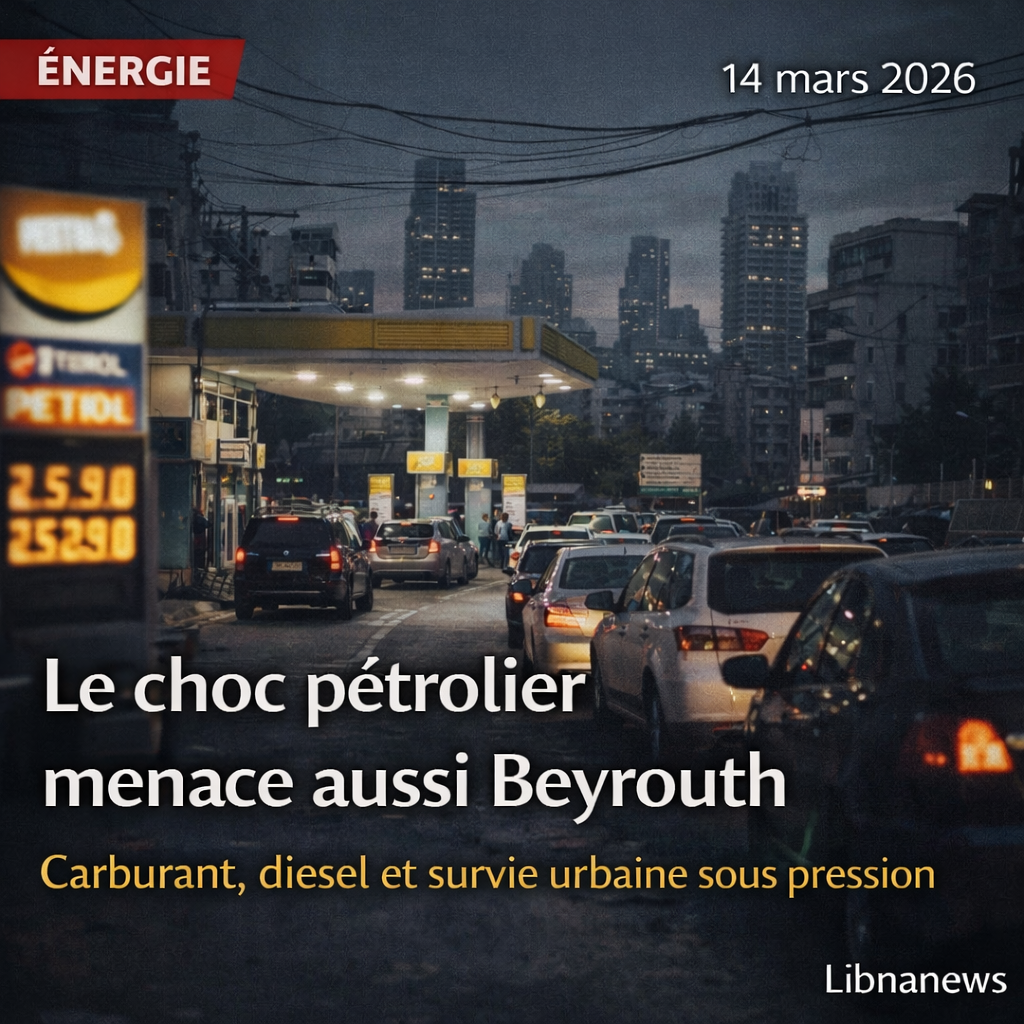
A regional war that enters Lebanese daily life through fuel
In Lebanon, there is no need for a local oil terminal to be hit if a war is to turn into an energy crisis. It is enough for the country to be what it is already: a highly exposed importer, a fragile market, an economy where fuel feeds both cars, generators, shops, hospitals, deliveries, accommodation centres and much of what still allows ordinary life to hold. In this context, regional explosion around Iran does not remain at the level of chanceries, markets or military maps. It descends very quickly to the level of the taxi, the fuel can, the transport of a sick person, the price of a delivery or the electric bill of a building.
The problem is all the more serious as Lebanon does not absorb this shock on a sound basis. The country is already emerging from several years of financial crisis, severe devaluation, income erosion, dependency on transfers and sustainable disruption of its public services. The real economy has long been functioning in degraded mode, with households arbitrating everything, companies reducing their ambitions and an energy sector already marked by underinvestment and dependence on private solutions. In such a system, a sharp rise in oil prices is not a bad signal among others. It immediately becomes a crisis multiplier.
We must therefore read the regional oil shock not as a separate subject from the war, but as one of its most powerful channels. The military front destroys lives, causes displacement and disorganizes the territory. At the same time, the energy front increases all the costs of survival. It makes war more expensive to endure, harder to flee, harder to manage for municipalities, more expensive for relief and heavier for already impoverished families. For Beirut as for the rest of the country, this pressure can become almost as structuring as the strikes themselves.
Suivez les principaux indicateurs économiques en temps réel.
Ormuz seems far away, but directly affects Lebanese homes
The Strait of Ormuz does not belong to the everyday imagination of most inhabitants of Beirut. Yet, it conditions an essential part of their cost of living. It is one of the major bottlenecks in global energy. By 2025, about 20 million barrels per day of crude oil and petroleum products were transiting, or nearly a quarter of the world’s maritime oil trade. When the war disrupted this passage in early March 2026, exports falling to less than 10% of their usual levels immediately turned a military crisis into a global supply shock. The International Energy Agency has described the situation as unpublished by its magnitude and announced a collective release of 400 million barrels of strategic reserves, the most important in its history.
For a country like Lebanon, this disruption is not theoretical. It is transmitted through several channels at once. First, the international price of crude oil, which tends to rise as soon as markets anticipate a lasting break. Then the costs of freight, insurance and alternative roads, which become more expensive even when the supply continues. Finally, fear itself: in such a sensitive market, anticipation of a new tension is sometimes enough to increase purchasing costs, speed up local adjustments and push distributors, importers and consumers to cover themselves or pass on the expected increases faster.
This means that Beirut can pay the price of Ormuz without being directly located on this strait, without having any leverage on its reopening and without participating in the strategic decision that put it in tension. This is one of the major weaknesses of fragile importing economies: they inherit the geopolitical cost without weighing on its outcome. Lebanon thus finds itself at the same time suffering the war on its territory and the global impact of regional war on energy roads.
The world market has reached an exceptional speed
What happened on oil at the beginning of the crisis was nothing like a simple common speculative movement. Production losses in the Gulf have been strong enough to push several major players to take urgent action. Saudi Arabia reduced its production from about 2 million barrels per day to almost 8 million barrels per day following the shutdown of large offshore fields, while other producers in the region also saw their exports restrained. In total, losses in the Gulf were estimated at at at least 10 million barrels per day. Scenarios of crude oil at $100, or even more in the event of prolonged disturbance, began to circulate rapidly.
For large economies, this kind of shock opens up a debate on reserves, monetary policy, budgetary arbitration or relations with producers. For Lebanon, the reasoning is much shorter. The country does not have a large public amortisation capacity, an integrated and robust energy system, or a stable currency capable of absorbing external change properly. In other words, what is elsewhere becoming a macroeconomic tension is turning Lebanon into almost immediate pressure on daily life.
This difference in exposure is decisive. In a strong economy, an oil shock can be amortized in part by public finances, foreign exchange reserves, internal competition or temporary capacity to smooth up increases. In an already disorganized Lebanese economy, adjustment is more brutal. The price rises quickly down to the pumps, to the generators, to the transport prices, and then to household expenditure. This is why the oil front is also directly threatening Beirut: because the capital concentrates the inhabitants, the displaced, the services, the distribution channels and the energy needs of the country as each increase spreads even faster.
Fuel not only affects cars, it affects all urban continuity
One common mistake is to reduce oil to the car issue alone. In Lebanon, this reading is insufficient. Fuel is at the heart of an entire urban economy. It runs taxis, minibuses, distribution trucks, medical vehicles, ambulances, generators, cold chains, water supplies, emergency travel, municipalities, technical services and much of the improvised mechanisms that compensate for structural deficiencies in the public network. When energy increases, the city becomes more expensive to keep afloat.
This reality is even clearer in the current context, as war is increasing the consumption of drugs. Detours lengthen the journeys. Displaced families increase emergency displacement. Accommodation centres need logistics. Health networks need to transport more with less fluidity. Municipal services operate in areas under pressure. NGOs and international agencies must deliver basic goods in a more volatile environment. In other words, the war increases the need for mobility as fuel becomes more expensive.
The result is a double penalty. The country consumes energy in less favourable conditions, and this energy costs more. It is this combination that makes the oil shock so dangerous. It is not just a normal market economy; It strikes an emergency economy, already forced to operate with more friction, more distance and more incompressible expenses.
Beirut concentrates shock because it concentrates shelter
The capital bears special pressure in this sequence. Not only because it remains an economic and logistical heart of the country, but also because it becomes one of the main places of reception, withdrawal and redistribution. When hundreds of thousands of people leave other regions, a large part of the cost goes mechanically to Beirut and its periphery: housing, travel, care, supplies, assistance, transportation, family networks, schools, reception centres and local supplies. If, at the same time, energy prices rise, it is the entire shelter function of the capital that becomes more expensive.
This pressure produces several chain effects. Households in Beirut pay more to move around, run a generator or receive displaced relatives. Households arriving in the capital meet a city where emergency solutions are expensive. Traders face a sometimes higher demand, but under conditions of much heavier cost and uncertainty. Care and relief actors see their logistics increase. The city thus becomes one of the places where the oil shock is most visible in its concrete consequences, even when it is not the starting point of the military front.
This explains why the energy subject cannot be relegated to the back of the only stories of strikes or diplomacy. In Beirut, expensive energy is not a parallel problem. It is one of the factors determining the city’s ability to continue to absorb the national crisis. If this capacity becomes too expensive, too unequal or too intermittent, it is all the architecture of refuge, care and urban continuity that becomes fragile.
The biggest effect is on incompressible expenditure
The major danger of an oil shock in a impoverished society is that it will first hit the expenses that cannot be avoided. A family can give up a different purchase. It cannot give up an emergency trip, a minimum share of electricity, water, certain medicines, food transported to it or fuel that makes it possible to escape, to reach a centre, to go to seek a loved one or to stay in a dwelling without sufficient public power. This is where rising energy becomes an acute social issue.
In Lebanon of March 2026, this dimension is all the more brutal as households have already reduced everything that could be. War does not meet comfortable budgets. She meets families who are coming out of several years of loss of standard of living and many of whom already live on the limit. Adding an oil shock to this reality amounts to increasing precisely the remaining non-negotiable posts. The litre of petrol, diesel, generator current, proximity transport, delivery of food and medical products cease to be simple prices. They become access or exclusion thresholds.
This also creates an additional inequality effect. Households able to pay the increase retain part of their mobility and physical security. Others reduce travel, delay care, consume less electricity, rely more on the environment or sink into a logic of assistance. The regional oil shock, therefore, is not just about everyone. It also deepens the gap between those who can still buy continuity and those who are gradually deprived of it.
Diesel is a hotspot of the Lebanese crisis
In many countries, diesel is a subject of transport and freight. In Lebanon, it is also much more than that. It is directly linked to the economy of private generators, thus the ability of many neighbourhoods, shops, health centres and buildings to operate outside the public network. When it tends or increases sharply, the rise does not stop at the pump. It spreads to neighbourhood electricity, to cold shops, to medical equipment, to emergency hotels, to schools used as shelters, to collective centres and to all small activities which cannot afford a prolonged interruption of the current.
This is why the regional oil shock in Lebanon has a greater depth than elsewhere. It threatens not only mobility, but also basic energy continuity. This continuity was already precarious before the war. The increase in diesel costs adds a layer of tension to an already weakened structure. It does not create a new problem; it aggravates an old problem until it changes scale.
In practice, this means that every increase in diesel can turn into a larger increase in the cost of living. Services are passed on, private subscriptions are increasing, schedules are shrinking, some businesses are limiting their activity, others are reducing their margins until they are exhausted. This type of pressure is not always spectacular, but it quickly uses fragile urban economies. Beirut, because it concentrates many of these mechanisms, is naturally at the heart of this transmission.
The real danger is the duration
Lebanon can absorb a few days of tension at the cost of increased discomfort. It will absorb much worse several weeks or months of long-term high prices, more risky freight and constant uncertainty on energy roads. For beyond a certain threshold, the oil shock ceases to be a cyclical outbreak. It becomes a change of behavior. Households leave less, move less, consume less, push back care or shopping. Traders reduce their stocks, schedules or ambitions. Support structures see their logistical costs rise. Municipalities get used to it faster. Reception centres become more expensive to maintain.
It is this hypothesis of duration that threatens the most Beirut. A capital can operate a time under pressure if it is assumed that normality will return quickly. It works much worse if we start to integrate that fuel will remain expensive, that electricity will remain more expensive, that the journeys will continue to increase and that the shelter function itself will become increasingly burdensome to finance. The risk is not only inflationary. It becomes structural. It changes the way the city lives, works, treats, welcomes and survives.
Beirut pays a risk she doesn’t control
Basically, it is perhaps the most unfair and revealing point. The Lebanese capital today pays part of the cost of a regional war over which it has almost no control. It does not decide the pace of the strikes around Iran, the state of Ormuz, the volume of Saudi production, or the liberation of global strategic reserves. However, it bears one of the most concrete effects of these decisions: the increase in energy costs at the very moment when it must receive, absorb, treat, redistribute and hold.
That is what makes the oil shock so dangerous for Lebanon. It is not just added to war. It becomes another form of war, more diffuse but very effective, against the country’s ability to maintain a minimum economic life. When the military front destroys places and the energy front increases survival anywhere else, society as a whole finds itself caught up.
The regional oil shock also threatens Beirut because it attacks the point where the city is still indispensable: its ability to serve as a centre of continuity in a country that is flickering. If this continuity becomes too expensive, too unequal or too fragile, then the war will have gained far beyond the military field.