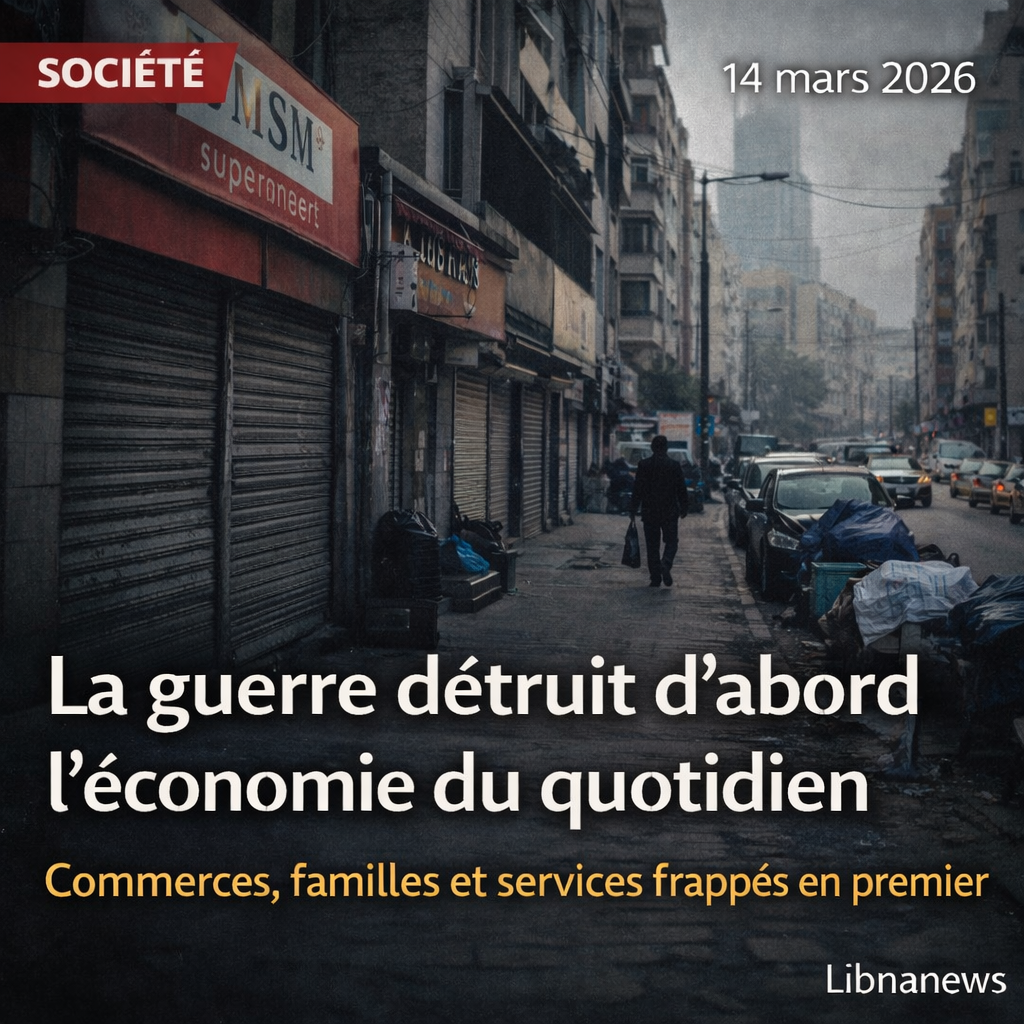
The first economy affected is not that of the dashboards
When a war suddenly settles or returns, the first reflex often consists of looking at the big indicators. Growth, balance of payments, reserves, energy prices, capital flows are questioned. It all counts. But this is not where destruction begins. It starts lower, faster, quieter. It begins in the economies of everyday life, i.e. in this pattern of gestures, income, small businesses, services, transport, rent, shopping, school schedules, deliveries, care and meals that allows a society to stand up. In Lebanon, in March 2026, it was precisely this economy that received the most immediate shock. More than 800,000 people have been displaced by escalation, more than one in seven people, while UN agencies describe a humanitarian emergency that is superimposed on an economic crisis that has never really been resolved since 2019.
The mistake would be to believe that this destruction is secondary because it seems diffuse. On the contrary, it is central. A country may sometimes absorb a one-time financial shock, delay certain budgetary decisions, or even survive a temporary deterioration in its large aggregates. It resists much worse when the ordinary mechanics that make families live are loosened. This is exactly what happens. Evacuation orders now cover about 14 per cent of Lebanese territory according to the Norwegian Refugee Council, hundreds of accommodation centres are approaching saturation, hospitals are under stress and whole services are operating in degraded mode. This pressure not only destroys buildings. It destroys life circuits.
That’s what we need to look closely at. For war does not ruin the country first through an accounting abstraction. It ruins it by interrupting the work of a driver who can no longer circulate, by emptying the cash register of a local grocery store, by increasing the price of a hotel night or a temporary rental, by closing a school turned into a shelter, by preventing a patient from reaching a pharmacy, by forcing a family to spend to flee instead of spending to live. The daily economy is always the front line of civilians.
Suivez les principaux indicateurs économiques en temps réel.
The local trade is the first link that breaks
In all wars, the small trade is struck before others, because it lives from very fine flows. It needs present customers, practical streets, regular deliveries, stable schedules and a minimum of confidence. When these conditions disappear, even without direct physical destruction, activity becomes brutally contracted. This is the case in Lebanon today. Massive displacements have drained some quarters and saturated others. Roads change status from one hour to another. Bombing and evacuation orders produce an economy of flight, not an economy of consumption. A supermarket, a bakery, a living room, a workshop, a café or a small neighbourhood service no longer work in a readable environment. They work in a moving geography of fear.
The problem is not just the decline of customers. It’s also a break in the routine. The usual customer doesn’t pass. The delivery man no longer knows the safe route. The employee does not know if he will be able to return the next day. The owner hesitates to open when it is not certain to be able to close normally. In a country already marked by bank collapse, inflation, chaotic dollarization and the erosion of purchasing power, these breaks are often worth condemnation. Many small Lebanese activities already lived with margins reduced to the extreme. The war does not impose a mere slowdown. It removes the lack of predictability from them.
This fragility is all the more serious because it affects sectors that do not have real reserves or assurances against war. Large companies can sometimes allocate losses, negotiate deadlines or move operations. The little business lives day by day. His cash is often his day of sales. When two, three or five days jump, balance breaks. In Lebanon, this mechanism has cascading effects. When a shop closes, it is also its suppliers, its employees, its customers and sometimes a whole local micro-ecosystem that pick up with it.
Family becomes a unit of economic survival
The other place where war destroys the daily economy is the family. Not in the sentimental sense, but in the material sense. The family suddenly becomes an emergency decision centre. She has to arbitrate between fleeing or staying, renting or squandering with relatives, buying fuel or saving, removing children from school or trying to maintain a semblance of continuity, paying for more expensive transportation or waiting, buying medicine or reducing other expenses. These arbitrations were already familiar to many Lebanese since the financial crisis. The war makes them even more brutal.
The massive displacement changes everything. When more than 800,000 people leave their usual place of life, the family economy ceases to be a management of months. It becomes a management of hours and days. Expenditure changes in nature. You don’t pay to improve your daily life. We pay to reduce the risk. Temporary accommodation, transportation, fast food, mattresses, water, medicines, telephone charging, child care, all these posts become priority. Education, leisure, maintenance, small improvement of housing, carryable projects go behind. The household economy is getting tougher. It defends itself instead of projecting itself.
It also produces a formidable effect of inequality. Families who still have a little savings, a network of relatives, a vehicle, more fluid access to the dollar or a secondary housing can absorb the shock a little better. The others quickly switch into addiction. They sleep in centres, in cars, sometimes in the streets or in improvised facilities. The Associated Press reported that the Lebanese government could accommodate only a limited part of the displaced, leaving many families in precarious or improvised solutions. This difference in exposure turns war into a social fracture accelerator.
Services collapse by saturation more than total disappearance
It is often assumed that in war service stops. In reality, they do not always stop; They’re distorting. They become intermittent, saturated, slow, unpredictable, unevenly accessible. This distinction is important because it better describes the lives of civilians. In Lebanon, health services in several affected areas had to partially or totally suspend their activities, while nearly 50 primary care centres had already closed in the first week of escalation according to UNFPA. But even where a service continues, it no longer works as before. He lacks staff, lacks access, lacks tranquillity, sometimes lacks fuel, medicines, safe roads.
This saturation also concerns schools, transport and social assistance. Hundreds of schools serve as accommodation centres. This means that the school stops simply being a learning place to become a relief infrastructure. The country gains shelter, but loses an educational pace. Transportation does not disappear completely, but it becomes more expensive, more random, more risky. The least route takes on a new economic value. The aid devices are operated in sorting mode. Reuters reported that several humanitarian organizations were forced to allocate their resources to situations closest to famine or extreme deprivation. In a normal economy, a service is addressed to all according to more or less stable rules. In a war economy, service goes first to the one who risks falling as quickly as possible.
This is where war destroys the economies of everyday life in the deafest way. It does not necessarily cut each wire. She uses every son at the same time. It fatigues institutions, overloads municipalities, moves teachers, disorganizes care, transforms administrations into emergency managers and forces citizens to spend more time, more money and more energy to get the same thing as before, when they still get it.
War inflation begins with housing, transport and food
There is spectacular inflation, visible in world energy markets. And there is more intimate inflation, the one that families encounter around the corner. In Lebanon of March 2026, the second is at least as important as the first. Temporary rents can rise in areas perceived as safer. Transportation is rising as a result of detours, risk, fuel and sudden demand. Food tends to be where the population flows and becomes scarce where the circuits are interrupted. Housing centres and solidarity networks alleviate part of the shock, but they do not replace a functional urban and territorial economy.
The decisive point is that this inflation affects precisely incompressible expenditure. A family may defer the purchase of equipment, clothing or furniture. It may not delay shelter, meals, urgent travel, child care, reloading of communications or the purchase of basic products. Thus, war not only crushes incomes. It gives priority to what we cannot avoid. This is why daily savings suffer even before global statistics capture the magnitude of the shock.
To this is added the increase in regional energy risk. The UN Secretary-General warned on 6 March that attacks across the Middle East posed a serious risk to the world economy. The increase in oil and the disturbances around Ormuz mechanically aggravate Lebanese vulnerabilities, because they affect transport, private electricity production, logistics and prices. In a country where so many activities are dependent on costly and fragmented energy solutions, regional war increases the cost of living.
The displaced not only lose their home, they lose their place in the economy
There is a lot of talk about displaced people in humanitarian terms, and it is necessary. But it must also be said that a displaced person is almost always a worker, a client, a pupil’s parent, a tenant, a small entrepreneur, a caregiver, a craftsman, a driver, an employee, a retired person who nevertheless participates in exchanges. The massive displacement therefore disorganizes the economic map as much as the human map. People are not only torn from their homes. They are torn off from their income and expenditure channels.
A person who held a business in Tyre or in a southern village does not simply lose use of a local. It loses its customers, its relationship to the supplier, its access to the stock, its role in a neighbourhood. A family that joins Beirut or a reception area does not only become displaced. It also becomes an additional demand in a tense housing market, in already used services, on shops that were not prepared to absorb such pressure. So war simultaneously creates economic vacuum where people leave and saturation where they arrive.
That is why the daily economy in Lebanon should not only be thought of as a declining economy. It is a displaced, deregulated, deterritorialised economy. Its flows do not stop all, but they are no longer in their place. And a country does not live well with flows that are no longer in their place.
The real question is no longer recovery, but minimal continuity.
In such a context, talking about recovery seems almost abstract. The priority is not yet to rebuild a cycle of investment or to reopen a debate on structural reforms, even if these issues come back. The immediate priority is minimum continuity. How can people still be able to eat, treat themselves, move, sleep, buy essentials, reach out to their loved ones, keep a link with work and not fall into total assistance too quickly? That’s the real economy of the moment.
This implies something other than a classical macroeconomic response. Traffic corridors are needed, targeted support for displaced families, support for municipalities and schools transformed into centres, emergency support for small traders and community services, and rapid humanitarian funding. However, the UN is already alerting about underfunding and the risk of a break in essential aid. If this money does not happen, the war will not only destroy infrastructure. It will destroy the very ability of households and small businesses to hold a few more weeks.
In essence, perhaps the most just formula is this: war does not destroy the economy of Lebanon first, it destroys the conditions of ordinary economic life first. And it’s often even more serious. Because a large aggregate can sometimes be rebuilt. A habit of work, a fabric of local trust, a lost clientele, a empty neighborhood, a discouraged family, a school transformed by the urgency, all this takes much more time to return.
Where civil resistance really works
The economic destiny of a country at war is therefore not only played out in central banks, ministries or donor conferences. It is played in the ability of daily savings not to die entirely. Every grocery store that reopens, every pharmacy that remains provided, every school that regains a function, every municipal service that holds, every family that manages to avoid the complete shift in distress represents a form of civil resistance. It’s not a lyrical formula. It’s a material reality.
In Lebanon, this civil resistance is now under immense pressure. The figures of displacement, the saturation of shelters, the partial closure of health structures, the stress on resources and the burden of the regional crisis indicate that the country has entered a phase in which the ordinary economy is defending itself metres per metre. The great subject is not only visible war. It is also the war against routines that still allows a society to recognize itself.
And maybe that’s where the hardest truth of this sequence is. Bombs destroy quickly. But what is then defeated, in shops, families, services, neighbourhoods and simple gestures, destroys even more deeply.