






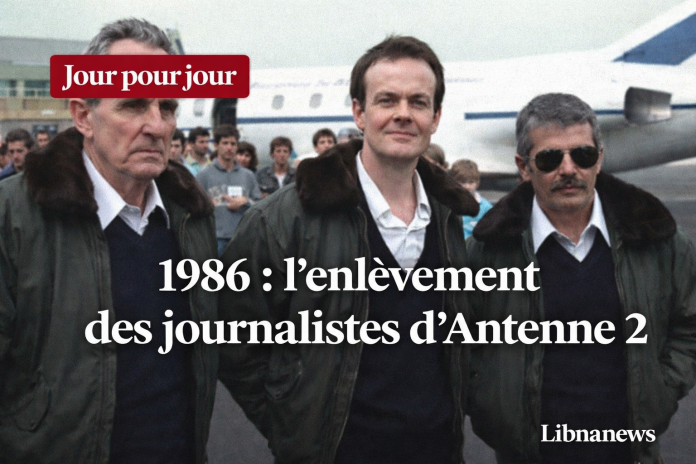
On 8 March 1986, at the end of the afternoon, four French journalists from Antenne 2 were intercepted by armed men on the streets of West Beirut. Philippe Rochot, 39-year-old Middle East correspondent, George Hansen, 45-year-old cameraman, Aurel Cornéa, 54-year-old sound maker, and Jean-Louis Normandin, 34-year-old lighting designer, have just filmed a demonstration organized by Hezbollah at the Bir el-Abed mosque in the southern Shiite suburbs of the Lebanese capital. The team, who arrived in emergency a few days earlier, covered the tribute paid to the victims of a car bomb attack that occurred exactly a year earlier in the same neighbourhood. On the way back, near the sports stadium damaged by the fighting, four armed men forced them to board a vehicle. The kidnapping is claimed as early as the following hours by the Organization of Revolutionary Justice, a group presented as a pre-name or emanation of Hezbollah. This act is part of the long series of Western kidnappings that has been shaking Lebanon since the early 1980s and which particularly affects French nationals.
The Lebanese civil war, which began in April 1975, has already killed tens of thousands and transformed Beirut into a field of ruins divided by denominational front lines. West Beirut, mostly controlled by Muslim and progressive militias, hosts a strong Shiite presence in the southern neighbourhoods. Hezbollah, a Shiite movement founded in 1982 with the support of Iran, deployed its first military and political structures there. Its official manifesto, published in February 1985, calls for the fight against Israel, denounces Western imperialism and advocates the establishment of an Islamic State. On 8 March 1986, the demonstration at the Imam Ali Reda mosque in Bir al-Abed commemorates the victims of an explosion that had killed about 80 people the previous year. The team of Antenna 2, sent in reinforcement after the announcement of the alleged execution of sociologist Michel Seurat by the Islamic Jihad on 5 March, filmed the speeches of the religious leaders and the assembled crowds. The images captured on that day show a tense atmosphere, marked by portraits of martyrs and calls to resistance.
The kidnapping takes place with a disconcerting speed. The four journalists, equipped with their filming equipment, travel in a civilian vehicle when they are stopped. The captors, masked and armed with kalashnikovs, forced them to abandon their equipment on the spot. No shots are fired, but the threat is immediate. The team is driven to an unknown destination in the southern neighborhoods. The next day, the Organization of Revolutionary Justice communicates documents belonging to the hostages to prove its responsibility. The claim is relayed by international news agencies. In Paris, emotion is lively. The French public opinion is anxiously following this new hostage taking, which is in addition to those of diplomats Marcel Carton and Marcel Fontaine, kidnapped in March 1985, and journalist Jean-Paul Kauffmann and sociologist Michel Seurat, captured in May 1985.
The regional context explains in part this wave of kidnappings. Israel still occupies a security zone in southern Lebanon since Operation Peace in Galilee in June 1982. The Multinational Force, composed in particular of French and American troops, withdrew after the suicide attacks of October 1983 against its barracks. Syria maintains a military presence in the North and in the Bekaa, while Iran extends its influence via Hezbollah. The abductors often demand the release of prisoners detained in France or Kuwait, as well as a change in French policy in the Middle East, deemed too favourable to Iraq in the war which it has opposed Iran since 1980. The dispute over the Eurodif nuclear project, frozen by Paris, is also fuelling tensions. In this climate, Western journalists, perceived as vectors of influence, become targets of choice.
The conditions of detention of the four men were particularly challenging. Originally separated, they are regularly transferred between different underground jails or secure apartments in the southern suburbs. Eyes blindfolded while moving, they live in small cells about 1.70 metres by 1.70 metres. Philippe Rochot shares his cell for a long time with Aurel Cornéa. The kidnappers confiscate them watches, belts and personal items. Meals are frugal, often made up of rice, bread and water. Showers are rare, walks are limited to a few steps. Simulacs of execution break the monotony: the hostages are kneeling in front of the wall, a hand slap imitating a shot. Rochot later said that he heard a voice announcing in French: « You will be executed. The jailers, a mixture of Hezbollah activists and sometimes Palestinians, alternate between threats and moments of relative humanity, sometimes allowing reading books or listening to radios. Rochot reads the 19th century Lagarde and Michard three times. Georges Hansen and Jean-Louis Normandin face similar conditions, sometimes attached to a radiator.
In Paris, the case mobilizes families and the media. The channel Antenne 2 broadcasts calls for release. President François Mitterrand and the new Prime Minister Jacques Chirac, who had been installed since the victory of the right at the legislative elections in March 1986, were managing this crisis in a context of unprecedented cohabitation. Interior Minister Charles Pasqua entrusts the file to discreet emissaries, including Jean-Charles Marchiani and Lebanese businessman Iskandar Safa, who have Syrian and Iranian contacts. France officially refuses any public negotiations but multiplies parallel channels. The attacks that struck Paris in 1986, attributed to Hezbollah, added to the pressure: the Rue de Rennes in September killed 7 people and injured more than 150 people. The government implicitly links these acts to the hostages detained.
Liberations take place in stages, revealing the complexity of the negotiations. On 20 June 1986, after 105 days of captivity, Philippe Rochot and Georges Hansen were released near the Beau Rivage Hotel in West Beirut. Located in the middle of the night, they reach the establishment on foot. Rochot said to the journalists present: « We have been well treated. We read French literature, we ate three times a day, we were entitled to three daily cigarettes and we could shave and shower. They have lost weight but appear in relative good health. Their release came a few weeks after the French elections and marked a first success for the Chirac government. Aurel Cornéa remains detained with Jean-Louis Normandin.
On 24 December 1986, Aurel Cornéa was released. Located in the streets of West Beirut, he was quickly taken over by the French embassy. His detention lasted nine months. The Syrian authorities then try to impose a passage through Damascus to enhance their role as mediator, but the hostages, thanks to the determination of their French escorts, avoid this detour. Jean-Louis Normandin remains captive longer. Often attached to a radiator, he sometimes refuses the orders of jailers, affirming his dignity despite exhaustion. His ordeal ended on 27 November 1987. Released along with journalist Roger Auque, abducted in January 1987, he is deposited 300 metres from the Summerland Hotel. A helicopter chartered by General Michel Aoun drove them directly to Cyprus, once again bypassing the Syrian passage imposed on the previous ones.
These phased releases illustrate the underground dynamics of the conflict. Syria, a tutelary power in Lebanon, plays a central role in the negotiations, even if Paris seeks to limit its influence. Iran, via Hezbollah, uses hostages as a diplomatic lever. The families of the hostages, grouped into associations, multiply public interventions. In Beirut, Bir al-Abed remains a stronghold of Hezbollah, where checkpoints and militias control movements. The Lebanese army, weakened and divided, cannot intervene. President Amine Gemayel, who has been in place since 1982, is helpless in the fragmentation of the country. International observers, including United Nations representatives present via UNIFIL in southern Lebanon, document these abductions without being able to prevent them.
The testimonies of the released persons shed light on life in captivity. Rochot evokes night transfers in vehicles with opaque windows, cells without natural light and interrogations about French politics. Hansen describes the constant anguish of execution simulacs. Normandin, released after twenty months, tells about the limited steps in his cell and the rare moments when the kidnappers agreed to light a candle. Cornéa, the oldest, stoically supports deprivation. None of the four are physically ill-treated systematically, but isolation and uncertainty weigh heavily. The kidnappers sometimes broadcast video messages to keep pressure on Paris.
At the media level, the case occupies a central place in French television newspapers. Antenna 2, later became TF1, follows the evolution hour by hour. The archive images show families waiting for news at Villacoublay airport during successive returns. Rochot and Hansen, upon arrival in France, grant measured interviews, avoiding details that could compromise the comrades still in detention. The government communicates with caution, stressing the need to preserve channels of dialogue. The French secret services, DGSE in the lead, coordinate operations with their Lebanese and Syrian counterparts.
1986 marks a peak in the crisis of French hostages. In addition to the team of Antenne 2, other French were captured: Marcel Coudari in February, then other isolated cases. Hezbollah, still in the organizational phase, consolidates its grip on Shia neighbourhoods. Bir al-Abed, the theatre of the March 8 demonstration, remains a symbol of resistance. The Christian militias of the Lebanese Forces, cut off in East Beirut, observe these events with concern. Israel continues its operations in the South, where Hezbollah fighters multiply guerrilla attacks. The international community regularly condemns such abductions, with no concrete result.
Negotiations are gradually being concluded through a mix of diplomatic pressures, discreet concessions and regional mediation. France maintains its official non-negotiation line while exploring all avenues. The release of Rochot, Hansen and Cornéa in 1986 paved the way for Normandin’s release the following year. Every return is celebrated soberly in Paris, with official and family receptions. The hostages are gradually returning to work. Rochot continues his career as a great reporter. Normandin later testified to the extreme psychological conditions endured.
In the months following Jean-Louis Normandin’s release on 27 November 1987, other French hostages remain in Beirut. Marcel Carton, Marcel Fontaine and Jean-Paul Kauffmann are waiting for their turn. The streets of West Beirut continue to be the scene of daily tensions, with flying blockades and militia patrols. Hezbollah is strengthening its positions in the southern suburbs, where charitable institutions and religious schools are proliferating under its control. The team of Antenne 2, once reunited in France, shares their experiences during debriefings inside the chain. The French authorities analyse the lessons of these 105 days for Rochot and Hansen, nine months for Cornéa and twenty months for Normandin.
Transfers of the hostages released to Beirut airport or directly to Cyprus involve careful coordination between the kidnappers, Syrian intermediaries and French diplomats. General Michel Aoun, then Commander-in-Chief of the Lebanese Army and opposed to Syrian tutelage, sometimes facilitated these operations to counter the influence of Damascus. Helicopters used for some returns avoid land-based roads deemed too risky. In Paris, the intelligence services compile the stories of the prisoners to identify networks and places of detention. The families, finally assembled, organize discreet reunions away from the cameras.
The kidnapping of 8 March 1986 remains, in the archives of the Antenne 2 channel, the last major report filmed by the team before its disappearance. The videos shot in Bir al-Abed on that day are preserved as historical testimony. They show the assembled Shiite crowds, the portraits of the martyrs and the inflamed discourses. These images, partially broadcast before the abduction, illustrate the rise of Hezbollah in the Lebanese political landscape. The movement, born of resistance to the Israeli occupation, has established itself as a key player in the southern neighbourhoods of Beirut.
The daily living conditions in West Beirut in 1986 explain the relative ease of abduction. Power cuts, high roads and permanent check-points limit movement. Foreign journalists must negotiate with each militia to circulate. The team of Antenne 2, however experienced, falls into a trap tense near the location of his report. The kidnappers take advantage of post-demonstration confusion to act without attracting attention. No direct witness publicly expresses himself for fear of reprisals.
Official reactions in Beirut are limited. The Government of Lebanon, weakened, publishes no-effect-effect-based convictions. The then Prime Minister, Rachid Karamé, calls for the early release of hostages while stressing the impotence of institutions in the face of militias. Hezbollah officially denies any direct involvement, allowing the Organization of Revolutionary Justice to assume responsibility. This concealment strategy, or taqîya, allows the movement to preserve its public image while exerting effective pressure.
In France, the case of the Lebanese hostages becomes a priority issue for the Chirac government. Interdepartmental meetings are increasing in Matignon. Families are received regularly at the Élysée and Beauvau Hotel. The media, for their part, maintain a constant watch, publishing portraits of hostages and geopolitical analyses. The gradual return of the Antenna 2 journalists temporarily appeases opinion, but anxiety persists as long as other French people remain captive.
Probable places of detention are in the southern suburbs between Bir al-Abed, Haret Hreik and the surrounding Palestinian camps. The hostages are displaced to avoid Israeli raids or Lebanese army operations. The jailers change regularly to complicate possible identifications. Transfers are made at night, in ordinaryized vans. Rochot and Cornéa share a cell for much of their joint detention, exchanging memories to maintain morale.
The final release of Jean-Louis Normandin on 27 November 1987 ended the chapter of the team of Antenne 2. Deposited with Roger Auque near the Summerland Hotel, he was immediately taken over by the French consular services. A medical examination confirms his general satisfactory condition despite the length of the captivity. In Paris, he was discreetly welcomed before returning to his family. The four journalists return to each other, sharing their respective experiences. Their accounts agree on the methods used by their kidnappers: isolation, mild sensory deprivation and psychological pressures.
In the weeks following the latter liberation, West Beirut continues to live at the pace of militia tensions. The Shiite neighbourhoods remain under high surveillance by Hezbollah, which consolidates its social and military networks. The families of the victims of previous abductions continue their efforts. The French authorities maintain discreet contacts with regional intermediaries to prepare for the next releases. The case of the Antenne 2 team, although resolved, leaves traces in Franco-Lebanon relations and in the collective memory of French journalists sent to conflict zones.
The INA archives keep images of successive returns to Villacoublay: Rochot and Hansen in June 1986, Cornéa in December, Normandin in November 1987. These sequences show thin, smiling men surrounded by their loved ones. The official statements always underline the joy of the reunion while reminding that other hostages are still waiting. The case remained open until the release of the last French in May 1988.
The technical details of the abductions reveal a broken organization. The kidnappers use vehicles stolen or lent by sympathizers. Communications are made via walkie-talkies recharged by truck batteries, as indicated by the items returned to the hostages when they were released. The cells are equipped with minimum ventilation systems to prevent escapes. The interrogations concern the alleged links of journalists with the French or Israeli services, which are still denied.
The Bir el-Abed district, the theatre of the March 8, 1986 demonstration, remains marked by this event. The residents remember the passage of the television crew just before the abduction. Permanent dams control entrances and exits. Hezbollah maintains its command structures and social services. Imam Ali Reda Mosque continues to welcome Friday prayers and annual commemorations.
The families of the four journalists, once the releases have been completed, organise private meetings. The former hostages testify to their colleagues to prepare for future missions in Lebanon. Antenne 2 strengthens its security protocols for war zone reporters. The notebooks and personal memories brought back by the released feed the internal analyses of the methods of captivity.
At the end of 1987, after the release of Jean-Louis Normandin and Roger Auque, West Beirut remained under tension. The Shiite militias patrol the streets, negotiations for the last French hostages continue behind the scenes and the inhabitants adapt to a life of alerts and restrictions of movement. The four journalists from Antenne 2, now free, join their families and teams in Paris, while diplomatic issues continue to evolve in the discretion of chanceries.
Retrouvez Libnanews sur mobile avec notifications et lecture rapide.
