





The capital is entering a new phase of war
The war changed faces in Beirut. For a long time, the capital lived with the idea that there was still a geography that was legible from the danger: some areas were more exposed, others remained relatively protected, and residents could still believe that the city retained shelter areas. This representation began to crack abruptly with the extension of the strikes to central neighbourhoods and seafront areas, even as hundreds of thousands of displaced persons converged towards Beirut and Mount Lebanon. In a few days, the capital no longer only welcomed the war of others; She began to feel it in her own urban texture, in her journeys, in her schools turned into shelters, in her buildings under tension and in her conversations of stairwell. More than 800,000 people had been displaced in the country, more than one in seven, and the humanitarian emergency had settled on a scale that Lebanon could not absorb normally.
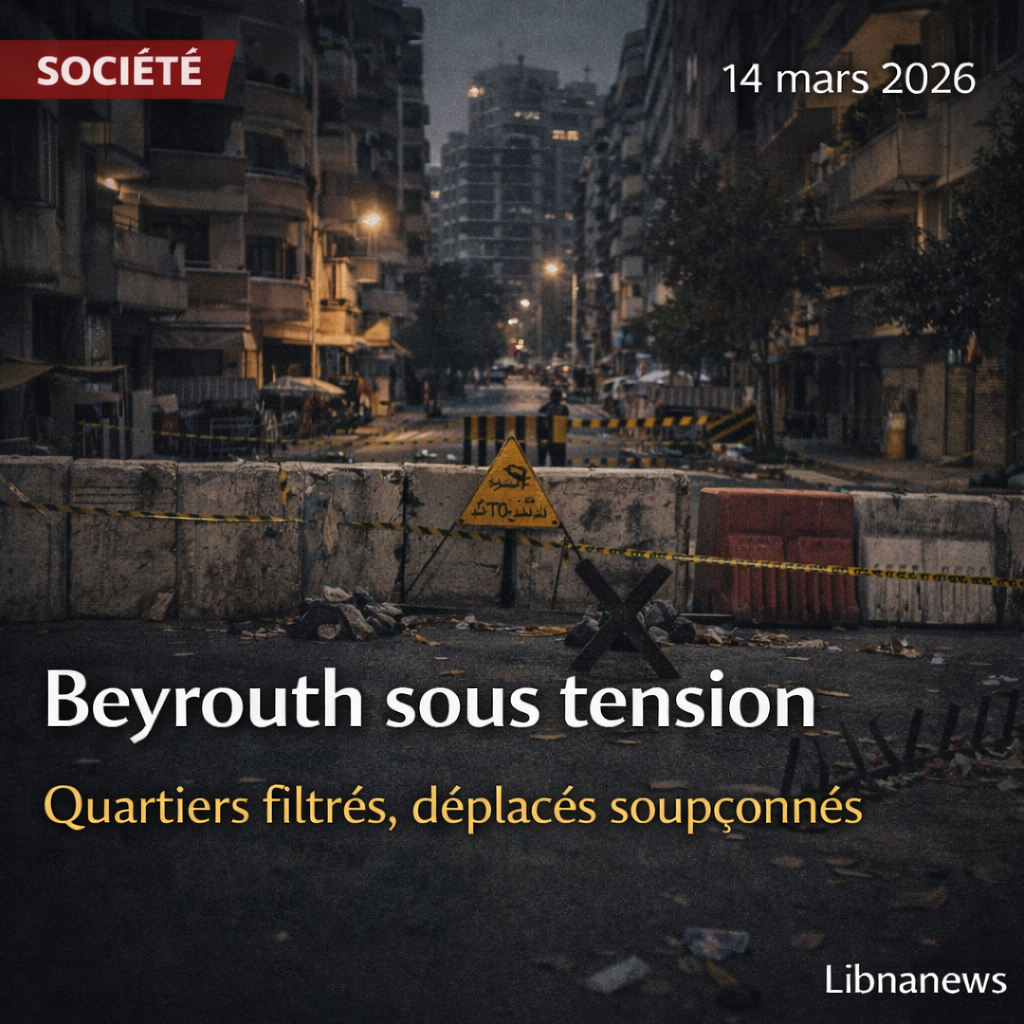
It was in this climate that stories of informal dams, closed neighbourhoods, filtering at the entrance to some streets, owners refusing displaced families and local networks taking control of some of the security. These stories don’t all tell the same thing. Some relate to the established fact, others to exaggeration, others to pure fear. But their multiplication is itself a political fact. She says that a growing part of the population no longer thinks only about state- or city-wide security, but about the local neighbourhood, street, building and us. When a society starts to reason like this, it enters a dangerous area, even if it has not yet turned into a formal militia order.
The strikes broke the old Beirut mental map
The tipping point is due to the nature of the targets and their location. When strikes reach or near Rauché, Aisha Bakkar, the Cornish of Ramlet al-Baida, and then other central areas of Beirut, the city no longer sees war as a peripheral reality. It ceases to believe that the danger is confined to a single urban basin or territory. The consequence is not only safe. It is psychological, social and political. Each neighbourhood begins to think of itself as potentially exposed, not as a spectator of war but as a space to protect. This change is enough to transform the way people perceive the displaced, the unknown, the occasional rentals, the empty apartments occupied temporarily and the improvised reception networks.
Suivez les principaux indicateurs économiques en temps réel.
In a city like Beirut, where the memory of fracture lines has never completely disappeared, this evolution has an immediate effect: community mental maps return faster than administrative maps. Neighborhoods are relegated through their supposed social, religious or political dominance. Others are conceived as buffer zones, refuges, or, on the contrary, areas contaminated by risk. This rereading not only produces anxiety. It produces practices. We’re watching more. We filter more. We’re questioning more. We want to know who arrives, where he comes from, who is staying, how long he remains and whether he can, by his presence, bring in a new danger with him.
The issue of internally displaced persons becomes an issue of urban security
Massive displacement is not only a burden on reception capacity. It changes the very nature of public space. In normal times, a city absorbs population flows through the market, services, family solidarity or progressive residential solutions. In times of war, these flows take the form of a precipitated exodus. Families arrive with little property, little information, sometimes no clear destination. They go to schools, halls, stadiums, churches, loaned apartments, hotels, cars or the street. This brutality of the movement changes the perception of the newcomer. He is no longer just a possible neighbour. It can become, in the minds of a part of the inhabitants, a vector of disorder, overload or risk.
This is where politically explosive confusion arises. The displaced person, who should be thought of as a victim of war, sometimes begins to be seen as a possible carrier of the danger which he himself struck. This shift is all the stronger when Israeli strikes affect increasingly diverse parts of the capital in targeted assassinations or attacks on front-line networks. A part of the opinion deduces from it while a building, street or neighbourhood can be endangered not by what it is, but by whom it houses. This logic naturally feeds the narratives of refusal, surveillance and filtering. It turns the city into a space of suspicion.
Where exclusion is already visible
Sorting is not just a hypothesis. In several locations, exclusions have been documented, particularly to the detriment of non-Lebanese. Humanitarian actors reported that migrants or refugees were not admitted to certain public shelters despite the absence of a formal rule to that effect. This point is decisive because it shows that, under the pressure of war, equal access to protection is already crumbling. Once a centre starts to select, even informally, the border becomes very thin between the practical organisation of reception and the reintroduction of a hierarchy of lives to be protected.
This mechanism can then expand. What begins with the refusal of a particularly vulnerable group can move towards finer distinctions between acceptable and undesirable, between those who reassure and those who worry, between families deemed to be compatible with a neighbourhood and those who are supposed to risk it. At this stage exclusion is not always proclaimed. It may remain diffuse, administered by owners, local officials, neighbourhood committees, guards or partisan networks that do not act officially on behalf of the police. But politically, the effect is already the same: the city ceases to be governed everywhere by the same principle of access and protection.
Where is the state when neighbourhoods begin to protect themselves?
The state has not disappeared. It remains there, by the army, by the security forces, by the ministries, by the municipalities, by the lists of collective centres, by the communiqués, by the management of the roads, by the aid distributed with the international agencies and by the governmental decisions on security. The United Nations also emphasizes that its partners are working with national and local authorities to organize the response, while mobile health, food and protection teams are deployed in shelters and areas of concentration for internally displaced persons. The problem is therefore not the total absence of the State. The problem is that it is no longer enough to saturate the ground. He is present, but he is no longer exclusive.
This distinction is crucial. A capital does not slide towards parallel protections only when the state collapses. It also slips into it when the state remains visible but overflowed, when it does not fully control all the flows, when it cannot guarantee the peace of every neighbourhood alone and when the inhabitants consider that it does not respond quickly enough to their concrete fears. From this point on, local structures are active: neighbourhood networks, building managers, reinforced guardmen, informal services, political relays, youth groups, parish committees, local associations, intermediaries linked to a particular organised force. None of these actors necessarily declare that they replace the state. But all contribute to effectively fragmenting security.
The real danger: not conventional militias first, but a capillary privatisation of security
The word « milice » often evokes a spectacular image: men armed in uniform, sovereignty displayed, official dams, prohibited areas. The current risk in Beirut is more discreet and, in a way, more insidious. It resides in the capillary privatization of security. A neighborhood doesn’t necessarily become a fortress. It starts by multiplying the filters. He develops his own identification reflexes. It delegates vigilance to actors who do not all have a public mandate. It implicitly decides that the safety of the premises justifies control practices which are outside the common rule. It is not yet a militia in a strong historical sense. But it’s already a diffuse Michael logic.
This slide is particularly plausible in a city where history has left powerful territorial reflexes. As soon as a major crisis occurs, Beirut resumes to be read as a mosaic of communities, areas of confidence, lines of protection and sectors that are more or less penetrable. The ongoing war, by extending targeting and saturating reception, reactivates this old software. The inhabitants want to protect their own, protect their buildings, protect their children, protect what remains of their normal lives. It’s human. The problem arises when such protection ceases to be an application to the State and becomes an appropriate jurisdiction locally.
Why the rumor so fast
The rumor prospers because it marries a partial reality. She’s not born of anything. It feeds on real but incomplete facts: strikes have hit unexpected areas, there are a large number of displaced people, the centres are saturated, some categories have been excluded from shelter, fears of targeting move with people, and the state struggles to occupy the entire security area of the capital alone. On this real basis, larger narratives are being built: such a neighbourhood would be kept, such a closed area, such a clean street, such a part of the capital managed by its own. Rumor does not need to be entirely true to be politically effective. It is enough to appear plausible in a city already ready to believe it.
It also thrives because it responds to a demand. Residents want to know where they can go, where to house relatives, where there are still safe shelters, where the risk is considered to be lower. Without sufficient and stable public information, they turn to social networks, neighbourhood groups, knowledge and word-of-mouth stories. Thus parallel maps of the city are made, sometimes more influential than official maps. In a society at war, these mental maps quickly become instruments of power. He who says where one can enter, where it is better not to present himself, where such a profile will be badly received, already exercises some form of authority over the city.
The risk of a return of local sovereignty
The risk to Lebanon is therefore not reduced to street clashes. It’s deeper. It is a matter of rebuilding local sovereignty in the interstices of the State. A city can continue to seem calm while fragmenting. Streets remain open, shops are still functioning, shelter schools are home to the world, public forces are patrolling, but real access to the city begins to depend on tacit authorizations, neighbourhood codes, social guarantees, recommendations or belongings. At that time, public sovereignty was crumbling.
Such a development would have several dangerous effects. First, it would set up a sustainable idea that security is not a common good, but a local resource, stronger for some than for others. Secondly, it would encourage the best-established political institutions to become concrete providers of protection, thereby increasing their legitimacy to the detriment of the institutions. Finally, it would complicate any exit from the crisis: once a neighbourhood gets used to protecting itself through its own networks, it is more difficult to return to full public management. The danger is not only parallel order. This is its normalization.
Alert signal for Beirut
The warning signal is not that a posted militia will tomorrow take control of an entire area of the capital. The warning signal is earlier. It is the time when people find it normal that reception is selective, that the entrance of a neighbourhood must be negotiated, that non-public networks filter in the name of security, and that trust in the state gives way to trust in local belongings. This shift is not yet fully accomplished. But several of its ingredients are already there: extension of strikes, massive displacement, saturation of reception, discrimination in some shelters, fear of safe contamination, and return of the community reading of the capital.
The real challenge for Lebanon is therefore immediate. It is not just about protecting the city from strikes or opening more shelters. It is a question of preserving a principle that Beirut remains a capital governed by common rules, not an addition of territories that filter according to their own fears. As long as the State, the army, the security forces and the local authorities retain the initiative on reception, dams and protection, this principle can still hold. But the longer the war lasts, the more fear becomes territorial, and the more practical legitimacy the local protection networks gain. This is where the major risk lies: not only violence, but the gradual disintegration of the very idea of a common city.