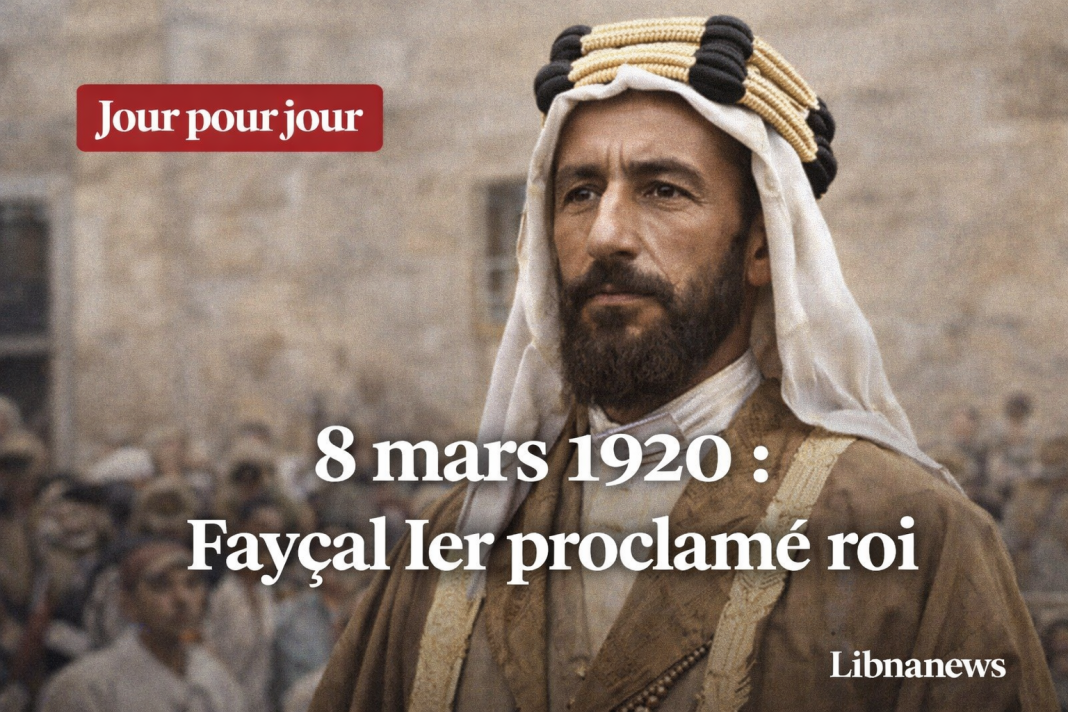






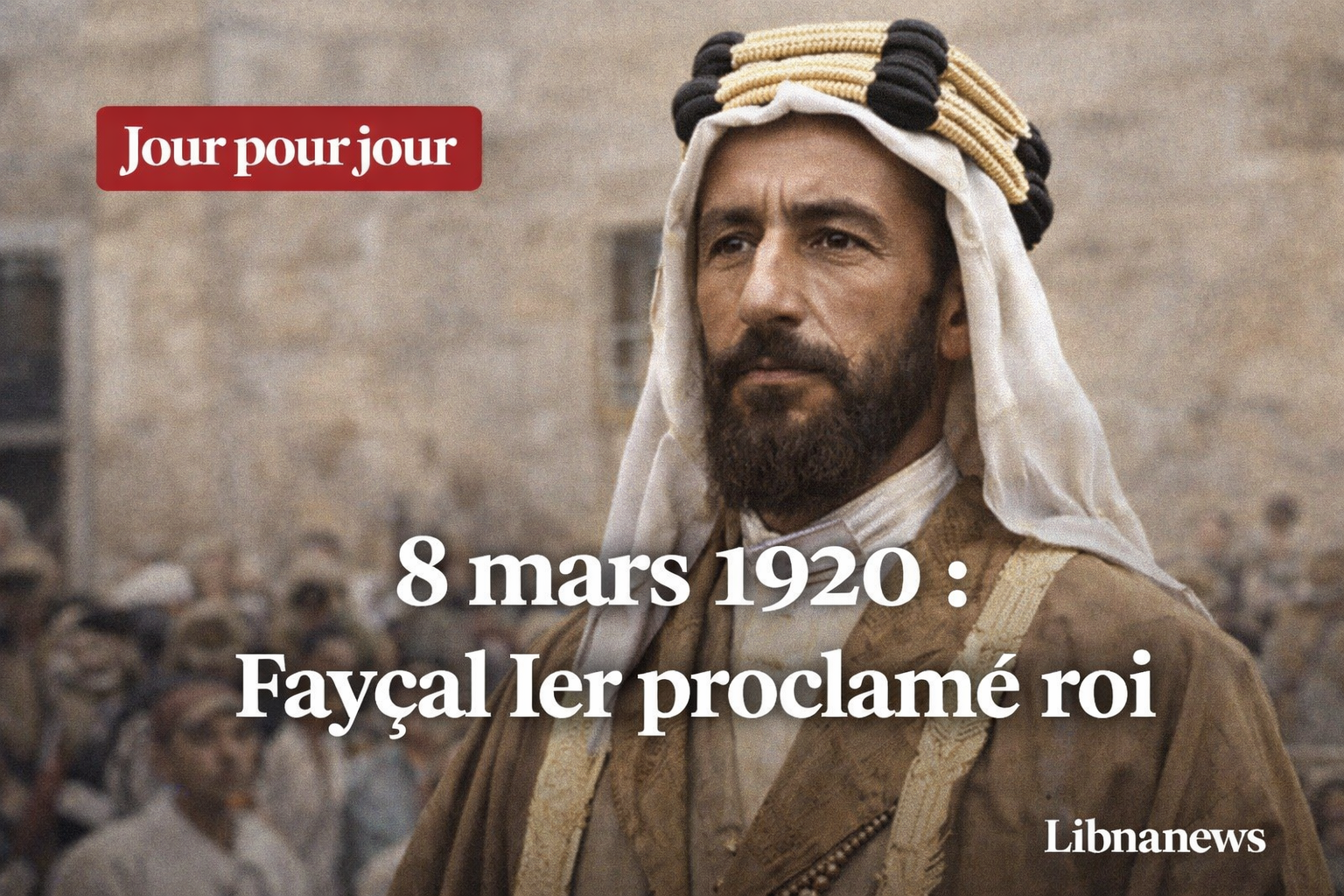
On March 8, 1920, Damascus awakens in an unprecedented popular fervor. After a solemn session of the Syrian National Congress, delegates proclaimed the complete independence of the Arab Kingdom of Syria and elevated Emir Fayçal bin Hussein to the rank of constitutional king under the title of Fayçal I. Thousands of Syrians descend into the streets of the old city, Arab flags float on balconies, fireworks illuminate the sky and shouts of joy ring to the souks. The event, which took place in the wake of a decisive session held the previous day, marked the culmination of Arab nationalist aspirations after the First World War. It reflects the will of a people to forge a sovereign state encompassing Greater Syria, from the borders of Mesopotamia to the shores of the Mediterranean, including the territories that now correspond to Lebanon and Palestine. This proclamation, the result of a representative congress, is nevertheless part of a tense international context in which the great European powers are already redrawing the map of the Middle East.
The immediate context dates back to the war years. The Ottoman Empire, allied with the central powers, collapsed after four years of conflict. The Arab Revolt, launched in June 1916 by darling Hussein bin Ali of Mecca with British support, played a decisive role. Fayçal, the third son of the treasurer, commanded the northern army alongside T.E. Lawrence, the British officer known as Lawrence of Arabia. Together, they lead an effective guerrilla against Ottoman lines. On October 1, 1918, Arab troops triumphantly entered Damascus, welcomed as liberators. Fayçal immediately established a provisional Arab government, with Ali Rida al-Rikabi as military governor. Local governments are in place: ministries, courts, Arabized schools. The Ottoman administration was replaced by Arab officials, and Arabic became the official language. This period, often referred to as « the reign of Damascus », saw the birth of the first symbols of a modern state: a red, white and black flag with a green star, Fayçal postage stamps and a coin in preparation.
The Syrian National Congress, a representative body elected in 1919 by a two-tier election inspired by the last Ottoman elections of 1913, is the real engine of this proclamation. Composed of about eighty-five delegates from inland Syria, coastal regions and Palestine, it brings together Sunni Muslims, Shiites, Christians, Druze and notables of all origins. Hashim al-Atassi, a moderate figure from Homs, holds the presidency. As early as July 1919, the Congress sent a memorandum to the King Crane Commission, sent by U.S. President Woodrow Wilson to probe local aspirations. Delegates call for total independence, reject any foreign mandate and demand unity from Greater Syria. They explicitly refuse the separation of Lebanon and Palestine. These resolutions, recorded in detailed minutes, reflect a unitary and constitutional vision: a parliamentary state with an Arab king chosen for its Hashemite legitimacy.
Suivez les principaux indicateurs économiques en temps réel.
On March 7, 1920, in plenary session, the Congress adopted a historic resolution. The text, read publicly the following 8 March, declares « the complete and unmarked independence of our Syrian country within its natural borders, including Palestine ». He established a representative civil regime and chose Fayçal as « the constitutional king of Syria under the title of His Majesty King Fayçal I ». The document puts an end to the governments of military occupation and provides for the convening of a parliament. A general amnesty is proclaimed for former Ottoman officials. Fayçal, present at the meeting, takes an oath before the assembly. His brother Zayd is the first to pay tribute to him. The news spreads like a trail of powder: telegrams sent to Arab capitals, demonstrations organized in major cities, telegraphs of support from Baghdad and Jerusalem. In Damascus, the government palace becomes the seat of an embryonic executive, where ministers such as Yusuf al-Hakim sit in Justice and Rida al-Sulh in Finance.
Yet this proclamation comes at the very moment when the European powers are finalizing their sharing. The 1916 Sykes-Picot Accords, secrets at the time, had already attributed France a zone of direct influence over Syria and Lebanon. The San Remo conference, opened on 19 April 1920, officially confirms the French mandate on Syria and Lebanon, while Britain obtains those of Palestine and Mesopotamia. France, represented by Georges Clemenceau and then by Alexandre Millerand, sees the kingdom of Fayçal as a direct threat to its historical interests in the Levant. However, negotiations had taken place: the Fayçal-Clemenceau agreement of 6 January 1920 recognized a French role in exchange for guarantees of independence. But the Syrian Congress rejects this agreement, judging that it breaks Arab unity. In Paris, the High Commissioner-designate, General Henri Gouraud, is already preparing military intervention. French troops landed in Beirut and began to advance inward.
The reign of Fayçal I, although brief, is accompanied by concrete measures to consolidate the nascent state. The Arab army is reorganized under the command of General Youssef al-Azma, Minister of War. Public schools are open, Ottoman programmes replaced by Arabic textbooks. The Syrian university was founded in Damascus. A policy of Arabisation affects the administration: officials must speak Arabic, official documents are translated. The Government was also trying to forge alliances with Bedouin tribes and minorities. Delegations were sent to London and Paris to advocate the Syrian cause. Fayçal himself, aware of the fragility of his position, multiplied speeches calling for national unity. He received Christian and Jewish notables to reassure minority communities. However, internal tensions persist: some radical nationalists criticise the monarchy of the regime, while supporters of a pure and hard republic are organizing on the margins.
International reactions are immediate and contrasting. In London, the Foreign Office observed with some benevolence, as Fayçal remained a historic ally of Britain. Winston Churchill, then Secretary of State for War, personally followed the case. In Paris, emotion is alive: the French press denounces a « provoking » and recalls France’s commitment to the Christians of the Levant. General Gouraud sent an ultimatum on 14 July 1920, demanding the dissolution of the Arab army, disarmament and the recognition of the mandate. Fayçal, caught between his congress and military reality, tries to negotiate. But radical nationalists, led by Youssef al-Azma, refuse any concessions. Confrontation becomes inevitable.
The Battle of Khan Maysalun, July 24, 1920, seals the fate of the kingdom. The French troops, commanded by General Mariano Goybet under the orders of Gouraud, face the poorly equipped Arab forces. Youssef al-Azma falls in battle, sword in hand, becoming a symbol of resistance. The Syrians, less in numbers and weapons, are crushed in a few hours. The next day, July 25, French troops entered Damascus without major combat. Fayçal, forced into exile, left the city on 27 July for Italy and then Great Britain. His government is collapsing. The dream of a unified Arab kingdom sevanates in less than five months. General Gouraud dissolved the congress and imposed the proxy administration.
In the days following the French entrance, Damascus found an apparent but tense calm. The proxy authorities set up military governors in the main cities. French patrols crisscross the streets. Syrian elders, former members of the Congress, are arrested or placed under surveillance. However, daily life resumed: open markets, mosques frequented, schools reopened under French control. The Arab flag came down from official buildings. The French mandate began to structure itself, with the creation of administrative services and the preparation of a census. The French troops, reinforced by Senegalese and Algerian contingents, control the roads.
On 1 September 1920, since the Pine Residence in Beirut, General Gouraud proclaimed the State of Greater Lebanon, bringing together the historical Mount Lebanon in the districts of Beirut, Tripoli, Sidon, Tyre and the Bekaa plain. This decision, taken less than six months after the proclamation of Damascus, explicitly responds to the French will to counter the Arab unitary project. It creates a distinct entity, mostly Christian, to serve as a counterweight. The borders of the new Greater Lebanon are set from Nahr al-Kebir in the north to the gates of Palestine in the south. This proclamation, hailed by the Maronite delegations and supported by Patriarch Elias Hoyek, marks the beginning of a lasting redistribution of the Levant.
In Damascus, the French administration consolidates its grip. General Gouraud appointed a civilian governor and established local advisory councils. Infrastructure works are under way: roads, telegraphic lines, modernisation of the port of Beirut. The French army sporadically represses the pockets of resistance in the Druze Jebel and in Palestine. Fayçal, exiled, continues his diplomatic efforts in London. He argued for a negotiated solution, but the facts on the ground prevailed. The French mandate was officially confirmed by the League of Nations in July 1922, endorsing the ephemeral kingdom.
The Syrian institutions tried in 1920 nevertheless left a trace. The draft constitution discussed by the Congress provided for a bicameral parliament, a separation of powers and guarantees for minorities. These ideas will arise later in the constitutional debates under the mandate. Fayçal’s experience in Damascus also formed the future king of Iraq: in 1921 the British offered him the throne of Baghdad, where he reigned until 1933. His passage into Syria remains engraved in collective memory as the first act of modern Arab independence.
In the months following the fall of the kingdom, the proxy order was gradually established. In Damascus, the Salhiyeh neighbourhood and the old town are back to their usual rhythm. Literary cafés, once places of political debate, resume their heated discussions. Syrian intellectuals, former congressmen, turn to the press or education. The French flag floats on the citadel. Joint Franco-Syrian commissions examine outstanding issues: cadastre, finance, justice. General Gouraud has increased his visits to the country to reassure the population. In Beirut, the proclamation of Greater Lebanon is accompanied by official festivities and the establishment of provisional institutions.
The French army, with several thousand men, established posts in the main Syrian cities. Local agreements are signed with tribal leaders to ensure road safety. The proxy administration is beginning to raise taxes and organize a census to prepare for future elections. In Aleppo and Homs, advisory councils are created along the lines of those that will later exist in Lebanon. Fayçal, since his exile, sends letters to Arab leaders to maintain the nationalist flame. His departure marks the end of a historical parenthesis, but ideas sown in March 1920 continue to influence subsequent generations.
The proxy archives still retain today the minutes of the 1920 Congress, the resolutions adopted and the telegrams exchanged. These documents bear witness to a time when Syria, for the first time, attempted to exist as a sovereign and unified state. The proclamation of 8 March remains, in the history of Arab nationalism, an essential landmark, recalling the initial momentum that preceded the colonial redistributions. In Damascus, the streets that saw enthusiastic crowds march in the spring of 1920 still bear the traces of these aspirations, even though the French order was imposed in the following months.