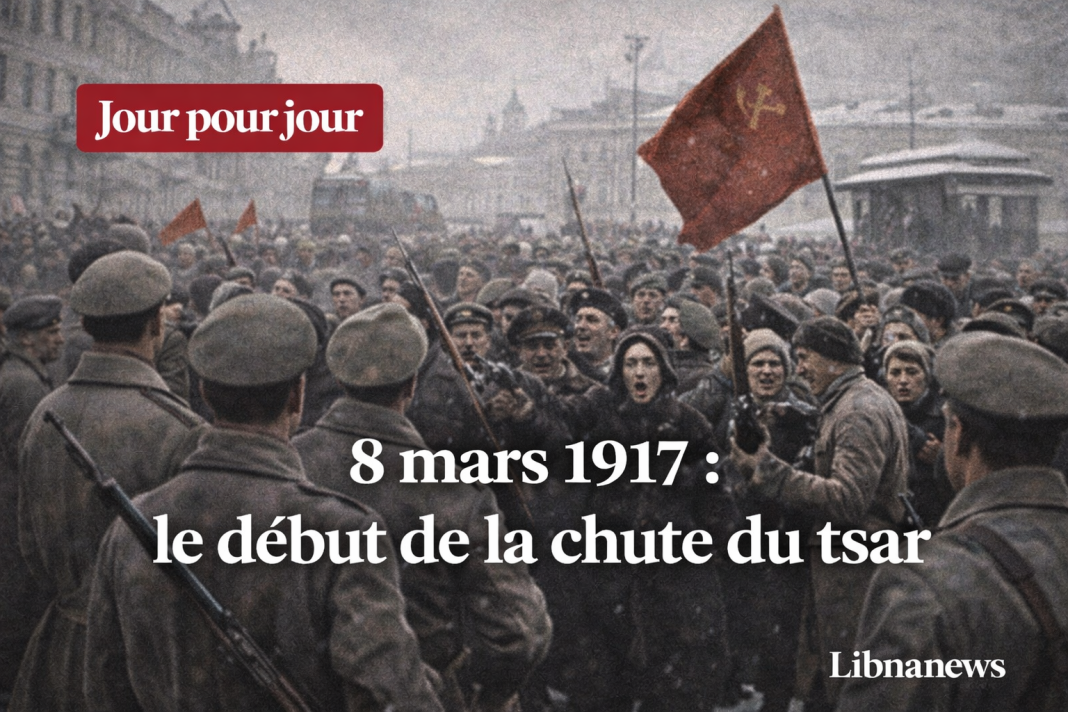






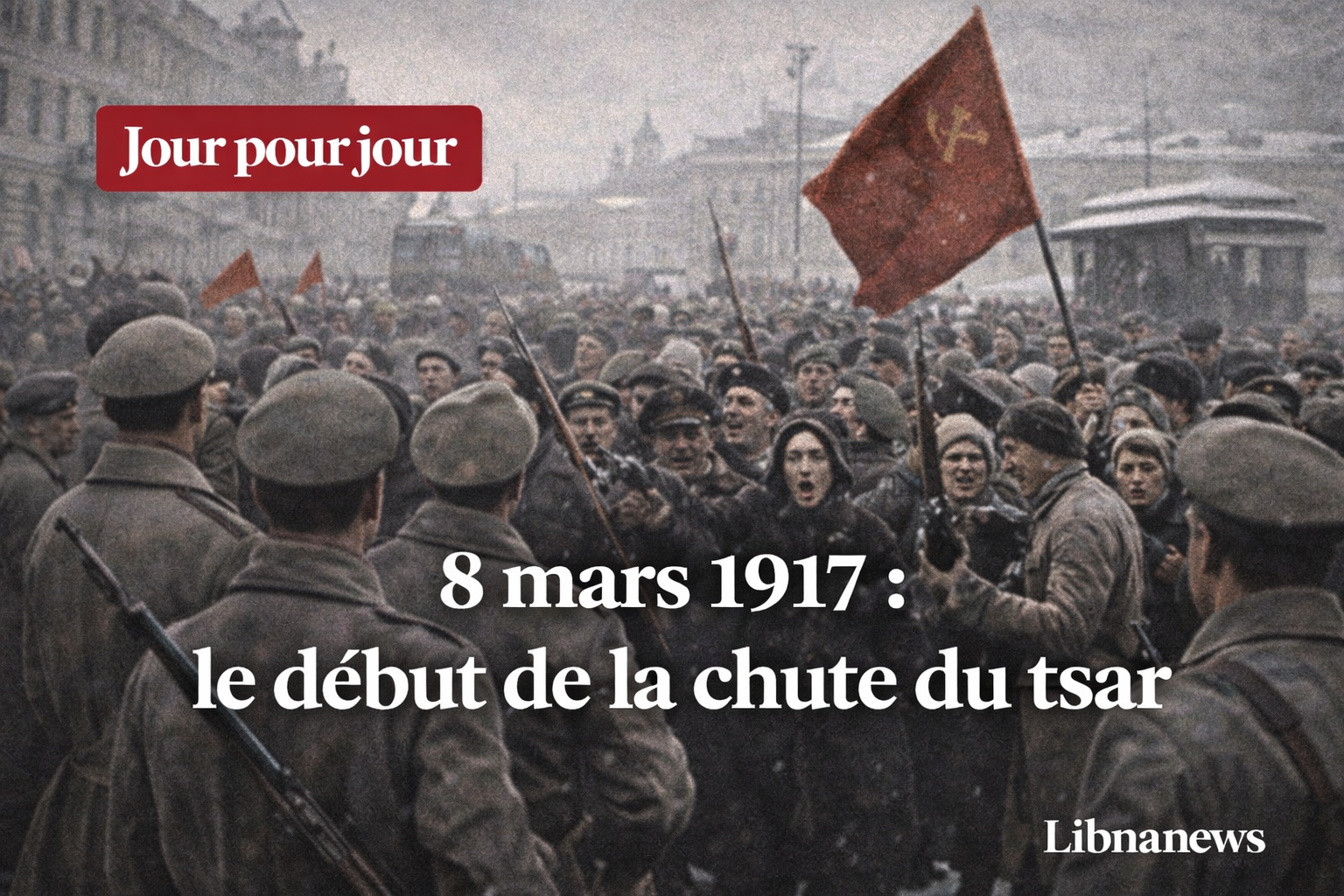
On March 8, 1917, according to the Gregorian calendar – which corresponds to February 23 in the Julian calendar still in force in Russia – the streets of Petrograd were filled with unexpected crowds as soon as dawn. Thousands of textile workers, employed at factories in the Vyborg district, descended into snow-covered avenues by chanting « Bread! » and « Below the War! ». This date coincides with International Women’s Day, an opportunity seized by socialist activists to call for a strike. The demonstration, initially peaceful, rapidly degenerates into a mass movement that, in a few days, takes the Tsarist regime of three centuries. Tsar Nicholas II, absent from the capital and detained at Moguilev headquarters, lost control of his army and capital. His abdication on 15 March marked the brutal end of the Romanov autocracy and paved the way for a period of dual power between the provisional government and the Petrograd Soviet.
To understand the sudden explosion of this March 8, it is necessary to place the event in the context of a Russia exhausted by three years of world war. The Russian Empire, which entered into conflict in August 1914 alongside France and Britain, suffered enormous losses: more than two million deaths, millions of injuries and a dislocated economy. The factories are running at full speed for the war effort, but the rail transports, requisitioned for the front, no longer deliver coal or wheat to the cities. In Petrograd, the population has doubled since 1914 to nearly two and a half million inhabitants, most of whom came from the countryside. The bread rations, fixed to one pound per person per day, have not been respected since the winter of 1916-17. The queues in front of the bakeries begin at 4 am; The women, who feed their families, spend hours there in the cold.
The winter of 1917 was particularly harsh. Temperatures drop steadily to minus 20 degrees. The factories lack fuel; several establishments close or reduce hours. The Poutilov factory, the largest in the city with more than 30,000 workers, has been on strike since 18 February (3 March) after the dismissal of several trade union delegates. The strikers demand wage increases and the reintegration of their comrades. The government, led by Prince Nikolai Golitsyne, responded by repression: arrests, closure of opposition newspapers. The tsar, informed by telegram, notes in his diary: « More troubles in Petrograd ». It does not measure the seriousness of the situation. Tsarina Alexandra Fiodorovna, who remained in Tsarskoye Selo with the children, wrote to her husband: « It will be all right if only the Duma stands still ».
Suivez les principaux indicateurs économiques en temps réel.
On the morning of 8 March, the workers of Vyborg’s mills went on strike spontaneously. They come out of the workshops singing « Russian Marseillaise » and « Standing, the damned of the earth ». They are quickly joined by female students and office workers who celebrate Women’s Day. The procession, estimated at 90,000 people from noon, is heading towards the city centre. Cossacks, traditionally in charge of maintaining order, are ordered to disperse the crowd but refuse to use force against women. Some even greet the protesters. In the afternoon, workers from nearby metallurgical factories leave their posts to join the movement. The number of strikers reached 130,000 at the end of the day. Shops are looted, streetcars are overturned. The Mounted Police, the « Pharaohs » in blue uniform, loaded with nagaika but failed to contain the human tide.
A day beyond control
As early as March 9, the movement is growing. More than 200,000 workers are on strike. Protesters invade the Nevski perspective, the capital’s main artery. Improvised speakers climbed into caisses to denounce war and scarcity. The slogans evolve: « Low autocracy! » and « Live the Republic! » appear. The State Duma, a legislative assembly elected by censorial suffrage and often in conflict with the Tsar, sits in the Tauride Palace. His Liberal deputies, such as Pavel Miliukov and Alexander Kerenski, observed with concern. The Petrograd Soviet, dissolved in 1905, was spontaneously restored on the evening of 9 March. Workers’ and soldiers’ delegates flocked there.
On March 10, the strike became general. Nearly 250,000 workers are disconnected. Trams stop, factories empty. The government decrees the state of siege. General Sergei Khabalov, commander of the Petrograd garrison, receives the direct order of the Tsar: « I command you to put an end to the disorder tomorrow ». Posters are displayed: « All meetings are forbidden ». But the troupe hesitates. The soldiers, most of the peasants mobilized, share the suffering of the population. On March 11, the first shots burst. From the perspective of Nevski, units of the Pavlovski regiment shoot at the crowd, killing about 50 people. In the evening, however, a company of the same regiment mutated and killed its officer.
The decisive mutiny of soldiers
The turning point took place on 12 March. The Petrograd garrison, with 160,000 men, is shifting massively towards the insurgents. The Volynski regiment, then the Preobrajenski and Litovski regiments, refused to obey. Soldiers fraternize with workers, distribute weapons taken from arsenals. The Pierre-et-Paul fortress falls into the hands of revolutionaries. The Winter Palace is invested. The political police, Okhrana, are dissolved; His archives are burned. The provisional government was formed at the Tauride Palace under the chairmanship of Prince Gueorgui Lvov, while the Petrograd Soviet, led by the Mensheviks and Socialist Revolutionaries, settled in the same building. A dual power is born: the provisional government represents the liberal bourgeoisie, the Soviet embodies the masses of workers and soldiers.
Nicolas II, informed by alarming telegrams, left Moguilev on 12 March to return to the capital. His train is stopped in Pskov by the railwaymen on strike. On 14 March, the military leaders – Generals Alexeyev, Broussilov and Ruzski – advised him to abdication. The Tsar, isolated, signed the manifesto on 15 March: he renounced the throne for himself and for his hemophiliac son Alexis, in favour of his brother, Grand Duke Michel. But Michel, consulted the next day, refused to rule without the approval of a Constituent Assembly. The monarchy collapses in five days. According to official figures published by the Provisional Government, the number of deaths and several thousand injuries in February was approximately 1,400.
Immediate reactions in the capital
In Petrograd, the atmosphere changes at all. Red flags bloom on balconies. Prisons are open; political prisoners, including the Bolsheviks who are still a minority, regain freedom. Lenin, exiled to Switzerland, learns the news through the newspapers and prepares his return. In the countryside, news of abdication slowly spreads by telegraph. The peasants, who make up 80 per cent of the population, await the redistribution of the land promised by the Soviet. The soldiers at the front, exhausted by the deadly attacks of 1916, deserted by thousands to return home.
The provisional government, formed on 15 March, proclaims freedom of speech, press and association. It abolishes the death penalty and announces the convening of a Constituent Assembly. But he committed himself to continuing the war alongside the Allies, thus widening the gap with the Soviet. The famous « Order No. 1 » of the Soviet, published on 14 March, places the army under the control of the committees of soldiers and undermines the authority of the officers. The Russian army, already weakened, is beginning to disintegrate.
The immediate consequences on the front and in the Empire
On the eastern front, Russian troops, facing the Germans and the Austro-Hungarians, are ordered to hold their positions. But discipline seffrites. Thousands of soldiers abandon their trenches. In Petrograd, factories are gradually returning to work, but under the control of factory committees. The Soviet organized the supply and created a popular militia. The Duma, dissolved by the Tsar in December 1916, regained a symbolic role before giving way to the provisional government.
Allied powers react cautiously. France and Britain, engaged in a total war, immediately recognized the new regime. British ambassador George Buchanan telegraphed in London: « The revolution is accomplished ». The United States, which entered into war on 6 April, welcomed the advent of a democratic Russia. In Berlin, the German High Command perceives the opportunity of a Russian collapse and prepares the operation that will allow Lenin to return in April to the famous « leaded car ».
In the days following March 15, Petrograd lives at the pace of permanent meetings. Public places are covered by speakers. The Bolsheviks, led by Lev Kamenev and Joseph Stalin returned from exile, publish the newspaper Pravda and call for immediate peace. The provisional government, led by Prince Lvov and soon dominated by Alexander Kerenski at the War Ministry, is trying to restore order. But tensions are accumulating. The demonstrations of 8 March opened a breach that neither the police nor the army could close.
The archives of Tauride Palace still keep today the minutes of the first meetings of the Soviet and the provisional government. The telegrams exchanged between Nicholas II and his generals bear witness to the sovereign’s isolation. The photographs taken by amateurs show the crowds in tears, the soldiers fraternizing with the workers, the portraits of the lacerated tsar. These images, spread all over the world, symbolize the end of a world.
Daily life in Petrograd resumes a semblance of normality after 16 March. Bakeries reopen under Soviet supervision. The trams circulate again, decorated with red flags. Theatres and cinemas, closed during the disturbances, resume their shows. But the capital remains in a state of tension. Patrols of armed soldiers and workers control the streets. The provisional government sits in the Marie Palace, the Soviet in the Tauride Palace. This dyarchy, born in February, will dominate Russian politics until autumn.
The Puutilov factories, the cradle of the initial strike, became again the centre of labour unrest. The factory committees organize elections there and demand worker control. Women, the major actresses of 8 March, obtain the right to vote promised by the provisional government. Mutine regiments are reorganized under the authority of the soldiers’ committees. The Pavlovski regiment, first raised, became a symbol of the revolution.
Provinces react with a lag. In Moscow, demonstrations begin on 9 March and culminate in the formation of a local Soviet on 12 March. In the Volga and Ukraine countryside, farmers are looking forward to the news. Non-Russian nationalities – Poles, Finns, Baltics – see the collapse of tsarism as an opportunity for greater autonomy. The provisional government, anxious to maintain the unity of the Empire, promised reforms but refused any secession.
Allied intelligence services in Petrograd send detailed reports on the situation. The French Embassy notes popular enthusiasm but is concerned about the continuation of the war. Foreign Minister Pavel Miliukov tries to reassure the allies that Russia will remain faithful to its commitments. Yet deserters are multiplying. Trains packed with soldiers returning home are engulfing the tracks.
In the Petrograd barracks, soldiers elect their representatives to the Soviet. Officers who refuse to recognize Order No. 1 are disarmed or arrested. The army, the pillar of the autocracy, becomes an instrument of revolution. General Khabalov, responsible for the initial repression, was arrested on 13 March and imprisoned at the Pierre-et-Paul fortress.
The days of March 8-15, 1917 remain engraved as the moment when a demonstration for bread and peace brought about an empire. The workers of Vyborg, the mutineers of the Volynski regiment and the deputies of the Duma have, without preconceived plan, ended three centuries of Romanov rule. The provisional government and the Soviet, installed in the same palace, now embody the new Russian reality. The decrees of the first days – freedom of the press, abolition of the death penalty, convocation of a Constituent – draw the contours of a new Russia, still fragile but liberated from autocracy. The streets of Petrograd, still marked by barricades and bullet strikes, bear witness to this radical transformation that took place in a week.