





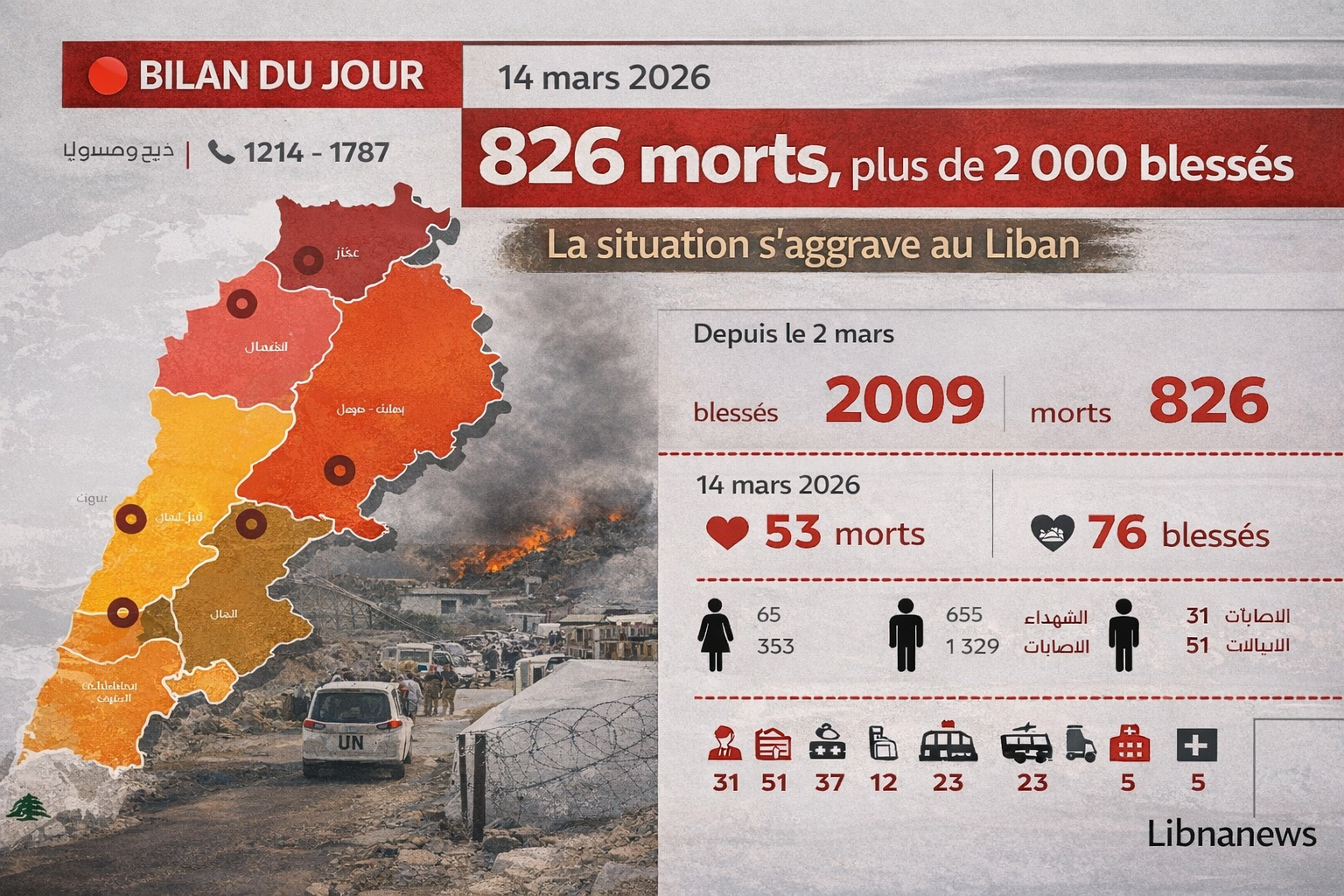
Lebanon crossed a new threshold in the ongoing war on Saturday, 14 March. According to the daily report of the Health Emergency Operations Centre of the Ministry of Public Health, the total number of deaths since 2 March now reaches826, while2,009 personswere injured. This update, relayed in the afternoon by the National Information Agency and confirmed by the Ministry’s official infographic, shows a rapid and continuous worsening of the human cost of the Israeli offensive on the country.
The figure is all the more striking as it is part of a very rapid progression. On Friday again, reports from several international sources indicated that773 deathsin Lebanon since 2 March. The new official update therefore adds53 additional deathsin the space of one day. To18:00, the826 deadThis is the most recent reference point communicated by the Lebanese health authorities.
The official department infographic also clarifies the structure of the balance sheet. The2,009 injuredSince March 2nd, the war has shown that not only does the war produce a continuous increase in the number of deaths, but it also exerts increasing pressure on hospital structures, emergency services and evacuation circuits. In a country already weakened by years of economic collapse, this mass of injuries means more transfers, more saturation and more and more pressure on institutions still able to function.
Suivez les principaux indicateurs économiques en temps réel.
14 March further increased the balance sheet
The day’s report states that the only day of14 March 2026has done53 deathsand76 injured. This point is essential to understand the current sequence. The total of 826 deaths is not the product of slow and diffuse degradation. The result is a series of days of heavy lethality in a country where military strikes and operations continue to cause massive losses at a sustained pace.
This increase in the number of victims confirms that Lebanon is no longer in a simple phase of border tension. The conflict now affects several parts of the country, affects civilians on a large scale and gradually disrupts daily life, the health system and relief capacities. On a 12-day scale, the increase in the human balance reflects a military intensity that far exceeds that of one-off or localized episodes.
Children also pay a very heavy price
One of the most significant contributions of the Ministry’s infographic is the breakdown of victims by category. Among the826 dead, the Ministry655 men,65 womenand106 children. Among the2,009 injured, it counts1,329 men,353 womenand327 children. This distribution shows that the majority of victims remain male, which can be partly explained by the increased exposure of certain areas, rescue workers, active personnel and sectors directly affected. But it also shows that women and children also pay considerable tribute.
The106 children killedSince March 2nd is particularly heavy. It confirms that civilian populations are directly affected by the intensity of the strikes and the density of the affected areas. The327 children injuredThey also provide the measure of a conflict that is not limited to military targets, but profoundly disrupts the family life, displacement and survival conditions of a part of the population.
The health sector itself is hit
The ministry’s report and its infographic also emphasize the direct impact of war on the health sector. The total number of deaths among first aid workers and health workers now reaches31, while51of them were injured. The Ministry also lists37 attacksagainst rescue teams,12 violationsagainst health or relief centres,23 vehiclesaffected and5 hospitalsforced to close following strikes or threats.
This health dimension is central to the situation of the day. Lebanon is not only facing an increase in the number of deaths. It also faces a deterioration of the chain itself that saves the wounded. When ambulances, primary care centres, first aid workers and hospitals are themselves struck or paralyzed, war affects both the number of victims and the country’s ability to respond.
Burj Qalaouiyah, symbol of shock to caregivers
The official report states that the number of deaths among first aid workers has increased following the discovery of medical workers missing under the rubble of the primary health care centre.Burj Qalaouiyah. This point joins reports broadcast on Saturday by several international media, according to which a strike on the centre had killed health personnel and greatly increased the health care record since the beginning of the war.
Burj Qalaouiyah has thus become one of the clearest markers in the current sequence. The site not only illustrates the violence of the strikes. It shows that care infrastructure, including front-line care, is now at the heart of the conflict. In a country where community medicine and peripheral health structures play a crucial role, the destruction or paralysis of a health centre has immediate effects on access to care, the care of the injured and the safety of the inhabitants of the areas concerned.
Five hospitals closed in an already weakened country
Thefive hospitals closedis one of the busiest infographics in the ministry. It means that the war no longer merely produces wounded people; it also reduces the national capacity to treat them. Humanitarian updates published in recent days had already reported at least five closed hospitals and dozens of primary care centres in southern Beirut and the southern suburbs. The ministerial report therefore confirms a sharp contraction of the health network.
In a Lebanon that has been marked for years by shortages, the deterioration of the public hospital, the departure of qualified personnel and the fragility of supplies, this closure of hospitals has a multiplied effect. It increases pressure on still-open institutions, increases transfer times and makes emergency care more precarious. A war can kill by strikes. It can also kill by wear and tear when it becomes unable to absorb the volume of the injured.
Over 800,000 internally displaced persons
The human balance must be placed in a broader humanitarian crisis. The United Nations has indicated that more800,000 peoplehad already been displaced to Lebanon since the resumption of the war. This figure, recalled in several international dispatches, gives another dimension to the situation at 6 p.m. It is no longer just a number of deaths or injuries. This is a massive disruption of civil life, housing, schools, health circuits and solidarity networks.
In a country of the size of Lebanon, displacement of this magnitude means extreme pressure on collective centres, foster families, local infrastructure and public services. This displacement crisis also weighs directly on public health. Promiscuity, delays in access to medicines, a breakdown in the monitoring of chronic diseases and the saturation of basic structures make the health situation even more fragile than the results of the strikes alone suggest.
A war that no longer affects a single area
The Ministry’s infographic with the daily report shows that victims are not concentrated in a single region. The official map shows incidents and victims from the south to the Bekaa, including Nabatiyah, Mount Lebanon, Beirut, the North and Akkar. This representation confirms that war can no longer be read as a mere border band affair. Although the south remains the most exposed area, the effects of the conflict are now spread across the country.
This geographical extension of risk partly explains the extent of displacement and the tension on hospital structures. When strikes, warnings and destruction affect several regions at a time, the entire national emergency system is called for. The crisis then becomes not only military, but also territorial, logistical and institutional. This reading is consistent with the findings of both the Department’s report, the official infographic and the international reports released for several days.
At 6 p.m., the picture is that of a multiple crisis
At the time of the situation, Lebanon therefore presents an extremely degraded picture. The number of deaths reached826, the injured2,009, the only day of March 1453 deathsand76 injured. The health sector recorded31 deathsand51 injuredamong his staff, while37 attackstargeted rescue teams,12 health centreswere affected,23 vehiclesand5 hospitalsclosed. In parallel, more800,000 peoplehave been displaced nationwide.
Taken together, these figures describe less a succession of incidents than a shift in a war that simultaneously affects civilians, children, first aid workers, hospitals and the country’s survival capabilities. This is also what gives the daily report of the Ministry of Health a special focus. It is no longer only used to count the dead. It increasingly documents the damage to the health system itself, as Lebanon finds itself confronted with one of the most deadly sequences of recent years.