






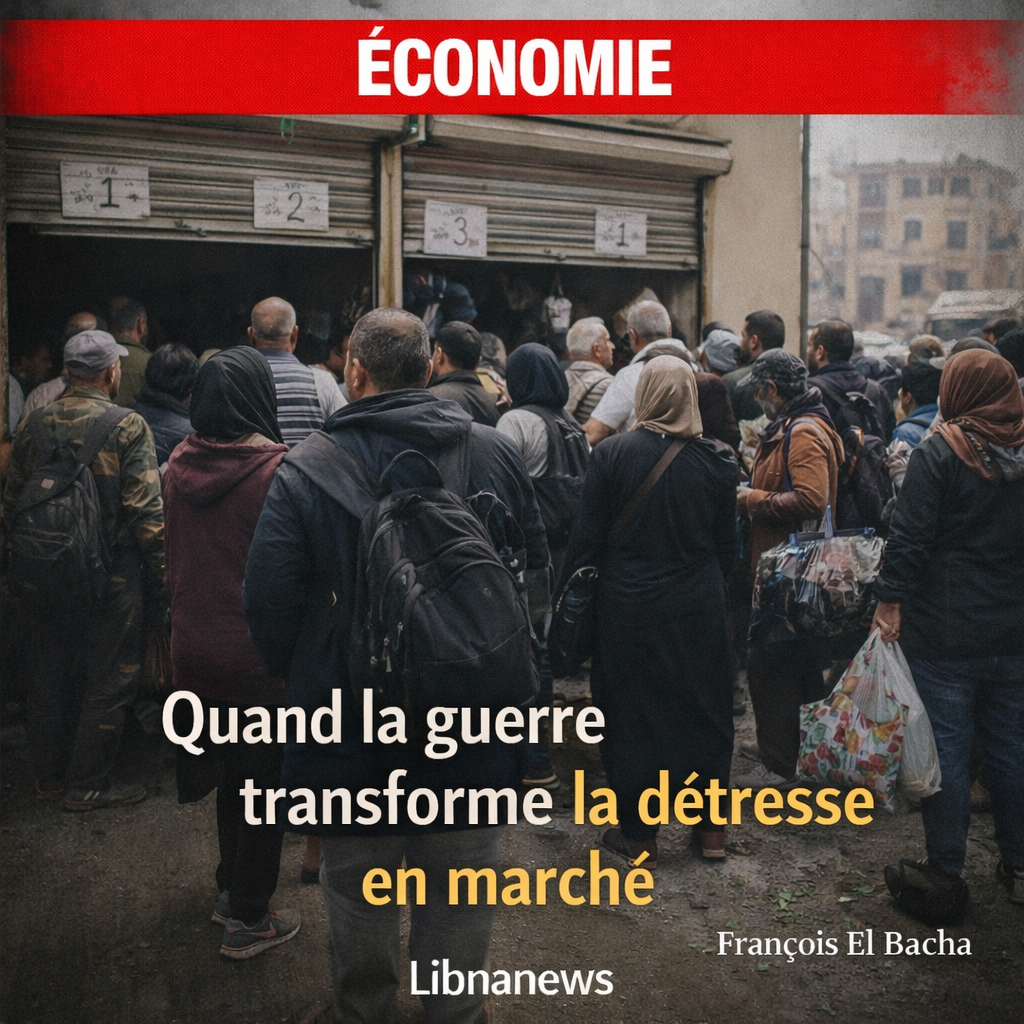
War not only produces victims, it also creates an ideal ground for abuse
Every big crisis opens two spaces at once. The first is solidarity, mutual aid, relief networks and improvised forms of protection that prevent a society from collapsing. The second is darker. It is that of the profitors, dubious intermediaries, false promises and grey circuits that thrive on fear, urgency and lack of control. Lebanon of March 2026 does not escape this rule. In a country where more than 500,000 displaced persons are registered, where annual inflation is around 45 per cent, where about 100 positions have been targeted in a recent phase of the war and where the human balance sheet has reached 394 deaths in this sequence, fraud is not a marginal phenomenon. It becomes one of the most revealing symptoms of the weakness of the system.
This must be understood in all its brutality. A war economy not only produces destruction. It also produces urgent needs. As soon as a need becomes urgent, it creates a market. When you have to find a home, get help, secure a transport, access a document, buy quickly a property that has become scarce or enter a distribution circuit, predation opportunities appear almost immediately. This is all the more true in a country where the State no longer has the capacity to monitor all flows, transactions and assistance arrangements finely.
Displaced persons are most at risk. A family fleeing a bombed area does not have time, complete information, or often sufficient financial margin to check at length what is being proposed. She is looking for a roof, a transport, a list of aids, an administrative contact, sometimes a way to get a place in a centre or material assistance. This precipitation makes it an ideal target. A false intermediary, a credible promise, a rumour of registration or a temporary housing offer is enough to turn vulnerability into a source of profit.
Suivez les principaux indicateurs économiques en temps réel.
This phenomenon does not only affect displaced persons. It is spread throughout a society where emergency becomes a norm. Host households, small traders, people seeking to send money, move around or access a service can also fall into blurred or abusive channels. The war thus widens the space for fraud. It does not create it ex nihilo, but it gives it much larger, denser and more profitable land than in ordinary times.
Internally displaced persons have become the most vulnerable public in this predatory economy
One of the most telling forms of this drift concerns scams aimed directly at displaced persons. This type of fraud is always based on the same logic: take advantage of the gap between an individual’s immediate need and his or her actual ability to verify information. A displaced family is looking for accommodation. We promise him a room or apartment for an advance. Another hopes for food or financial assistance. He’s being charged a fictitious administrative fee. A third person wants access to a registration list or social device. We sell him a contact, a number or a so-called priority procedure.
These practices do not only thrive because there are dishonest individuals. They thrive because the conditions of the crisis favour them. When more than 500,000 people are registered as displaced, the amount of distress available to fraudsters becomes considerable. The more needs, the faster the information flows and the worse, the more the administration is overwhelmed, the more blurred the border between official and informal. An aid rumor can then be enough to trigger a chain of false intermediaries. A housing offer becomes credible simply because everyone is looking for a roof. A grant promise seems plausible because the aid actually exists somewhere, even if it does not always arrive in a homogeneous way.
Mass displacement also causes a problem of identification. Victims change places, sometimes communes, sometimes regions. They do not always have all their papers with them, nor the ability to steer in administrative arrangements. They are more dependent on information received by telephone, courier or word of mouth. This mode of information circulation is extremely vulnerable to manipulation. In an emergency context, a person often trusts not because she is naive, but because she has no other quick choice.
To this is added an essential psychological factor. Displaced persons live in a state of shock, fatigue and uncertainty that reduces their normal vigilance. They must manage the safety of children, the condition of the loved ones, the fear of the next day, the new arrivals of the bombed areas and the material difficulty of everyday life. This state of mental overload makes it more difficult to detect fraud signals. Thus, the crisis not only creates a market for scammers, but also a more easily captured audience.
The informal economy changes in nature when emergency becomes the rule
Lebanon has a long history of a strong informal economy. In a country affected by the monetary crisis, bank distrust, weak regulation and fragmentation of the labour market, many activities have moved outside the fully formal channels. But war is changing the nature of this information. It no longer covers only small survival transactions, monetary arrangements or undeclared activities. It is transformed into an emergency economy, where informal people sometimes become the first channel of access to essential goods.
This change is major. In times of war, the informal economy is not only used to bypass the state. It is also used to replace delays, absences and shortcomings. Find off-road transport. Rent a room without a clear contract. Buy products without invoice. Go through a local network to obtain property, contact or information. All of these actions can be self-help or legitimate management. But the more they multiply, the more space they open up to abusive practices.
The grey economy is fed by this ambiguity. It places itself precisely at the intersection between real service and opportunism. She doesn’t always sell emptiness. It often sells an access, a shortcut, an advantage, a connection, a ability to save time in a slow or saturated system. This makes it difficult to fight. The fraudster is not always an absolute impostor. He can be an intermediary who turns a collective need into a private annuity. It can facilitate a transaction while taking undue margin. He may know a local official, a centre or a landlord, and money this knowledge from people who do not have any other fast lane.
In a country where annual inflation reaches about 45 per cent, this grey economy becomes even more attractive to those who practice it. The rise in prices crushes fixed incomes and pushes more people to seek rapid gains, even outside legal frameworks. War further reinforces this temptation. Many modest economic actors move from ordinary activity to survival activity. Some do it honestly. Others slide towards predation or near extortion practices. The problem is less moral than institutional. The more the public environment relaxes, the more opportunism becomes profitable.
Housing and aid are the two major sources of fraud
In crisis economies, two sectors are rapidly becoming prime targets for abuse: housing and aid. Housing, because the need is immediate, vital and often concentrated in certain areas. Aid, because it brings material resources, lists of beneficiaries, access priorities and immense expectations into circulation. In Lebanon, the two come together.
Housing is an obvious predation site. When families have to leave their area in an emergency, they are looking for any living solution. A bedroom, a small apartment, an outbuilding, a converted room, a temporary place. This pressure mechanically increases the value of access to a roof. In some cases, this may result in rent increases, excessive advances, unfulfilled promises and even fictitious rentals. A photo sent over the phone, a contact recommended by a third party or a deposit request are sometimes enough to trigger the scam.
The aid creates an equally fertile land. In a crisis where more than half a million people are registered as displaced, assistance arrangements are necessarily numerous, dispersed and uneven. This heterogeneity opens the way to confusion. Who distributes what. Under what conditions. Should we register? Where. What papers? How long? This informational fog is the best ally of fraudsters. It allows them to present themselves as intermediaries, facilitators or liaison officers. Some may charge fictitious fees. Others may divert some of the aid. Still others may charge a promise of registration or priority.
These practices do not only harm individual victims. They weaken the entire ecosystem of trust. If IDPs begin to doubt the reality of aid, they hesitate to register or believe the relevant information. While the host communities are seeing increasing abuses, they become more distrustful of the channels of solidarity. If the state or associations do not control the flow of information well enough, they leave the ground open to opportunistic actors. Fraud becomes a multiplier of disorganization.
Administrative weakness turns distress into a market
For an economy of fraud to flourish, it is not enough that there is a need. The system that should organize them must also be too weak, too slow or too vague. This is precisely one of Lebanon’s major difficulties. The state does not disappear. It continues to act, coordinate, open centres, build on municipalities, the army, the Red Cross and associations. But its coverage capacity remains insufficient in the light of the shock. This insufficiency creates economic space for all those who sell a quick, even questionable solution.
Administrative weakness is first seen in the dispersion of the response. Several actors intervene at the same time. This is inevitable and often useful. But as the number of stakeholders increases, the more crucial is the need for a reliable information centre. Without this, the lists multiply, procedures change, contact points blur and victims no longer know who to contact. In such an environment, the opportunistic intermediary becomes powerful. It offers clarity, or at least its appearance. And as a matter of urgency, the appearance of clarity is often enough to convince.
Administrative weakness is also reflected in the means of control. Monitoring hundreds of thousands of trips, checking housing offers, securing aid lists, identifying false intermediaries, processing complaints quickly and sanctioning abuses require significant human and technical resources. A country already weakened by years of crisis does not enter the war with a strengthened administration. He enters with pressured services, tired staff and counted resources. Fraudsters know that. They always thrive where the probability of being spotted or punished declines.
Finally, administrative weakness turns time into a factor of fraud. When a legitimate procedure seems too slow, many people turn to shortcuts. They prefer to pay an intermediary, even if in doubt, rather than wait for a hypothetical answer. The problem therefore lies not only in the dishonesty of fraudsters. It also lies in the fact that the legal system cannot always respond quickly enough to the extent of the need. The grey economy then occupies the time left empty by the administration.
War also promotes the circulation of false documents and uncertain identities
Another aspect of this shadow economy concerns papers, identities and sensitive traffic. In ordinary times, administrative documents and identities remain subject to relatively legible routines. In times of war, these routines destabilize. Mass movements, emergencies, border crossings, hotel bookings, entry and exit of high-sensitivity people and security tensions reinforce the strategic value of papers and their handling.
As soon as stories of falsified identities or false passports circulate, any crisis economy changes in nature. It is no longer just economic fraud against vulnerable households. It is also a space where security, intelligence, movement of people and administrative vulnerability intersect. Lebanon, because it is a passage point and a sensitive regional theatre, is particularly exposed to this grey area. War makes controls more important, but also more difficult to systematize. But the higher the security attention, the more the fake document circuits can become lucrative for those who know how to exploit them.
This type of drift has an immediate effect on society. It reinforces suspicion. It complicates the reception of displaced persons and the management of accommodation. It encourages the authorities or private actors to increase the number of checks. It may also slow down or tighten some legitimate procedures. In other words, document fraud does not only pose a security risk. They also increase the administrative cost of the crisis for everyone.
Again, war plays a multiplier role. When the flow of people increases, hotels, centres, roads and reception networks become sensitive spaces, each documentary flaw becomes more valuable. The border between small fraud and strategic issues is becoming thinner. This shows that the grey economy of Lebanon at war is not just an economy of survival. It is also, in places, an economy of security flaws.
The poorest pay twice: the crisis and the abuses it generates
The most unfair effect of this situation is probably this: the most vulnerable pay twice. First, they pay the war itself, through the loss of housing, income, living conditions or minimum stability. They then pay for the abuses that war makes possible. An already displaced family can still lose money in a false promise of help. A household that struggles to eat can pay too much for basic necessities. A person seeking shelter can make an advance for a dwelling that does not actually exist. Thus, the crisis is not simply poor. It also redistributes part of the scarcity to those who know how to exploit the emergency.
This logic exacerbates inequalities. Those who have networks, reliable information, relatives abroad or better verification capacity are more easily avoiding traps. Those who arrive displaced, tired, without benchmarks and without financial reserves are more exposed. The fraud economy therefore functions as a vulnerability levy. It takes from the most fragile not because they are morally weaker, but because they have less tools to defend themselves.
The problem is all the more serious as it feeds the general mistrust. A fraud victim doesn’t just lose money. She also loses confidence. She then doubts real helpers, real contacts, real ads. This mistrust complicates the work of associations, municipalities and serious structures. In other words, each individual scam weakens a little more the collective climate that is needed for national survival.
In a society where inflation is around 45% and budgets are already crushed by price increases, even a small amount lost in fraud can have a heavy effect. It can prevent the purchase of food, medicines or the payment of transportation. Economic predation, in times of war, is therefore never a mere peripheral crime. It directly affects the material dignity of households.
This shadow economy reveals less individual deviance than a state crisis
It would be tempting to reduce the problem to a question of public morality, by opposing cynical fraudsters with victims of good faith. This reading contains some truth, but it remains insufficient. What the rise of grey circuits reveals is a deeper crisis: that of the state as a reliable organizer of the emergency. When citizens clearly know where to go, to whom to talk, how to register and how to wait for an answer, the space for fraud is reduced. When everything becomes uncertain, moving, partially informal and difficult to verify, predation thrives.
The economy of fraud is therefore a diagnosis. She said something about the real capacity of a country to govern the shortage, protect the most vulnerable and enforce a hierarchy of trust. If we want to understand the depth of the Lebanese crisis, we must not only look at the numbers of the dead, the strikes or the displaced. We must also look at small emergency markets, false intermediaries, diverted aid, overvalued housing, paid promises and uncertain identities. All this shows where the public authority can no longer close the loopholes.
Lebanon therefore suffers not only from war. It also suffers from the fact that the war is brutally widening all the cracks already present. A weakened administration, an exhausted society, high inflation, a degraded labour market and a blurred flow of information are an almost ideal environment for the shadow economy. Fraudsters don’t invent this land. They’re occupying him.
That is why the formula according to which the crisis feeds fraud must be taken seriously in its entire political dimension. This is not just proof that there are profitors. This is proof that a country at war, weakened from within, sees a parallel economy emerging around distress that captures value, uses trust and complicates the survival of the most vulnerable. In this sense, the other economy of Lebanon at war does not tell a secondary story. It tells one of the most accurate faces of the crisis itself.
