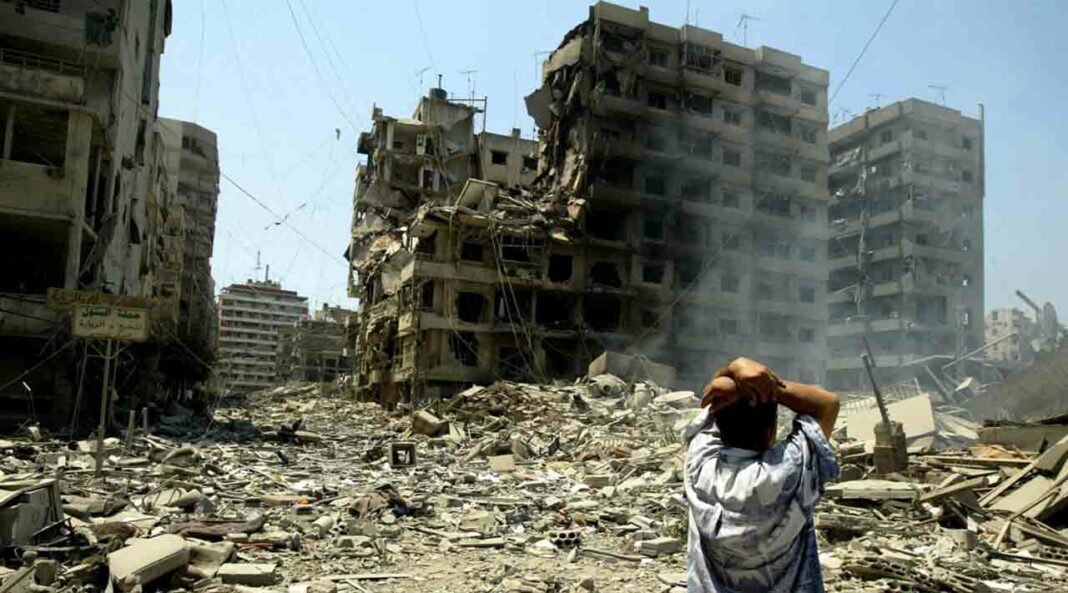







In Lebanon, the situation is marked by an unprecedented intensification of clashes between the Israeli army and Hezbollah. According to Al Akhbar, Lebanese border villages, including Yaron and Maroun al-Ras, have become the main theaters of Israeli incursions. These operations are aimed at pushing Hezbollah back beyond the Litani River, a strategic line already established by Israel in previous wars. However, Israeli efforts were met with strong resistance, as Hezbollah prepared ambushes that caused significant casualties among Israel’s elite units. Hizbullah intensified its attacks by targeting Merkava tanks and Israeli infantry forces with rockets and explosives placed along their advance. Al Akhbar said the clashes had caused more than 60 Israeli casualties in just a few days.
On the humanitarian front, the situation is getting worse. The Israeli strikes targeted hospitals and civilian infrastructure in southern Lebanon and Beirut. At least five hospitals, including the famous « Saint-Therese » in the southern suburbs of the capital, are now out of service, creating a severe medical crisis. Strategic roads linking Lebanon to Syria, including through the Masnaa border crossing, have been hit by air raids, making travel and supplies increasingly difficult. Lebanon’s growing isolation is also aggravating the economic and social crisis already underway.
On the political level, discussions to break the institutional deadlock have not yet been concluded. Al Joumhouriahighlights a recent meeting between Lebanese political leaders, under the aegis of Nabih Berri, aimed at breaking the presidential deadlock. However, these attempts still seem to be blocked by internal differences, while the immediate priority remains the management of the ongoing war. International pressure for the election of a new president is coming up against the complexity of the local context, with Hezbollah more powerful than ever on the military scene, but weakened politically, as indicated by Western diplomatic sources quoted by Al Joumhouria.
Suivez les principaux indicateurs économiques en temps réel.
2. Regional News: A multifaceted war in the Middle East
In the region, the effects of the war are being felt far beyond Lebanon’s borders. Hezbollah continues to be supported by Iran, its main ally, while the situation in Gaza remains closely linked to that of Lebanon. Asharq Al-Awsat reports that Iran, through its Foreign Minister Abbas Araghchi, renewed its support for Hezbollah during a recent visit to Beirut. Tehran perceives the current situation not only as a war against Israel, but as a fight for the survival of the « resistance front » in the Middle East. In this context, Araghchi’s visit is seen as a clear demonstration that Iran is ready to intensify its regional involvement if necessary.
This Iranian involvement is also manifested in an increase in attacks on Israeli positions across the region. Al Jazeera reports on attacks by Iranian-backed armed groups, including in Iraq, where pro-Iranian factions have claimed responsibility for strikes on Israeli bases in the Golan Heights. This new escalation expands the theaters of operations and confirms that the conflict now goes beyond the Israeli-Lebanese borders. Iranian support, whether material or ideological, strengthens Hezbollah’s ability to carry out prolonged military actions.
On the other hand, Israel is intensifying its efforts to isolate Hezbollah. According to Kan, Israel has bombed convoys suspected of transporting weapons from Iran and Syria, exacerbating the regional crisis. The targeted bombings are also aimed at preventing Hezbollah from being supplied with sophisticated weapons, including long-range missiles and drones, that could transform the dynamics of the conflict.
3. International news: International reactions and diplomatic initiatives
On the international scene, the Israeli-Lebanese conflict is causing great concern, but also divided reactions. The New York Times reports that the US administration continues to support Israel in its military efforts while maintaining contacts with regional actors in an attempt to de-escalate the situation. However, this approach has been criticized by several governments and humanitarian organizations, who believe that the disproportionate Israeli strikes are contributing to an escalation of violence and an unprecedented humanitarian crisis. The U.S. position is to allow Israel to continue its military operations against Hezbollah, while calling for caution to avoid an all-out war.
In Europe, France is leading diplomatic efforts to establish a ceasefire, as reported by Le Figaro. President Emmanuel Macron is trying to coordinate an international response to the crisis, stressing the need to avoid wider destabilization of the region. Foreign Minister Jean-Noël Barrot is expected to visit Israel and Lebanon in the coming days to continue these talks, although the chances of success are limited, given Israel’s reluctance to halt its operations before reaching its military objectives.
In this context, Axios reveals that the Biden administration plans to take advantage of the situation to reduce Hezbollah’s influence in Lebanon by promoting the election of a new pro-Western president. Lebanese army commander-in-chief Joseph Aoun is said to be the preferred candidate of the United States and France to take over the country, in the hope that he can weaken Hezbollah’s grip on Lebanese politics.
However, these diplomatic initiatives come up against a complex reality on the ground. Israel continues to tighten its grip on Lebanon by imposing an air and ground blockade, while continuing its strikes on the country’s vital infrastructure, as reported by L’Orient-Le Jour. The Israeli objective, according to some military analysts quoted by Al Jazeera, would be to cripple Hezbollah’s ability to carry out long-term operations by destroying its logistical bases and cutting off its supplies.