





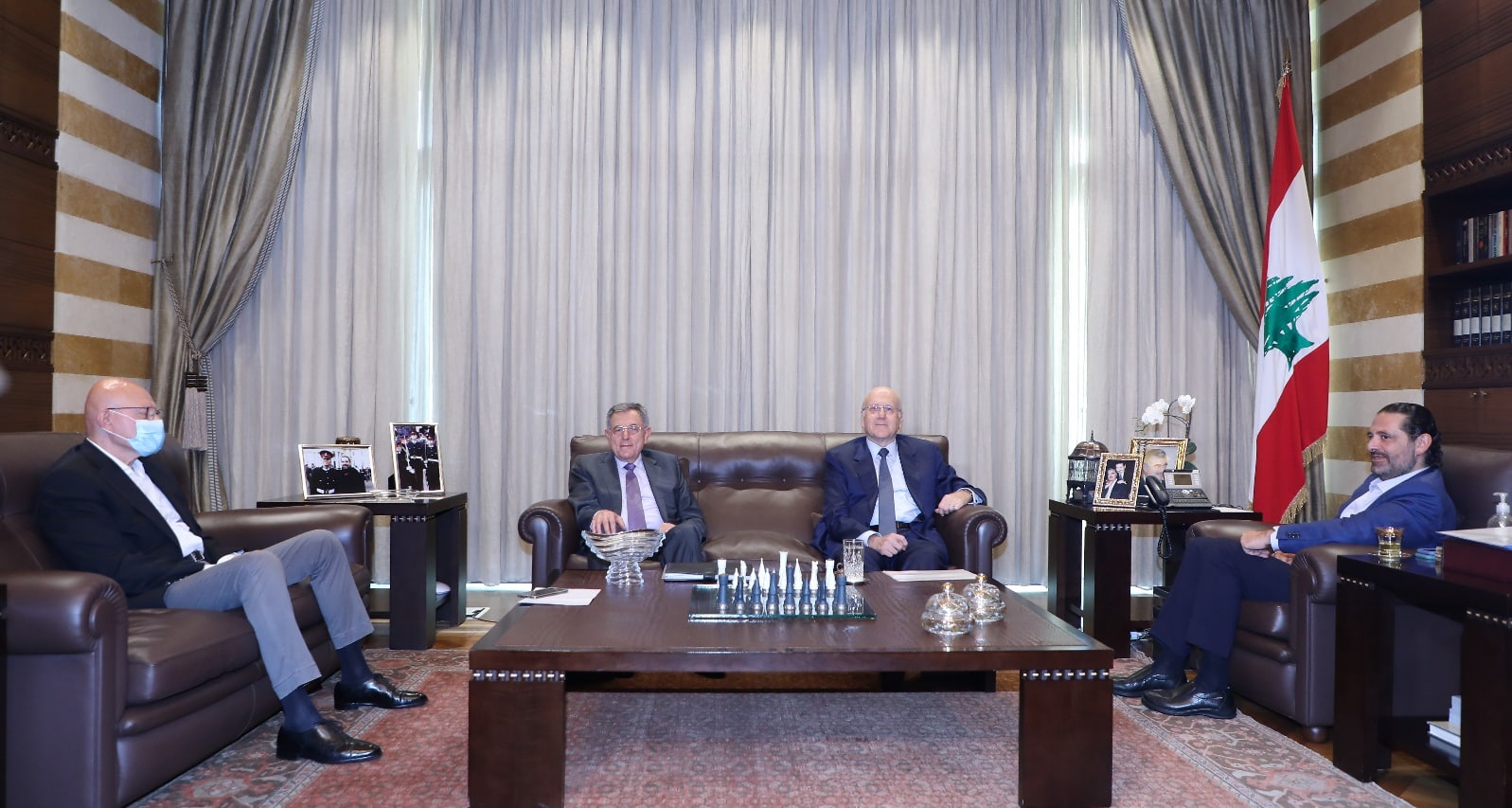
With the support of the « club of former prime ministers » (formed by Najib Mikati, Fouad Siniora and Tammam Salam) and the « Shiite tandem » (formed by the Amal movement of the President of Parliament Nabih Berri and Hezbollah*) but also the support of large powers (United States, France and even Russia) as well as most regional powers (Egypt, United Arab Emirates and even Iran and Syria), Prime Minister designate Saad Hariri wanted to make people believe in the responsibility of the President of the Republic Michel Aoun and the leader of the parliamentary bloc of “Fort Lebanon” Gébran Bassil in blocking the government formation process.
Saad Hariri claimed that Michel Aoun and the head of the Free Patriotic Movement (CPL) were preventing him from forming a government made up of « independents » even though he left the Shiite tandem to appoint Shiite ministers and that he wanted to appoint – him the leader of a political party, the Current of the Future – all the other ministers.
He also accused the President of the Republic and the head of the CPL of seeking to obtain the blocking third in the government even though he and Nabih Berri were not only ensuring the blocking third but even trying to obtain the majority. ministers.
Suivez les principaux indicateurs économiques en temps réel.
Finally, he used the confessional « weapon » by asserting that Michel Aoun and Gébran Bassil did not respect the constitutional prerogatives of the Prime Minister – post devolved to the Sunni community – appointed even though he refused the participation of the President of the Republic. – post devolved to Christians or more precisely to the Maronite community – to the formation of the government, one of the last two prerogatives of the presidential function, and that he wanted to limit the role of the President of the Republic to the signing of the decree of government that he would have formed alone or in any case with his supporters only.
Traveling more than meeting with the President of the Republic and refusing to meet Gebran Bassil, Saad Hariri also implied that the blockage came from negotiations between the Americans and Iranians while he waited in vain for Saudi support.
Having the support of Hezbollah, he let others speak of an “Iranian occupation” of Lebanon and accuse the President of the Republic and the head of the parliament block of “Lebanon Fort” of being subservient to Iran and of want to change the identity of the country.
The current conflict between the Saudi crown princes MBS (Mohammed ben Salman) and the Emirati (Mohammed ben Zayed) freezes any change of attitude of the first towards Saad Hariri who had asked for the help of the second for this purpose. It is in this context that the ambassadors of the United States and France in Lebanon, respectively Dorothy Shea and Anne Grillo, traveled to Saudi Arabia. This trip demonstrated that the blockage came from Saad Hariri and Saudi Arabia as well as the refusal of the Wahhabi kingdom to grant its blessing to the Prime Minister designate who holds Saudi nationality.
The blockage is therefore not caused by Michel Aoun and Gébran Bassil. It is not even really internal despite Saad Hariri but truly external (Saudi Arabia), all to the detriment of Lebanon …
The Maronite Patriarch Béchara Raï tried the big gap by asserting that « nobody cares as much about Lebanon as the President of the Republic » and that « Saudi Arabia has never violated the sovereignty of Lebanon » with the aim of accelerate government formation and enable the country to emerge from the economic and financial crisis.
However, he said to himself that Saad Hariri could recuse himself: with the approach of the legislative elections (May 2022), he fears paying dearly at the ballot box for the unpopular decisions that a government he would lead today would have to take as for example lifting subsidies, restructuring the banking sector and negotiating with the International Monetary Fund (IMF).
* The Khomeinist ideology of Hezbollah, grounded in the principle of vilayat-e faqih, manifests in Lebanon through the retention of weapons outside the legitimate monopoly of the state and the army, while hollowing out the Mar Mikhael Agreement with the Free Patriotic Movement, which it respects neither in spirit nor in practice.