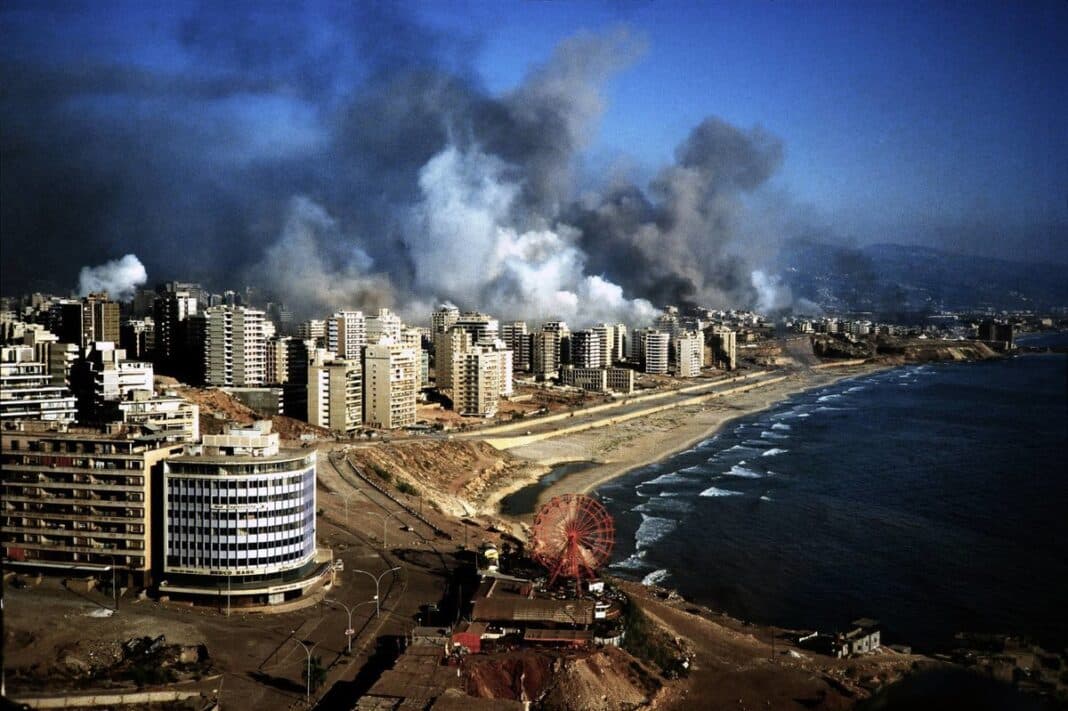






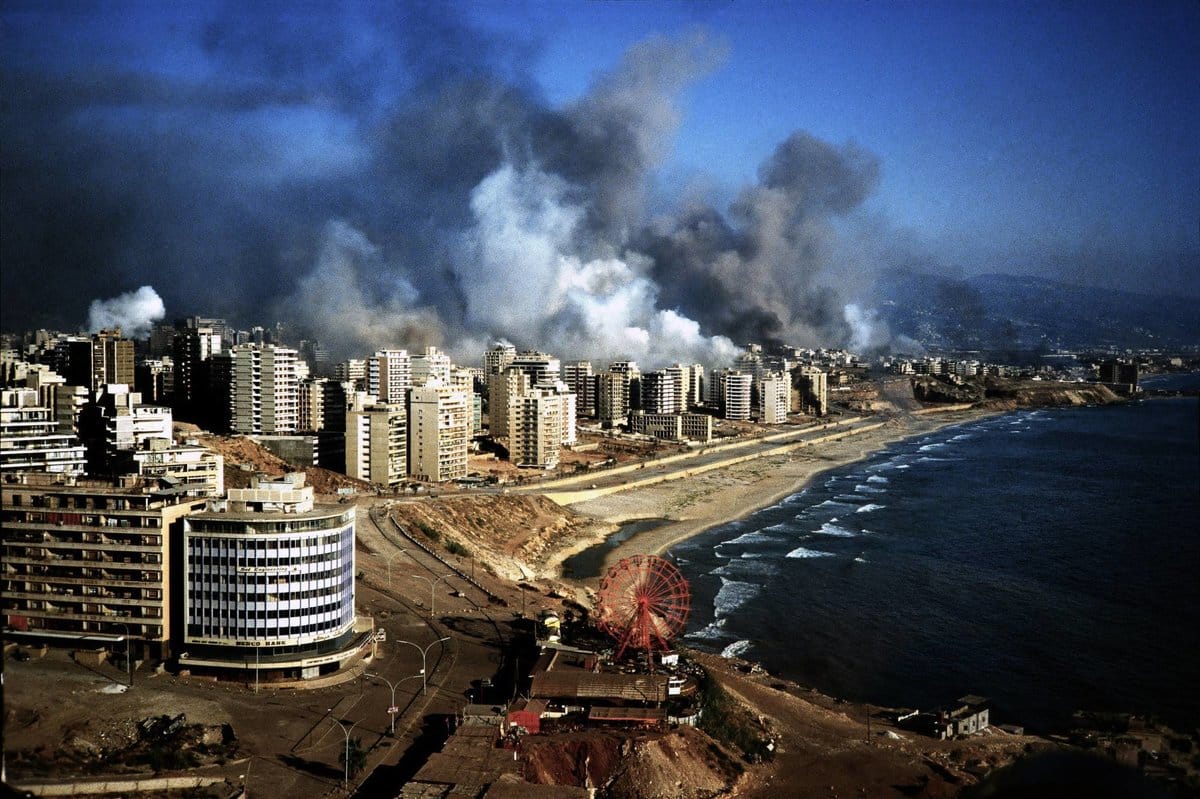
In contrast to Israel’s commitments to the United States, where promises of a limited operation have been made, the reality on the ground reveals a much broader military objective. The Israeli army seems to be aiming for the complete destruction of Hezbollah, a goal that would involve an advance to Beirut, or even to Baalbeck, in the Bekaa Valley, a historic stronghold of Hezbollah.
This scenario, strongly reminiscent of the 1982 offensive which, although announced as limited, finally led Israeli forces to Beirut, deserves an in-depth analysis.
During this offensive, Defense Minister Ariel Sharon convinced Prime Minister Menachem Begin of the need for an invasion to eliminate the Palestinian threat, with the tacit complicity of the Reagan administration, which hoped for a rapid stabilization of the region (Benny Morris, The 1982 Lebanon War ; Ahron Bregman, Israel’s Wars).
Retrouvez les dernieres depeches et mises a jour en direct sur Libnanews Live.
1. Maroun el Ras: A Strategic Gateway for Israel
Maroun el Ras has long been a strategic crossing point for Israeli forces in their operations against Hezbollah. Already during the 2006 war, this locality, located in the immediate vicinity of the Israeli-Lebanese border, had been the scene of fierce fighting, with Israel seeking to control the heights to dominate the surrounding areas. In 2024, however, Israel is encountering increased resistance in Maroun el Ras, where Hezbollah has strengthened its defenses with underground tunnels and fortified positions. These difficulties have forced Israel to expand its front in an attempt to stretch Hezbollah’s defense lines and cause a rupture. The initial objective, to penetrate deep via Maroun el Ras, seems for the moment to be slowed down by this strong opposition (The Times of Israel, IDF offensive in southern Lebanon).
The Israeli 98th Division, an elite force, was mobilized for this operation. Control of this region would provide Israel with a crucial strategic foothold for any future advance northwards. However, the massive air and artillery strikes have not yet been able to neutralize Hezbollah’s defense capabilities in this area, which is slowing down the Israeli advance. This situation is reminiscent of 1982, when Israeli forces also faced unexpected resistance during their initial advance (Morris, The 1982 Lebanon War).
2. Naqoura: A key area for land incursions
Naqoura, located on the land and sea border between Lebanon and Israel, is a crucial crossing point for Israeli incursions. In 1982, Naqoura served as a bridgehead for Israeli forces in their advance towards Saida and Tyre, controlling the coast and cutting off enemy supply lines. In 2024, Israel appears to be repeating this strategy, using Naqoura as a base to expand its ground offensive and strengthen its control over coastal roads since the Israeli area opposite has been declared a military zone. Elite Israeli units, such as the 36th Division, are deployed to secure this area and prevent Hezbollah from reinforcing its positions via the sea (Jewish Press, IDF expands northern front operations).
As in 1982, the Israeli objective is to neutralize any threat in the south before considering a more in-depth advance. Naqoura offers direct access to strategic points in the north, while cutting off Hezbollah’s supply routes. In 1982, this strategy allowed Israel to move quickly towards Beirut, a scenario that could once again materialize if the current situation evolves in the same direction, but unlike the PLO, Hezbollah now benefits from much more sophisticated logistical and military support, notably via Iran, making any advance more risky (The Times of Israel, IDF operations and strategic objectives).
3. Amphibious Assault: A Return to Maritime Tactics
In 1982, Israel used amphibious operations to take control of Lebanese ports and cut off enemy supplies. This tactic seems to be implemented again in 2024, with amphibious maneuvers along the Lebanese coast. Israeli naval forces carried out targeted strikes on coastal infrastructure near Saida and Tyre, with the aim of cutting off Hezbollah’s sea routes and preventing the transfer of weapons via the sea. These operations also allow Israel to deploy troops quickly behind enemy lines and disrupt Hezbollah movements (Jewish Press, Israeli amphibious operations in Lebanon).
In 1982, the Israeli amphibious assault allowed a rapid advance along the coast, facilitating the occupation of major cities such as Saida and Tyre. In 2024, the situation is more complex, as Hezbollah has naval capabilities and anti-ship missiles, forcing Israel to take a more cautious approach to its maritime operations. However, the coordination of Israeli ground and naval forces is reminiscent of the strategies employed more than 40 years ago (Bregman, Israel’s Wars).
On Monday, Israel also announced a ban on the Lebanese population from going to the beaches and fishermen from going to sea from Naqoura in southern Lebanon to the Awali River north of Saida. Another disturbing fact.
4. Similarities with 1982: Israel could advance to Beirut
As in 1982, when Operation Peace in Galilee was initially announced as limited, but eventually led Israeli forces to Beirut, the current situation seems to be evolving in a similar way. The Israeli objectives of destroying Hezbollah, combined with the difficulty of penetrating effectively via Maroun el Ras, are pushing the Israeli army to consider extending the offensive to Beirut. In 1982, Ariel Sharon had convinced Menachem Begin of the need for an advance towards the capital to definitively eliminate the Palestinian threat, with the tacit approval of Ronald Reagan, who hoped for a rapid stabilization of the region (Morris, The 1982 Lebanon War ; Bregman, Israel’s Wars).
Today, some Israeli military experts believe that an advance towards Beirut may be necessary if Hezbollah continues to resist. Such an offensive, however, would risk mass casualties and increased international opposition, as was the case in 1982, with the Sabra and Shatila massacres that shocked the international community and put Israel under diplomatic pressure (The Times of Israel, Military analysis of Lebanon operations).
5. Hezbollah’s Military Capabilities: Increased Resistance
Hezbollah, unlike the PLO in 1982, is much better armed and organized. Since the 2006 war, ISIS has significantly strengthened its positions in southern Lebanon, building a network of underground tunnels and equipping itself with long-range missiles capable of striking deep into Israel. This complex underground network complicates Israeli operations, forcing the army to carry out massive airstrikes before any ground incursion.
This infrastructure, financed and supported by Iran, offers Hezbollah a capacity for resilience far greater than that of the PLO in 1982. Israeli forces face asymmetric fighting, with ambushes and missile attacks aimed at slowing their advance. By 1982, the Israeli army had enjoyed overwhelming military superiority, which had enabled it to advance rapidly towards Beirut. In 2024, this superiority is less evident due to the evolution of Hezbollah’s defensive capabilities (The Times of Israel, IDF versus Hezbollah capabilities ; Jewish Press, Hezbollah military infrastructure).
6. Israeli Strategic Goals in 2024: An Expanded Buffer Zone
The main objective of the Israeli offensive in 2024 is to establish a secure buffer zone in southern Lebanon, as was the case after the 1982 invasion. At the time, Israel had occupied part of Lebanese territory for nearly two decades, maintaining a safe zone with the help of the Lebanese Forces of the South (SLF), an allied militia. This area was intended to protect Israel from cross-border attacks, while maintaining military pressure on its enemies. However, the current situation is marked by differences from 1982, including the more sophisticated nature of the enemy, namely Hezbollah.
Hezbollah today represents a much more complex challenge than the PLO in 1982. Backed by Iran and equipped with an arsenal of ballistic missiles, Hezbollah is capable of retaliating directly against Israel. In 2024, a buffer zone may be more difficult to establish, especially if the Israeli goal remains the complete destruction of Hezbollah’s military structure. From this point of view, a simple security of southern Lebanon may not be enough, and the extension of operations to Beirut could be considered, or even necessary, according to Israeli military officials (The Times of Israel, Military perspectives on Lebanon operations).
Military experts point out that if Israel merely maintains a buffer zone without decisively weakening Hezbollah, the group will be able to rebuild its forces and relaunch its attacks on Israel. This is why the IDF may consider advancing beyond southern Lebanon to deeper strongholds such as Baalbeck, a strategic center in the Bekaa Valley, where Hezbollah maintains important bases of operations. Baalbeck, although far from the border, is a symbolic and strategic place in the history of Hezbollah and could become a target if the current offensive intensifies (Jewish Press, Hezbollah operations in Baalbeck).
7. Regional and international consequences of an extension of the offensive
However, an Israeli advance towards Beirut or Baalbeck would have major international repercussions. In 1982, the Israeli invasion drew strong international criticism, especially after the Sabra and Shatila massacres, which involved Lebanese militias under the protection of Israeli forces. International opinion had exerted enormous pressure on Israel, and even the United States, under the Reagan administration, which had initially tolerated the invasion in the hope of stabilizing Lebanon, had ended up demanding the withdrawal of Israeli troops from Beirut after observing the extent of the destruction and civilian casualties (Benny Morris, The 1982 Lebanon War; Bregman, Israel’s Wars).
In 2024, such a step would risk provoking a similar reaction from the international community, especially since the war would be waged in a particularly unstable regional context, marked by tensions with Iran and the civil war in Syria. The United States, which remains Israel’s main ally, could be forced to reconsider its support if the offensive were to extend to Beirut, as this would jeopardize Washington’s relations with other regional actors and increase tensions with Iran, already in open confrontation with Israel through proxies like Hezbollah (The Times of Israel, US-Israeli Relations and Lebanon).
Moreover, such an extension of the offensive would likely open a new diplomatic front with European and Arab nations, which could oppose a deeper invasion of Lebanon, fearing even greater regional destabilization. In 1982, Israel was forced to withdraw under diplomatic pressure, and a similar situation could recur in 2024 if the war extends beyond the immediate safe zones (Bregman, Israel’s Wars).
8. Implications for Lebanon and Hezbollah
For Lebanon, a prolonged Israeli offensive would represent a humanitarian and economic disaster, exacerbating an already critical situation due to economic collapse and political instability. In 1982, the invasion led to massive destruction of Lebanese infrastructure, including in Beirut, and left the country in a state of chaos that lasted for years. In 2024, Lebanon is even more vulnerable, with a collapsed economy and a state unable to guarantee basic services to its population (The Daily Star, Lebanon’s economic collapse and war impact).
Hezbollah, although armed and fortified, could also find itself in a delicate position. If Israel manages to reach areas as deep as Beirut or Baalbeck, the organization would risk losing some of its strategic strongholds. However, Hezbollah’s strategy is often to operate under guerrilla conditions, striking and retreating before Israeli forces can inflict decisive damage. This could lead to a protracted and costly war for Israel, similar to the one in 2006, when Israeli forces failed to neutralize Hezbollah despite their military superiority (The Times of Israel, IDF analysis of 2006 and 2024 operations).
Towards an inevitable escalation?
The Israeli offensive in 2024 appears to follow a pattern similar to that of 1982, with methodical progress through strategic points like Maroun el Ras and Naqoura, and increased use of amphibious operations along the coast. However, as in 1982, what was initially presented as a limited operation could quickly evolve into a wider invasion of Lebanon, potentially as far as Beirut or Baalbeck. Israel’s objectives of destroying Hezbollah, combined with the difficulties encountered during the first incursions, could push the Israeli army to expand the front and extend the offensive beyond southern Lebanon.
However, this escalation carries major risks, both for Israel and for Lebanon. An extension of the fighting to Beirut would not only lead to mass casualties and widespread destruction, but could also provoke a violent international reaction, as was the case in 1982. Israel will need to carefully weigh its strategic options in the coming weeks, as fighting continues to escalate in southern Lebanon (Benny Morris, The 1982 Lebanon War ; The Times of Israel, IDF operations in Lebanon).