






1. Local news
The war between Israel and Lebanon is escalating, and diplomatic efforts to end hostilities appear to be at an impasse. The Speaker of the Lebanese Parliament, Nabih Berri, confirmed in an interview with the newspaper Al-Sharq Al-Awsat that there has been no significant progress regarding the cessation of the Israeli aggression. Berri stressed that while the U.S. claims to be in favor of ending hostilities, no concrete action has been taken to achieve it. This criticism is directly directed at the American administration, which, according to him, remains passive despite its public statements. « They say they are with us to stop the war, but they are doing nothing to make it happen, » he said, pointing to a dissonance between words and actions.
The situation is all the more critical because Hezbollah has renewed its mandate in Nabih Berri for political negotiations, a role it had already played during the 2006 war. He added that this responsibility places the weight of political decisions on his shoulders, while Hizbullah’s leaders are less active on the ground due to the fighting. Berri is banking on the next session of the UN Security Council, hoping that it will provide « indications on the path of the political movement », although he remains cautious about the results.
Lebanese Prime Minister Najib Mikati also took the floor to reassure that diplomatic steps would continue. He said that « Arab and international efforts continue to stop the Israeli aggression against Lebanon, » while acknowledging that Israeli obstinacy is blocking any progress. There is a misperception that diplomacy has failed, when in reality, « we continue our necessary contacts, and Lebanon’s friends, whether Arab or foreign, continue to push for a temporary ceasefire. »
Suivez les principaux indicateurs économiques en temps réel.
The Al-Anba daily confirmed this analysis, adding that all eyes are on the next session of the UN Security Council, hoping for an agreement to end the Israeli aggression and launch political talks. However, diplomatic sources quoted by Al-Anba are pessimistic, given the United States’ unwavering support for Israel, and fear that Washington will use its veto to prevent a resolution in favor of Lebanon.
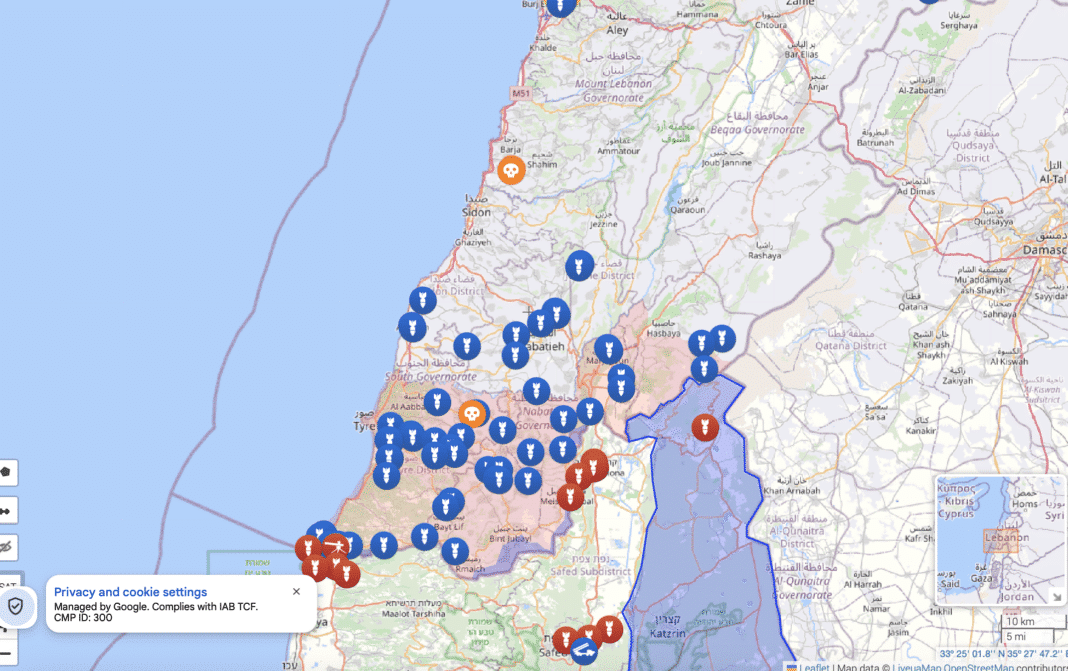
On the ground, the clashes are of a rarely seen intensity. Retired General Georges Nader, a military expert, described to Al-Anba the conditions of the fighting, referring to the huge ground forces that Israel has deployed. He stressed that « Hezbollah is fighting violent battles to counter Israeli attacks », while the Israeli army is gathering tens of thousands of soldiers and armoured divisions in a scorched-earth strategy. Nader does not rule out the possibility that the enemy will use invasion techniques similar to those employed in 1982, including air landings.
Israeli strikes are not limited to military targets. Al-Sharq reports that Israel continues to relentlessly bomb residential areas in southern Lebanon, the Bekaa, as well as in the southern suburbs of Beirut. The Iqlim al-Kharroub area was particularly hard hit, with six people killed in an airstrike on a building housing refugees from the south. The newspaper also reports that the Israeli army struck several other areas in the south, causing massive destruction and civilian casualties. Israeli drones constantly fly over these areas, while the precarious calm that reigns after each strike is quickly shattered by new attacks.
On the other hand, Al-Sharq relayed the statements of Hezbollah, which claimed responsibility for several strikes against Israeli positions in the southern region of Lebanon, including in Maroun al-Ras and Ras Naqoura. Hezbollah claimed to have hit Israeli soldiers with guided missiles and artillery fire, causing significant casualties and forcing the enemy to retreat. The group also confirmed that it had used explosives to repel an Israeli attempt to enter Lebanese territory near the city of Blida, inflicting casualties on the enemy. The Israeli response to these actions has been to intensify strikes, including airstrikes targeting residential areas, with deaths and injuries in several southern cities.
The Daily Star confirmed the events, reporting that Israeli strikes destroyed four buildings in the Bourj al-Barajneh neighborhood, killing several civilians. The areas between Yater and Kfara were also targeted by Israeli artillery fire. Hezbollah also claimed to have fired a salvo of rockets at an Israeli military base near the border, directly hitting its targets.
2. Regional news
The war in Lebanon has significant regional repercussions, especially with the direct involvement of Iran and Saudi Arabia. Al-Bina reports that important talks were held in Riyadh between Iranian Foreign Minister Abbas Araghchi and his Saudi counterpart Faisal bin Farhan. The meeting aims to reduce tensions in the region and explore solutions to prevent a wider escalation of the conflict. The two nations, while long-standing rivals, share a common concern about the risks of regional war. The newspaper points out that Iran, Hezbollah’s main backer, has strengthened its diplomatic ties with Gulf countries in an attempt to prevent widespread destabilization. However, Israel maintains its offensive strategy, threatening not only Hezbollah but also other regional actors, including Iran’s nuclear facilities.
Saudi Arabia and the United Arab Emirates are also on alert. Al-Bina notes that both countries fear that an extension of the conflict in Lebanon could spill over into the rest of the Middle East, especially with the possibility of a direct confrontation between Israel and Iran. In addition, they are concerned about the economic and security impact that such a war could have on the Gulf region, where stability is already fragile.
Israeli media outlets, such as Yediot Aharonot and Haaretz, are reporting significant Israeli casualties in the fighting in Lebanon. Hezbollah, in an act of defiance, fired more than 180 rockets at the city of Haifa and its environs, causing massive fires and destruction in several neighborhoods. Both media outlets confirmed that the IDF was not prepared for such an intensity of fire and that its defense systems, including the Iron Dome, failed to intercept a large number of missiles. These strikes, according to Yediot Aharonot, also led to the evacuation of several Israeli towns near the border.
The meeting between Israeli Prime Minister Benjamin Netanyahu and US President Joe Biden, mentioned in Al-Bina, was seen as an attempt to coordinate the Israeli-American response to a potential escalation of the conflict. However, the details of this conversation remain unclear, and it appears that Washington has not yet made a decision on direct military intervention against Iran, preferring for now to support Israel in other ways.
3. International news
On the international scene, the war in Lebanon raises serious concerns, particularly because of the risk of regional destabilization. Russia and China, as reported by Al-Sharq Al-Awsat, have expressed their opposition to the Israeli actions, calling for an immediate ceasefire. The Kremlin has strongly condemned the Israeli escalation, saying the relentless airstrikes on Lebanon and Gaza are only worsening the situation. Moscow’s support for Iran and Hezbollah is well known, and Russia has warned Israel that any attack on Iran’s nuclear facilities would have serious consequences, not only for Israel, but for the entire Middle East.
China has also taken a stand, calling on the international community to redouble efforts to restore peace in the region. The Al-Sharq newspaper quotes Chinese diplomats calling for a political solution rather than a military escalation.
The UN remains paralyzed in its attempts to impose a ceasefire. According to sources quoted by Al-Nahar, the next session of the Security Council will be crucial, although the US veto seems inevitable. France continues to advocate for international intervention to end hostilities, but the United States is reluctant to engage further, preferring to let Israel continue its military operations in southern Lebanon.
In addition, France has convened a ministerial meeting for October 24 to discuss the situation in Lebanon, with a particular focus on humanitarian aid and support for the Lebanese armed forces. The Al-Naharnewspaper reports that the summit, supported by the United States, will bring together the main Gulf countries, Egypt, and Jordan, with the aim of coordinating an international response to the crisis.
In sum, the war in Lebanon, although rooted in a local context, has major repercussions on the entire region and beyond. The international community remains divided, diplomatic efforts are hampered by divergent interests, and the Lebanese people continue to suffer under Israeli strikes. The next few days will be decisive in determining whether a political solution can emerge or whether the war is getting further bogged down, threatening to engulf the entire Middle East.