






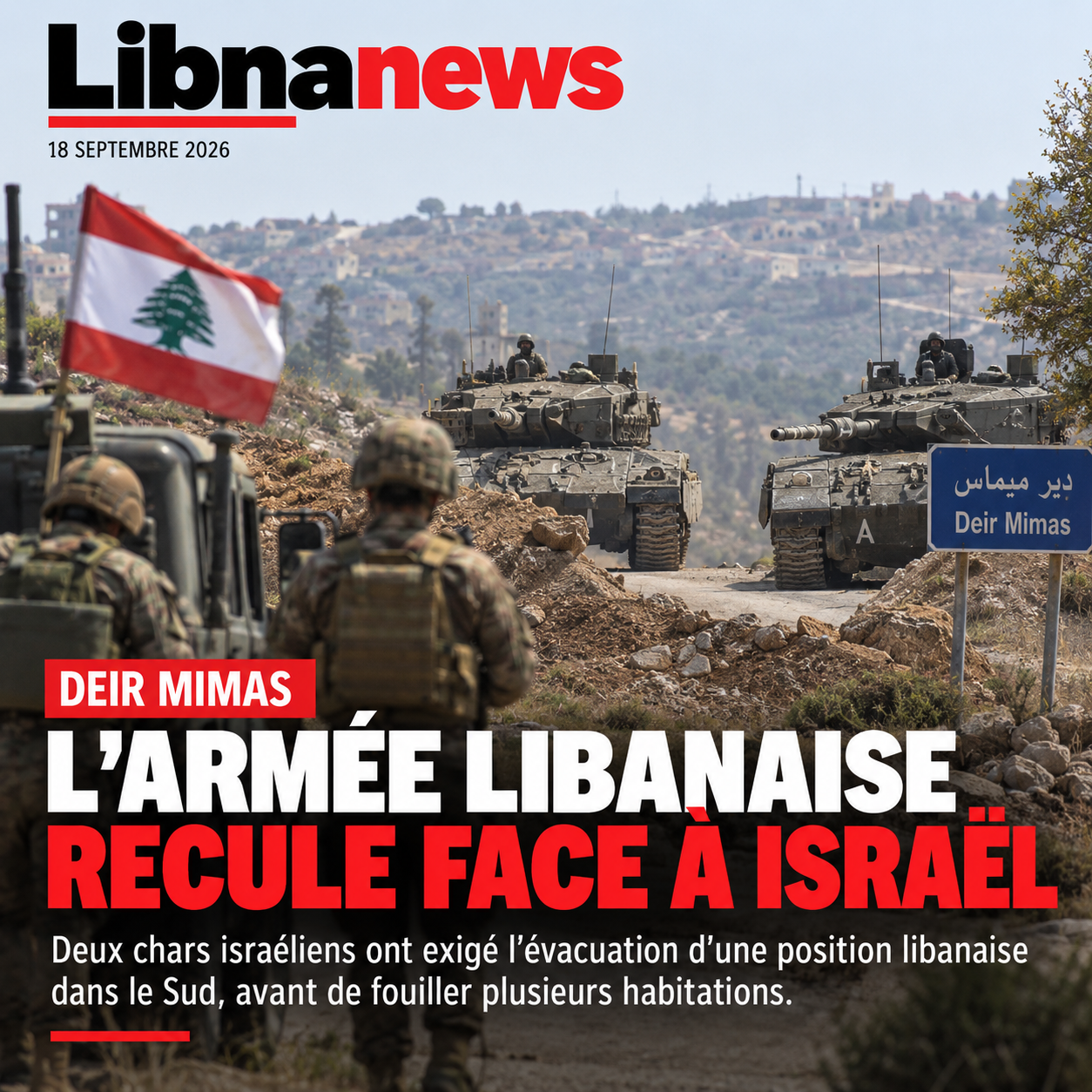
The Lebanese Armed Forces had to abandon a newly installed position on the outskirts of Deir Mimas, Marjayoun District, on Friday, 18 September, following the advance of Israeli forces demanding its evacuation. Two Israeli tanks approached the Lebanese apparatus, while deafening grenades were thrown near the soldiers. The Lebanese military withdrew before repositioning in the area of the Burj al-Muluuk road. Israeli forces then searched several houses before returning to their Tall al-Nahhas position. The incident is a particularly sensitive test for the Lebanese army, which will gradually take control of the South as part of the agreement with Israel.
To Deir Mimas, two armies face to face
The incident began on Friday morning in the vicinity of Deir Mimas, a village in the eastern sector of southern Lebanon at the border of the area currently occupied by Israel. The Lebanese army had just established a new position on an axis linking, inter alia, Deir Mimas to Burj al-Muluk.
An Israeli force has moved towards this position. Two tanks advanced on the road before stopping in front of an embankment, behind which were Lebanese Army vehicles. The distance between the two devices was greatly reduced.
The Lebanese army sent reinforcements. The situation has been transformed for several hours into a direct confrontation, without exchange of live ammunition between the two armies.
However, the Israeli military threw six deafening grenades around the position. According to reports from several Lebanese media, Israel had previously requested the evacuation of the new Lebanese military point.
The balance of power was particularly unbalanced. The Israeli army had engaged tanks in the immediate vicinity of the device, while the Lebanese soldiers had been given the task of holding a position on the margins of an Israeli military-controlled area.
Israel demands withdrawal of Lebanese position
It is this Israeli demand that gives the Deir Mimas incident its political significance. It was not just an Israeli patrol passing near a Lebanese post. The confrontation directly concerned the possibility for the Lebanese army to establish a position in the territory which it is called upon to control.
According to available information, Israel challenged the establishment of this point and requested its evacuation. Local reports also indicated a threat to the position if Lebanese soldiers refused to leave.
The Lebanese army finally retreated. The estimates of the distance of withdrawal differ from one witness to another. A photographer on site reported a repositioning of about 100 metres in a first phase. Other local reports referred to a larger movement towards the north and the Burj al-Muluk road.
What is established is that the device installed near Deir Mimas was not defended by weapons when Israeli forces advanced. The Lebanese Army has favoured the withdrawal and use of liaison mechanisms to prevent direct confrontation.
To qualify this episode as « capitulation » is therefore a political assessment. Militaryly, the facts show thatunder pressure of a foreign force, without the armed commitment of the lebanese army to maintain the position.
Lebanese soldiers targeted by deafening grenades
The episode was not limited to a static confrontation. When the Lebanese military attempted to maintain or re-establish their presence, Israeli forces fired deafening grenades into their immediate environment.
Six such grenades were reported. No exchange of fire between the two armies was reported and no casualties among the Lebanese military were reported in the first available information.
Residents were blocked at home during the confrontation. Movements at the entrance to Deir Mimas were severely disrupted, while Israeli tanks occupied access to the area.
The incident then moved around the houses close to the abandoned position. Israeli soldiers searched several houses. The Lebanese army then repositioned itself towards the main road of Burj al-Muluuk.
Israeli forces eventually left the area where they had advanced and returned to Tall al-Nahhas. The Lebanese army maintained its presence on the Burj al-Muluuk axis and in other positions around Deir Mimas.
The « mechanism » used to prevent confrontation
Contacts were initiated during the confrontation through the mechanism for handling incidents between the parties. They helped prevent the face-to-face from degenerating in exchange for fire.
This is consistent with the doctrine followed so far by the Lebanese army against Israeli forces. The military institution does not participate directly in the war against Israel and seeks to avoid a conventional confrontation that it has neither received political order nor the material means to engage.
This caution, however, takes on a new dimension in Deir Mimas. The Lebanese army was not facing an attack on a Hezbollah position. It was his own settlement that was contested by the Israeli military.
The episode thus raises a concrete question: how far can the army actually deploy in the territories where it is supposed to gradually replace the other armed forces and restore the exclusive authority of the State?
In Deir Mimas on Friday, this limit was set on the ground by Israeli forces.
An incident at the heart of the agreement with Israel
The face-to-face is part of the particularly sensitive framework of the agreement concluded on 26 June after several rounds of negotiations under American mediation. The arrangements include the gradual withdrawal of Israeli forces from the territories they control in southern Lebanon and the deployment of the Lebanese army.
It is also linked to the disarmament of Hezbollah and the restoration of the state monopoly on weapons.
On paper, the two movements must therefore respond: Israeli withdrawal on one side, extension of the authority of the Lebanese army on the other. In the field, their synchronization remains much more difficult.
Israel retained control of areas in southern Lebanon and justified its presence by the need to prevent threats against its territory. At the same time, the Israeli army continues to carry out strikes, ground operations and destruction in several areas.
The Lebanese army is also seeking to gradually expand its deployment. But the Deir Mimas incident shows what happens when these two logics meet physically: a Lebanese position can be directly confronted with an Israeli force refusing its settlement.
The Paradox of Hezbollah Disarmament
The incident is directly related to the debate on Hezbollah disarmament. The principle upheld by the Lebanese authorities is based on the State’s defence monopoly and the deployment of the army in areas where Hezbollah military structures must disappear.
This strategy, however, presupposes that the army can effectively exercise its authority in the territory concerned.
Deir Mimas puts this condition to the test. If the Lebanese army gradually replaces Hezbollah in certain areas but then has to abandon a position when Israel demands its withdrawal, the question of its ability to effectively secure state sovereignty becomes inevitable.
This does not mean that the Lebanese military had a mission to open fire on Friday. Such a decision could have provoked direct military confrontation between Lebanon and Israel and led to a much greater escalation.
But the alternative chosen also has a political cost. The images of a Lebanese Armed Forces repositioning themselves against Israeli armoured vehicles can fuel the arguments of the opponents of Hezbollah disarmament, who have long maintained that the regular army does not have the means to protect the territory alone.
The incident thus comes at a particularly sensitive time for the Lebanese authorities, who are trying to obtain more resources for the military institution.
The incident occurred after the Paris meetings
The timetable is particularly striking. The face-to-face of Deir Mimas comes after consultations in Paris on international support for the Lebanese army.
President Joseph Aoun met French President Emmanuel Macron and King Abdullah II of Jordan. Preparatory discussions also focused on the international conference to support the Lebanese Army and the Internal Security Forces.
On Friday morning, Joseph Aoun reported on these meetings to Prime Minister Nawaf Salam. Both officials referred specifically to the situation in the South and the continuation of Israeli attacks.
A few hours earlier, on the ground, the Lebanese military met Israeli tanks in Deir Mimas.
This succession of events illustrates the gap between the diplomatic objective and the military reality. International partners call on the Lebanese army to assume more responsibility in the South. Beirut calls for equipment, financing and political support. But its deployment takes place in an environment where the Israeli army retains considerable military superiority and still controls parts of Lebanese territory.
An army that avoids direct confrontation
The absence of a Lebanese response is not a novelty in the doctrine of the army since the beginning of the war. The Lebanese armed forces sought to remain outside the confrontation between Israel and Hezbollah, even when military or army positions were affected.
This posture is based on a strategic reality. The military capabilities of both armies are not comparable. Israel has, among other things, a combat aircraft, considerable intelligence, heavy armoured personnel and a much higher firepower.
A local decision to open fire in Deir Mimas would have quickly exceeded the village. It could have engaged the Lebanese State directly in a military confrontation with Israel.
The issue raised on Friday is therefore not only that of the behaviour of a few soldiers at a dam. It concerns the political instructions given to the army when an Israeli force advances over a Lebanese position and demands its evacuation.
There was no official announcement on Friday afternoon that the army had been ordered to engage Israeli forces in such situations.
Israel withdraws, but retains initiative
The confrontation ended without exchange of fire. After advancing, imposing a retreat from the Lebanese position and searching the houses, Israeli forces left the immediate vicinity of Deir Mimas and returned to their Tall al-Nahhas position.
The Lebanese army remained deployed on the main road to Burj al-Muluuk. Therefore, it did not leave the entire area and the incident cannot be described as an abandonment of Deir Mimas by the military institution.
But the course of the confrontation remains significant. The disputed Lebanese position was not maintained against the Israeli advance. Israel was able to enter the area, launch deafening grenades, conduct searches, and then withdraw without confrontation with the army.
It is this sequence, more than the duration of incursion, that makes Deir Mimas a precedent to watch. The gradual deployment of the Lebanese army in the South must necessarily produce other situations where its positions will be closer to the areas still controlled by Israel.
The next test will therefore be whether the coordination mechanism makes it possible to establish rules preventing the repetition of such situations, or whether any new Lebanese settlement near the occupied area can be challenged on the ground by Israel.
On Friday evening, Israeli tanks had returned to Tall al-Nahhas, and the Lebanese army remained present on the Burj al-Muluq axis. But the position behind the confrontation had, in a matter of hours, demonstrated the difficulty of transforming the principle of the deployment of the State in the South into effective control of the territory.